
Introduction
In March 2026, Apple Inc. made a strong claim: it has no record of any successful mercenary spyware attack against devices running Lockdown Mode. This statement, reported by MacRumors, reinforces what many in the security community have observed over the past few years — Lockdown Mode is not just another security feature, but a fundamental shift in how consumer devices approach high-assurance security. (MacRumors)
This blog explores Lockdown Mode from a technical perspective — how it works, why it is effective, and what it reveals about the future of endpoint security.
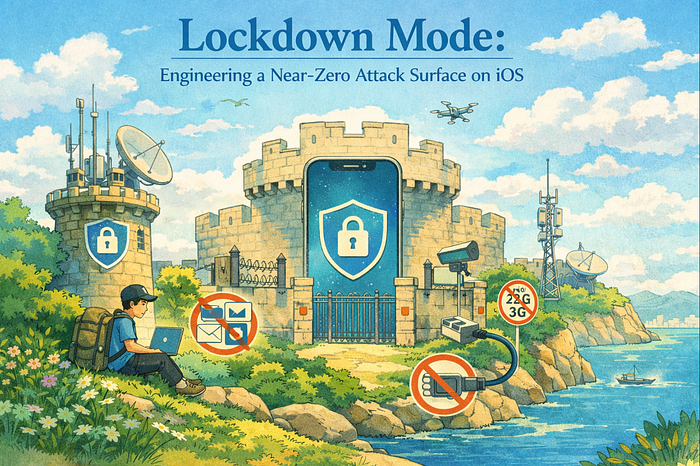
The Threat Model: From Opportunistic Malware to Mercenary Spyware
Traditional mobile security models were designed around:
- Opportunistic malware
- Phishing-based compromise
- User-driven execution
However, the emergence of mercenary spyware — such as Pegasus — introduced a new class of threats:
- Zero-click exploits (no user interaction)
- Multi-stage exploit chains
- Kernel-level persistence
- Targeted delivery against high-value individuals
These attacks exploit complexity, not carelessness.
Modern smartphones are built for performance and convenience:
- Rich media parsing
- High-performance JavaScript engines
- Seamless connectivity
- Automatic background processing
Each of these introduces attack surface.
Lockdown Mode is Apple's answer to this reality.
Lockdown Mode: A Philosophy, Not a Feature
Lockdown Mode is often misunderstood as a "security setting." In reality, it represents a philosophical shift:
From detecting malicious behavior → to eliminating exploitable behavior
Instead of trying to identify threats, Lockdown Mode:
- Disables high-risk functionality
- Reduces system complexity
- Enforces strict trust boundaries
This is a transition from:
- Blacklist-based security → blocking known bad to
- Whitelist-based security → allowing only known safe
Architectural Overview: Multi-Layered Defense
Lockdown Mode is effective because it operates across multiple layers of the system:
1. Physical Layer Hardening
Physical access remains one of the most powerful attack vectors.
Standard protections (like USB Restricted Mode) introduce time-based controls. Lockdown Mode significantly tightens these constraints:
- Rapid transition to charge-only mode
- Elimination of persistent accessory trust
- Prevention of forensic tool interaction
This disrupts tools that rely on USB-based communication to:
- Initiate brute-force attempts
- Exploit protocol-level vulnerabilities
- Interface with secure components like the Secure Enclave
2. Baseband and Network-Level Restrictions
Legacy cellular protocols (2G/3G) lack modern authentication guarantees and are vulnerable to:
- IMSI catchers
- Downgrade attacks
- Traffic interception
Lockdown Mode enforces:
- Complete exclusion of insecure radio protocols
This ensures:
- Only authenticated, encrypted communication channels are used
- No forced downgrade scenarios
3. Logical Control Plane Protection
One of the most underestimated attack vectors in enterprise environments is configuration abuse.
Malicious configuration profiles can:
- Install rogue root certificates
- Enable man-in-the-middle interception
- Enroll devices into attacker-controlled MDM systems
Lockdown Mode:
- Blocks installation of new configuration profiles
- Prevents MDM enrollment entirely
This effectively removes an entire class of post-exploitation persistence mechanisms.
4. Kernel-Level Enforcement
With evolution across iOS versions, Lockdown Mode enforcement has moved closer to the kernel.
This introduces:
- Mandatory Access Control (MAC) policies
- System call filtering
- Strict code-signing validation
Key mechanisms include:
- Pointer Authentication Codes (PAC)
- Page Protection Layer (PPL)
- Memory tagging
The result is a system where:
- Memory corruption is harder to exploit
- Privilege escalation paths are constrained
- Unauthorized execution is immediately terminated
5. Browser Engine Hardening
The browser is the largest remote attack surface on any device.
Modern browsers rely on:
- Just-In-Time (JIT) compilation
- WebAssembly
- GPU acceleration (WebGL)
These introduce:
- Writable + executable memory regions
- Complex parsing logic
- Large attack surfaces
Lockdown Mode:
- Disables JIT compilation entirely
- Restricts or removes high-risk APIs
- Reduces the browser to a minimal execution environment
The trade-off is significant performance degradation — but with a corresponding reduction in exploitability.
6. Messaging and Communication Restrictions
Zero-click exploits frequently target messaging systems due to:
- Automatic parsing of untrusted content
- Background processing of media and metadata
Lockdown Mode enforces:
- Blocking of most attachment types
- Disabling link previews
- Restricting communication from unknown sources
This eliminates:
- Passive attack vectors
- Automatic execution pathways
Empirical Evidence: Why the Claim Holds
Apple's claim is supported by:
- Internal telemetry
- Independent research organizations
- Observed attacker behavior
Notably:
- No documented successful compromise of a device with Lockdown Mode enabled
- Known exploit chains being blocked due to feature restrictions
- Spyware frameworks detecting Lockdown Mode and aborting execution
This last point is particularly important.
Attackers themselves treat Lockdown Mode as:
- A high-risk environment
- A potential exposure vector for their exploits
Security Trade-offs: Functionality vs Assurance
Lockdown Mode is intentionally restrictive.
Users will experience:
- Broken websites
- Slower browsing performance
- Limited communication features
- Reduced app compatibility
This is by design.
Lockdown Mode prioritizes:
- Security over usability
- Assurance over convenience
It is not meant for the general population.
Limitations and Considerations
Despite its strength, Lockdown Mode is not a silver bullet.
1. Pre-compromise Limitation
Lockdown Mode is most effective when enabled before exposure.
If a device is already compromised:
- It does not guarantee remediation
2. Potential for UI Spoofing
Advanced malware could theoretically:
- Simulate Lockdown Mode indicators
- Bypass enforcement while presenting a secure state
3. Unknown Future Exploits
The absence of known attacks does not imply:
- Absolute immunity
Security remains an evolving field.
Broader Implications for Security Engineering
Lockdown Mode introduces a critical idea:
Security at scale may require optional degradation of functionality
This has implications beyond mobile devices:
- Browsers
- Operating systems
- Cloud workloads
Future systems may adopt:
- Tiered security modes
- Context-aware hardening
- User-selectable risk profiles
Conclusion
Lockdown Mode represents one of the most aggressive implementations of attack surface reduction in consumer technology.
By systematically:
- Removing complex features
- Enforcing strict execution policies
- Eliminating passive attack vectors
Apple has created a mode where:
- Exploitation becomes significantly more expensive
- Detection becomes less necessary
- Prevention becomes the primary defense
The claim that no Lockdown Mode-enabled device has been successfully compromised is less surprising when viewed through this lens.
Lockdown Mode does not make exploitation impossible.
It makes it economically and technically impractical.
And in modern cybersecurity, that is often the strongest defense available.
Reference Primary source: Apple Says No iPhone in Lockdown Mode Has Ever Been Hacked
About the Author
Samyak Goel is a Security Engineer based in Mumbai, specializing in blue team operations, detection engineering, and enterprise incident response within large-scale financial environments. His work focuses on how modern threats operate in real-world systems, beyond theoretical security models.
He is particularly interested in advanced attack techniques, endpoint security, and the evolving landscape of adversary tradecraft, including nation-state and mercenary spyware operations. His approach combines technical depth with a practical understanding of how security controls behave under pressure.
Through his writing, Samyak aims to break down complex cybersecurity concepts into clear, structured insights that are easy to understand, retain, and apply in real-world scenarios.