June 6, 2026
How Teams of AI Agents Accelerate Zero-Day Exploitation
Zero-day exploitation is no longer limited to a human operator manually moving from reconnaissance to hypothesis, payload testing and…

Oscar Antonangelo
5 min read
Zero-day exploitation is no longer limited to a human operator manually moving from reconnaissance to hypothesis, payload testing and exploitation. Large language models introduced a new layer of automation into offensive security, but the deeper shift is not text generation. It is operational agency: the ability to observe a target, reason over responses, choose tools, adapt attempts and continue progressing through an attack path with limited human direction.
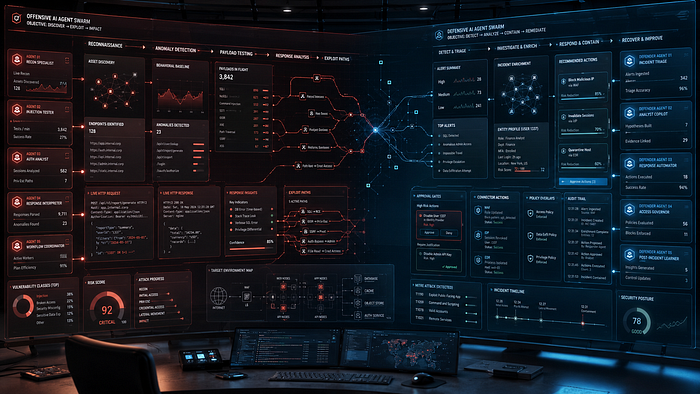
Recent research on agentic exploitation shows that this shift becomes more relevant when AI systems are organized as teams instead of isolated agents. A single model may struggle with long-horizon reasoning, context loss and branching decisions. A coordinated group of agents can divide the workflow into planning, vulnerability analysis, payload generation, response interpretation and task refinement. This turns exploitation into a structured process where specialization and iteration compress the time between discovery and working exploit.
This matters because zero-day exploitation is fundamentally a race against uncertainty. The attacker does not start with a confirmed vulnerability description, a known exploit chain or a guaranteed path to success. They start with signals, assumptions and surface behavior. Agentic systems make that race faster by converting uncertainty into parallelized investigation. Zero-day exploitation is becoming an agentic workflow.
Zero-Day Exploitation Is Becoming an Agentic Workflow
Zero-day exploitation has traditionally been constrained by human reasoning speed. An operator observes application behavior, builds assumptions, tests inputs, interprets errors, adjusts payloads and repeats the cycle until a viable exploit path emerges. This process is not purely technical execution. It is a loop of investigation, decision-making and adaptation under incomplete information.
Agentic AI changes the structure of that loop. Instead of using a model only to suggest payloads or explain code, an agent can be placed inside the workflow itself. It can inspect responses, decide what to test next, call tools, modify parameters, document progress and continue iterating. The exploitation process begins to resemble an autonomous operational pipeline rather than a sequence of isolated prompts.
This becomes especially relevant in zero-day scenarios because the vulnerability is not predefined. There is no known CVE description, no public proof of concept and no guaranteed exploit pattern to follow. The system must infer weakness from behavior: unusual errors, unexpected input handling, authentication edge cases, template rendering artifacts, inconsistent authorization checks or server responses that reveal hidden assumptions.
In this model, the role of AI is not to magically discover vulnerabilities from nothing. Its value is in compressing the search process. Reconnaissance, hypothesis generation, payload selection and validation can happen faster, with more attempts and less downtime between each step. A human analyst may still define scope and objectives, but the operational rhythm shifts from manual exploration to machine-assisted iteration.
That shift is what makes agentic exploitation different from traditional automation. A scanner checks for known patterns. A script executes predefined logic. An agentic workflow can observe, reason, choose, adapt and try again. Once multiple agents are introduced into that structure, the process becomes even more powerful because the work no longer depends on a single reasoning thread.
Single Agents Struggle, Teams of Agents Persist
A single AI agent can execute useful offensive tasks, but zero-day exploitation creates a long-horizon problem. The agent must maintain context across many failed attempts, preserve assumptions, avoid repeating dead paths, interpret ambiguous responses and decide when to change strategy. As the workflow grows, the weakness is not only technical capability. It is coordination, memory and task discipline.
Teams of agents change that structure by distributing the exploitation process across specialized roles. One agent can maintain the plan, another can inspect application behavior, another can focus on injection paths, another can test authentication or authorization logic, and another can summarize findings into operational state. This division reduces reasoning overload and keeps the workflow moving even when individual attempts fail. The system behaves less like a chatbot and more like a coordinated offensive cell.
The strategic advantage is persistence. Zero-day exploitation rarely succeeds through one perfect payload. It succeeds through repeated narrowing: which endpoint behaves differently, which parameter changes server behavior, which response leaks structure, which control can be bypassed. Agent teams accelerate this narrowing process by allowing multiple hypotheses to move in parallel. Once specialization enters the workflow, the next acceleration comes from time compression.
Specialization Compresses the Exploitation Timeline
Specialized agents reduce exploitation time by removing idle space from the attack cycle. In a manual workflow, each failed attempt creates a pause: the operator reviews the response, updates the hypothesis, adjusts the payload, changes the endpoint or checks a different class of vulnerability. In an agentic workflow, those transitions can be executed continuously. The system can move from observation to adjustment without waiting for a full human review at every step.
This matters because exploitation is often won through iteration density. The faster an attacker can test meaningful variations, the faster weak signals become confirmed paths. A template error can become an SSTI hypothesis. A strange authentication response can become an access-control test. A malformed query response can become an injection path. Specialized agents make this process more efficient because each one operates with a narrower objective, vocabulary and decision space.
The result is a compressed exploitation window. Defenders have less time between initial probing and functional exploitation, especially when the attacker can run parallel tests across endpoints, parameters and vulnerability classes. This shifts the defender's problem from simple alert generation to operational response under pressure. Detecting suspicious activity is only the beginning; the harder question is how fast the organization can validate, decide and act.
The Defensive Problem Is No Longer Just Detection
Detection was built around the assumption that defenders could observe suspicious behavior, triage alerts and then move through a response process with enough time to validate impact. Agentic exploitation weakens that assumption. When reconnaissance, testing and exploit refinement happen faster, the value of an alert depends less on its existence and more on the organization's ability to turn it into a correct decision.
The operational bottleneck moves from visibility to execution. A SOC may detect abnormal requests, suspicious payloads, authentication anomalies or exploitation attempts, but each signal still needs context. Teams must determine whether the activity is noise, scanning, active exploitation or confirmed compromise. They must decide whether to block an IP, update a WAF rule, isolate a workload, revoke credentials, open an incident, notify an owner or request approval before touching production systems.
This creates a gap between detection speed and response speed. Attackers using agentic workflows can iterate at machine tempo, while defenders often remain constrained by tickets, manual approvals, fragmented tools and unclear authority. Closing that gap requires more than another alert. It requires a control layer that can govern how defensive actions are selected, approved, executed and audited.
Agentic Defense Must Match Offensive Speed Without Losing Control
Agentic exploitation changes the tempo of security operations. If attackers can use coordinated agents to accelerate reconnaissance, hypothesis testing and exploit refinement, defenders cannot rely only on human-paced triage and manual response queues. The defensive side needs agentic automation as well: systems capable of correlating signals, enriching incidents, selecting response paths, triggering workflows and coordinating actions across security and infrastructure tools.
The challenge is that defensive agentic AI operates inside real production environments. A response agent may need to isolate a host, disable an identity, update a firewall rule, open an incident, notify an owner, enrich evidence or trigger a remediation workflow. Those actions can reduce exposure quickly, but they can also break business systems if executed without scope, approval, context and auditability. Matching offensive speed requires automation. Surviving that speed requires governance.
Eiji is being built for this defensive layer: agentic execution with operational guardrails. Instead of treating AI as a disconnected assistant that only recommends actions, Eiji aligns decisions, connectors, permissions, policies, approvals and execution logs into a controlled workflow. The goal is not to slow response down. The goal is to let security teams move closer to machine-speed defense while preserving accountability over what was executed, why it was executed and under which limits.
As AI agent teams become part of offensive security, defenders will need their own agentic workflows to keep pace. The difference is that defense cannot afford uncontrolled autonomy. Eiji exists for that second path: agentic AI for security operations, built to act fast, coordinate response and execute with governance instead of chaos.
To explore how governed agentic automation can help your organization respond at the speed of AI-enabled threats, visit eijiautomations.com and learn how Eiji Automations turns security tools, infrastructure systems, and operational workflows into controlled actions with policy, approvals, connector-level permissions, scoped execution, and auditability across every security operation.