

For decades, the incident response playbook was the backbone of the Security Operations Centre. A structured, documented set of steps — detection, containment, eradication, recovery — that guided analysts through security incidents with consistency and accountability. The problem in 2026 is that those playbooks were built for a world where attackers moved slowly enough for humans to keep up.
That world no longer exists. According to Unit 42's 2026 Global Incident Response Report — which analysed over 750 major cyber incidents across 50 countries — AI has cut attack times to 72 minutes from initial access to significant impact. Real-world intrusions now reach exfiltration in 1.2 hours for the fastest quartile, down from 4.8 hours the year prior. The static playbook, manually updated and rigidly structured, cannot operate at that speed.
Here is how AI is fundamentally changing incident response playbooks in 2026 — and what every SOC analyst needs to understand.
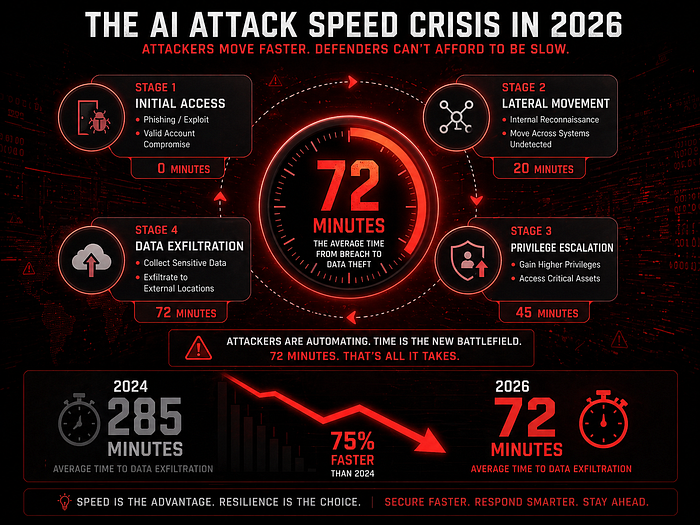
Key Stats: - 72 minutes — AI-driven attack time from access to impact (Unit 42 2026) - 85% of playbooks will be AI-generated dynamically by H1 2027 (IDC) - 48% of incidents included browser-based activity in 2026
1. The Death of the Static Playbook
Traditional incident response playbooks were built as static documents — predefined decision trees that mapped specific threat scenarios to specific response steps. A phishing playbook. A ransomware playbook. A data breach playbook. Each manually written, manually updated, and manually executed.
The problem is structural. Static playbooks represent a moment-in-time understanding of threats. Every time an attacker evolves their technique, the playbook becomes partially obsolete. Maintaining them requires constant effort from already stretched security teams — and in practice, most organisations run playbooks that are months or years out of date. According to IDC's FutureScape 2026 Predictions report, by the first half of 2027, 85% of detection and response playbooks will be generated dynamically at the time a SOC alert is triggered — not pulled from a static document library.
Static playbooks can no longer keep pace with the speed and sophistication of modern attacks. The move to dynamic, AI-generated playbooks is not optional — it is the defining shift in SOC operations for 2026 and beyond. — IDC FutureScape 2026
2. Dynamic AI-Generated Playbooks — How They Work

AI-driven playbook generation works fundamentally differently from the static model. Instead of pulling a pre-written document, the system analyses the specific alert in real time — its indicators, context, affected assets, threat intelligence correlation, and the organisation's existing tool stack — and generates a tailored response workflow on the fly.
According to IDC research, dynamic playbooks pull data from across the IT ecosystem — threat intelligence feeds, asset inventories, business process maps, and previous incident data — to ensure every response is both comprehensive and relevant to the specific incident. Machine learning models then refine the playbook logic over time, learning from past incidents to improve future responses. The result is a playbook that is always current, always contextual, and never static.
Platforms like D3 Security's Morpheus AI and Radiant Security are already delivering this capability — generating response workflows at runtime based on the specific incident, the customer's tool stack, and organisational policies. No authoring. No versioning. No maintenance burden.
3. AI Changes Every Phase of the IR Lifecycle
The NIST SP 800–61r3 framework — released April 2025 and now the foundational standard for incident response — covers four phases: Preparation, Detection and Analysis, Containment and Eradication, and Post-Incident Activity. AI is reshaping every one of them.
In the Detection and Analysis phase, AI correlates signals across endpoint, identity, email, cloud, and network telemetry simultaneously — compressing what once took hours of manual investigation into minutes. In Containment, AI-powered SOAR platforms execute response actions autonomously — isolating endpoints, revoking credentials, blocking IPs — before lateral movement begins. In Post-Incident Activity, AI generates incident timelines, root cause analyses, and updated threat intelligence automatically, feeding back into the playbook generation system for the next event.
Microsoft's Security Blog published in April 2026 frames this clearly: good IR processes limit damage, but great ones make the organisation stronger for the next incident. AI-powered IR is the mechanism that makes that continuous improvement systematic rather than aspirational.
4. The New Threat — Responding to AI Incidents Themselves

In 2026, incident response has a second meaning that most playbooks have not yet addressed. As organisations deploy AI systems — agents, copilots, automated workflows — those AI systems become targets themselves. Prompt injection attacks, model poisoning, adversarial manipulation of ML pipelines, and training data exfiltration are now active threat vectors that traditional playbooks were never designed to handle.
Microsoft's April 2026 Security Blog on AI incident response identifies the core challenge: observability. Traditional security telemetry monitors network traffic, authentication events, and process execution. AI incidents generate different signals — anomalous output patterns, spikes in user reports, shifts in content classifier confidence scores, unexpected model behaviour after an update. Most organisations have not yet instrumented their AI systems for these signals. Without them, defenders may first learn about AI incidents from social media or customer complaints — not from their own detection stack.
Extend your playbooks. Instrument AI systems for the right signals. Rehearse novel scenarios. Invest in the people who will be on the front line when something breaks. — Microsoft Security Blog, April 2026
5. What SOC Analysts Must Do Differently in 2026
The shift to AI-driven incident response does not remove the analyst from the equation — it changes what the analyst is responsible for. According to Unit 42's 2026 IR Report, most breaches still succeed due to preventable gaps in visibility and security controls, not failures of AI systems. The human layer remains critical — but its focus has shifted.
Analysts in 2026 must be able to validate AI-generated playbooks before execution — understanding what the system decided and why, and identifying when the AI reasoning is incorrect or incomplete. They must be able to govern AI containment actions — knowing when to allow autonomous response and when to intervene. And they must be able to extend playbooks to cover AI-specific threat vectors that no vendor has fully solved yet.
The SOC analyst of 2026 is not a playbook executor. They are a playbook governor — responsible for the quality of AI decisions, the accuracy of automated responses, and the continuous improvement of a system that learns from every incident they oversee.
The game has changed. The analysts who understand the new rules will define what incident response looks like for the next decade.