
Why even the most resilient hearts need a safe place to rest
Even the strongest hearts grow tired.
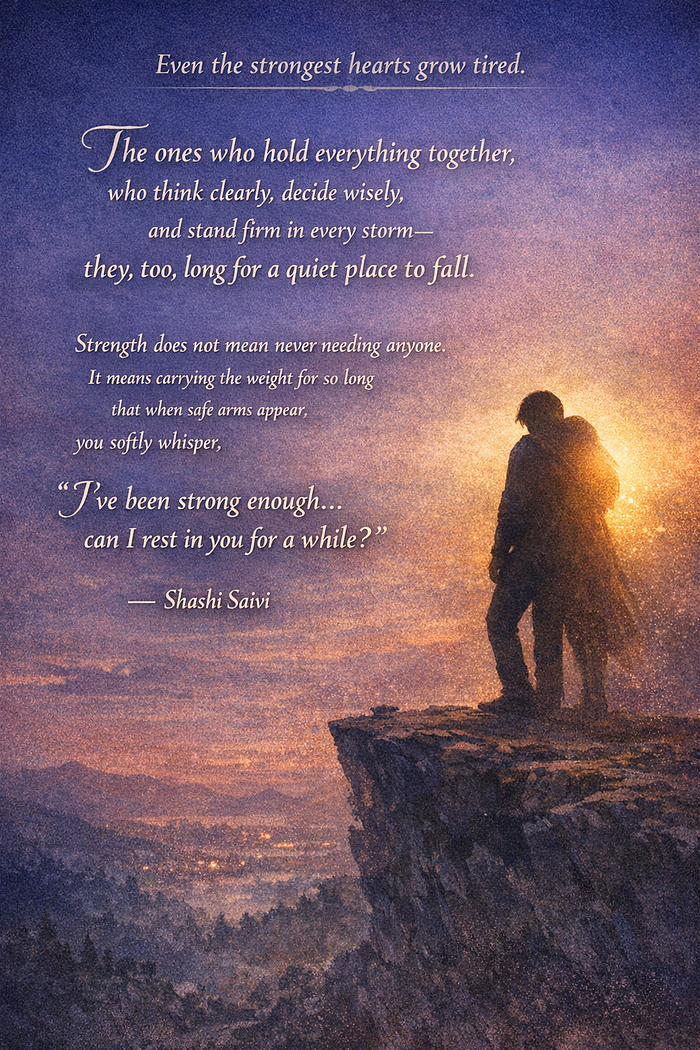
The ones who hold everything together, who think clearly, decide wisely, and stand firm in every storm — they, too, long for a quiet place to fall.
Strength does not mean never needing anyone. It means carrying the weight for so long that when safe arms appear, you softly whisper, "I've been strong enough… can I rest in you for a while?
We all know that person.
The calm one. The fixer. The decision maker. The one who doesn't panic when things go wrong. The one everyone calls first.
Maybe that person is you.
From the outside, strong people look unshakeable. They handle pressure. They think clearly. They show up. Again and again. But here's the part we rarely talk about: strength is often a role, not a personality.
And roles can be exhausting.
The Psychology of Being "The Strong One"
Psychologists talk about something called emotional labor. It's the invisible work of managing your own emotions while also carrying the emotional weight of others. Leaders do it. Parents do it. Partners do it. High achievers do it.
When you are the strong one, you are constantly regulating yourself. You swallow your fear so others feel safe. You hide your doubt so others feel confident. You push through your exhaustion so things don't fall apart.
Over time, this creates something known as emotional suppression. You get so used to holding it together that you forget how to let go.
And here's the catch. Suppressed emotions don't disappear. They sit quietly in the background. They show up as irritability, mental fatigue, trouble sleeping, or that heavy feeling you cannot explain.
Not weakness. Just overload.
Why Strong People Struggle to Ask for Support
There is also a psychological pattern called the "competence trap." When people see you as capable, they stop checking if you are okay. The more reliable you are, the less likely others are to assume you need help.
And slowly, you start believing it too.
You tell yourself: "I can handle this." "It's not that bad." "Others have it worse."
So you keep going.
But humans are wired for connection. Neuroscience shows that feeling emotionally safe with someone lowers stress hormones like cortisol and increases oxytocin, the bonding hormone. In simple words, being able to lean on someone is not dramatic. It is biological.
We are not designed to carry everything alone.
Strength and Softness Can Coexist
Somewhere along the way, we confused strength with emotional independence.
But real strength is not about isolation. It is about stability. And stability does not mean you never need support. It means you choose wisely where to rest.
Think about it this way. Even the strongest muscle needs recovery time. Without rest, it tears.
The heart is no different.
The strongest people are often not looking for someone to fix them. They are not looking to be saved. They simply want a space where they do not have to be "on." A place where they can say, without explaining themselves:
"I've been holding a lot."
And instead of being admired for their resilience, they are simply understood.
The Power of Safe Arms
Psychology calls it secure attachment. When you feel safe with someone, your nervous system relaxes. Your guard drops. You breathe differently. You speak differently.
That quiet moment when a strong person says, "Can I rest for a while?" is not weakness.
It is trust.
It is the strongest person in the room, finally allowing themselves to be human.
And maybe that is the real definition of strength. Not standing alone in every storm. But knowing when you have carried enough and allowing yourself to lean when the right arms appear.
If you are the strong one, hear this clearly:
You do not lose your strength when you rest. You renew it.
And sometimes, the bravest sentence you will ever say is this:
"I've been strong enough. Can I rest in you for a while?"
— Shashi Saivi