
Organizations around the world have invested heavily in cybersecurity over the last decade. They adopted recognized standards, implemented governance structures, acquired advanced security tools, and expanded compliance programs. Yet despite these investments, many organizations continue to experience the same recurring problems: delayed detection, slow remediation, fragmented operations, unclear risk visibility, and difficulty translating technical findings into executive decisions.
The issue is often not the absence of controls. It is the operating model behind them.
Many cybersecurity programs still function through periodic cycles: quarterly reviews, annual assessments, scheduled audits, delayed remediation plans, and static reporting models. Meanwhile, threat actors operate continuously. Vulnerabilities emerge daily. Attack surfaces shift constantly. Business environments change faster than traditional governance mechanisms can respond.
This creates a structural mismatch between how organizations defend themselves and how threats actually evolve.
The Gap Between Governance and Execution
Traditional frameworks remain valuable. Standards from National Institute of Standards and Technology, International Organization for Standardization, and other institutions provide critical guidance for control design, risk management, and governance maturity.
However, many enterprises discover that having a framework does not automatically create continuous security performance.
It is common to see organizations with mature documentation but weak execution discipline. Controls may exist on paper while operational effectiveness remains uncertain. Dashboards may report activity, yet fail to answer the most important question: Is risk actually decreasing over time?
That challenge inspired the development of the S4T Framework.
What Is the S4T Framework?
S4T was designed as a Continuous Cybersecurity Execution Model focused on helping organizations transition from static security management to adaptive, measurable operations.
Its core premise is simple:
Cybersecurity should not be managed as a periodic administrative function. It should operate as a continuous performance system.
Instead of treating security as a sequence of isolated assessments, S4T emphasizes constant monitoring, rapid learning cycles, measurable control performance, and operational feedback loops.
A Continuous Model for a Continuous Threat Environment
At the center of the framework is the recognition that cyber risk is dynamic. It changes according to multiple variables, including control effectiveness, vulnerability exposure, operational readiness, and threat activity.
Because risk is dynamic, the management model must also be dynamic.
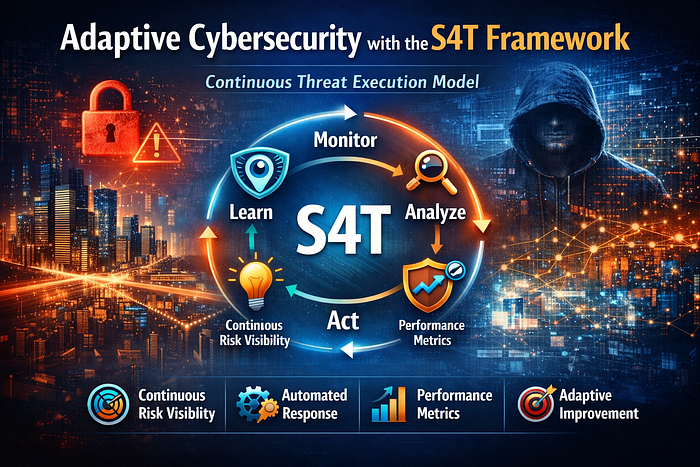
S4T therefore prioritizes a closed-loop operating cycle:
Monitor → Analyze → Act → Learn
This cycle helps organizations move beyond passive visibility and into active improvement. Monitoring alone does not reduce risk. Action does.
Likewise, action without learning often creates recurring inefficiencies. Mature cybersecurity programs require both execution and adaptation.
Measuring What Actually Matters
One of the recurring weaknesses in enterprise security programs is overreliance on compliance metrics. Passing an audit or completing a checklist may be necessary, but these indicators do not always reflect resilience.
S4T encourages organizations to evaluate security through operational performance indicators such as:
- response speed to critical events
- remediation consistency
- reduction of exploitable exposure
- validation of control effectiveness
- resilience trends over time
These measures provide leadership teams with clearer visibility into whether cybersecurity investments are generating real defensive outcomes.
Why This Matters to Executives and Boards
Boards and executives increasingly ask sophisticated questions about cybersecurity. They want to understand not only whether controls exist, but whether the organization can respond effectively under pressure.
A static maturity model may answer whether policies were documented last quarter. A continuous execution model is better suited to answer whether defenses are improving this week.
That distinction is becoming increasingly important in regulated industries, high-growth environments, distributed enterprises, and organizations facing persistent threat activity.
Practical Benefits of Continuous Security Execution
Organizations adopting continuous operating principles can improve several dimensions simultaneously. Detection cycles may shorten. Remediation workflows may become more predictable. Operational teams may gain clearer prioritization. Leadership may obtain stronger decision-grade visibility into residual risk.
Most importantly, cybersecurity becomes integrated into business tempo rather than operating as a disconnected control function.
Final Perspective
Traditional frameworks still play an essential role. They provide structure, common language, and governance discipline. But in a threat environment defined by constant change, static models alone are no longer sufficient.
Modern resilience requires execution systems capable of adapting continuously.
That is the purpose of the S4T Framework.
Full Research Publication
Read the full research paper on ResearchGate: https://www.researchgate.net/publication/403771363_S4T_Framework_A_Continuous_Cybersecurity_Execution_Model
#Cybersecurity #CISO #RiskManagement #SecurityOperations #InformationSecurity #Governance #DigitalTransformation #ZeroTrust