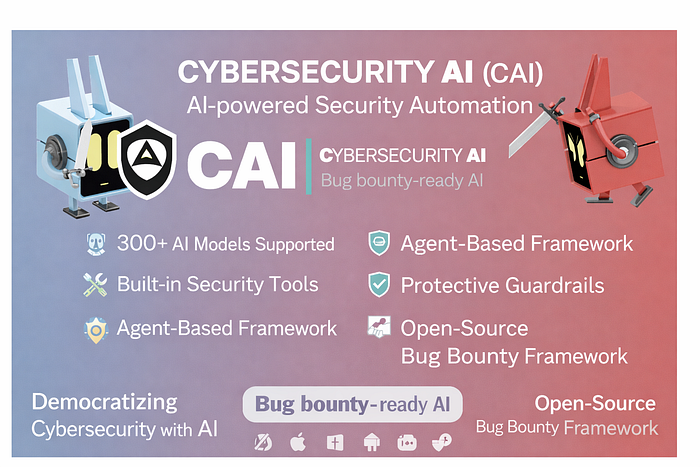

Cybersecurity is evolving faster than ever. Traditional security tools — static scanners, rule-based systems, and manual pentesting — are struggling to keep up with modern attack complexity.
Enter Cybersecurity AI (CAI) — an open-source framework designed to bring AI agents into real-world offensive and defensive security operations.
CAI is not just another tool. It represents a shift from:
- Manual security → Autonomous & AI-assisted security
- Static tools → Dynamic, agent-based systems
- Reactive defense → Proactive vulnerability discovery
Built by Alias Robotics, CAI is already used by:
- Security researchers
- Ethical hackers
- Bug bounty hunters
- Enterprises
What is CAI?
Cybersecurity AI (CAI) is a lightweight, open-source framework that enables users to build AI-powered security agents.
These agents can:
- Discover vulnerabilities
- Perform reconnaissance
- Execute exploitation workflows
- Assist in defensive security
Think of CAI as:
"An operating system for AI-driven cybersecurity agents."
Why CAI Matters
The cybersecurity landscape is changing rapidly:
- AI-powered attacks are increasing
- Security complexity is exploding
- Skilled pentesters are limited
CAI addresses this by:
- Democratizing advanced security tools
- Enabling automation at scale
- Enhancing human capabilities (not replacing them)
Research shows:
- Up to 3600× faster performance vs human pentesters (CTF benchmarks)
- Real vulnerabilities discovered in production systems
Core Architecture of CAI
CAI is built on a modular, agent-based architecture with 8 key pillars:
1. Agents
AI entities that:
- Observe systems
- Reason about tasks
- Execute actions
2. Tools
Built-in capabilities like:
- Linux command execution
- Web search (OSINT)
- Code execution
- SSH tunneling
3. Handoffs
Agents can delegate tasks to other specialized agents.
4. Patterns
Defines how agents collaborate:
- Swarm (decentralized)
- Hierarchical
- Sequential (Chain-of-Thought)
- Recursive
5. Turns & Interactions
Execution cycles between agents and tools.
6. Tracing
Full observability using OpenTelemetry + Phoenix.
7. Guardrails
Protection against:
- Prompt injection
- Dangerous commands
- Malicious payloads
8. Human-in-the-Loop (HITL)
Humans remain in control for:
- Oversight
- Decision-making
- Critical actions
Key Features
300+ AI Models Support
- OpenAI (GPT-4o, O1, etc.)
- Anthropic (Claude)
- DeepSeek
- Ollama (local models)
Built-in Security Tools
Ready-to-use modules for:
- Reconnaissance
- Exploitation
- Privilege escalation
Agent-Based Design
Create custom agents for:
- Bug bounty
- Red teaming
- Blue team defense
Guardrails Protection
Multi-layered safety system:
- Input validation
- Output validation
- Encoded payload detection
Research-Driven Framework
Backed by multiple academic papers and benchmarks.
Real-World Use Cases
1. Bug Bounty Automation
- Automated vulnerability discovery
- Faster report validation
- Deduplication (used in HackerOne workflows)
2. Web Application Security
- API vulnerability scanning
- Race condition exploitation
- Data exposure detection
3. Robotics Security
- Identified vulnerabilities in humanoid robots
- Exposed telemetry leaks and weak encryption
4. OT (Operational Technology) Security
- Found vulnerabilities in MQTT brokers
- Discovered critical flaws in industrial systems
5. CTF Competitions
- Top-10 ranking in Dragos OT CTF
- Outperformed human teams in certain phases
6. Enterprise Security Testing
- Continuous automated assessments
- AI-assisted red teaming
Ethical Principles
CAI is built on two strong ethical foundations:
1. Democratization
Make advanced cybersecurity AI accessible to everyone.
2. Transparency
Expose real capabilities of AI in security (vs vendor hype).
Important:
- Not meant for illegal hacking
- Designed for ethical security testing only
Installation Guide (Step-by-Step)
Prerequisites
- Python 3.12
- Git
- Virtual environment
Installation (Linux / Ubuntu)
sudo apt-get update
sudo apt-get install -y git python3-pip python3.12-venv

# Create virtual environment
python3.12 -m venv cai_env

# Activate environment
source cai_env/bin/activate

# Install CAI
pip install cai-framework
Setup .env File
echo -e 'OPENAI_API_KEY="sk-1234"
ANTHROPIC_API_KEY=""
OLLAMA=""
PROMPT_TOOLKIT_NO_CPR=1
CAI_STREAM=false' > .env
Run CAI
caiYou'll see the CAI CLI interface.
Alternative: Docker Setup
docker compose build
docker compose up -d
docker compose exec cai cai
Example: Creating a Simple Agent
from cai.sdk.agents import Agent, Runner, OpenAIChatCompletionsModel
from openai import AsyncOpenAI
import os

agent = Agent(
    name="Cyber Agent",
    instructions="You are a cybersecurity expert",
    model=OpenAIChatCompletionsModel(
        model="openai/gpt-4o",
        openai_client=AsyncOpenAI(),
    )
)

result = await Runner.run(agent, "Scan for vulnerabilities")
Advanced Integrations
OpenRouter
Use multiple LLMs via one API.
Azure OpenAI
Enterprise-grade deployments.
MCP (Model Context Protocol)
Integrate external tools like:
- Burp Suite
- Custom APIs
Research Impact
CAI has contributed significantly to the field:
- Introduced PentestGPT lineage
- Built CAIBench for evaluation
- Identified gaps in LLM security claims
- Developed prompt injection defenses
Limitations
CAI is still evolving:
- Not fully autonomous yet
- Requires human supervision
- Setup can be complex
- Depends on external models
Future of Cybersecurity AI
By 2028:
- AI pentesters may outnumber humans
- Security workflows will be agent-driven
- Autonomous defense systems will emerge
CAI is laying the foundation for this future.
Conclusion
Cybersecurity AI (CAI) is more than a framework — it's a paradigm shift.
It enables:
- Faster security testing
- Scalable automation
- Smarter vulnerability discovery
But most importantly:
It augments human intelligence, not replaces it.
TL;DR
- CAI = Open-source AI framework for cybersecurity
- Uses agent-based architecture
- Supports 300+ AI models
- Automates pentesting & security workflows
- Used in real-world bug bounty + CTFs
- Still evolving but highly powerful
Thank you so much for reading
Like | Follow | Subscribe to the newsletter.
Catch us on
Website: https://www.techlatest.net/
Newsletter: https://substack.com/@techlatest
Twitter: https://twitter.com/TechlatestNet
LinkedIn: https://www.linkedin.com/in/techlatest-net/
YouTube:https://www.youtube.com/@techlatest_net/
Blogs: https://medium.com/@techlatest.net
Reddit Community: https://www.reddit.com/user/techlatest_net/