
"App works on my phone, but on customer's phone login fails randomly."
So you do the usual dance: check networking, certificates, backend logs, device model quirks. Nothing. Then you notice something odd: the failure happens only for high-value actions — login, OTP verify, add beneficiary, transfer.
A week later you reproduce it on a test device that's "not rooted" (according to every root-check library you've ever used). No su binary. No test-keys. No suspicious packages.
And yet…
Frida hooks your functions. Magisk hides itself. Zygisk injects into your process. The attacker proxies your API calls using a clean integrity verdict harvested elsewhere.
That's the moment most teams realize:
Root detection didn't die because rooting vanished. It died because the attacker doesn't need to look rooted.
In 2026 the real question is not:
"Is this device rooted?"
It's:
"Can I trust this app + this install + this runtime + this request enough to allow this action?"
Let's talk about what actually works.
Why classic root detection fails now
Traditional root checks were built for a different era:
- Look for
su, BusyBox, Magisk folders - Read system properties (
ro.debuggable,ro.secure,test-keys) - Scan installed packages
- Check mount points and writable system partitions
- Detect debugger/emulator strings
These are still useful… as noise, not truth.
Modern modification stacks are built specifically to defeat these checks:
- Systemless root avoids classic filesystem footprints
- Magisk DenyList / hiding removes obvious package and process indicators
- Zygisk-based injection blends into normal app runtime
- Hooking frameworks can patch your detection code after it runs
- Proxy setups replay "good" signals from a clean device into a modified environment
So if your decision logic is:
"If root detected → block"
…then the attacker's job is simply:
"Never look rooted."
And they often succeed.
The mindset shift: from "detect root" to "defend actions"
Modern Android security is about protecting sensitive actions, not labeling devices as "good" or "bad".
✅ Protect actions, not devices
Identify high-risk actions and apply stronger proof to them:
- Login & session creation
- OTP verification
- Add bank account / beneficiary
- Change password / add device
- High-value payments / payouts
- Viewing sensitive PII
✅ Move trust decisions to the server
Client-side checks are tamperable. Enforcement belongs on the backend, based on server-verified signals.
✅ Make it expensive to cheat
You won't achieve perfect detection. Your goal is repeatable friction that raises attacker cost.
What actually works in 2026
1) Play Integrity API (server-verified) as your primary gate
If your app still relies only on local root detection, you're effectively blind.
Play Integrity provides Google Play–backed signals about:
- App integrity — Are you talking to an unmodified app recognized by Play?
- Device integrity — Does the device meet integrity requirements?
- License / account signals — Is the install coming from a legitimate Play context?
- Optional risk signals (opt-in) — App access risk, Play Protect status, unusual device activity, device recall bits, etc.
This is not just "an Android check." It's a server-verifiable statement about the app + device + request.
Don't trust the phone. Trust a server-validated verdict.
2) Content binding with requestHash (anti-replay)
Attackers love replay and proxy attacks. Your integrity token must be bound to the action you're protecting.
Modern flow:
- Build a canonical representation of the request context
- Hash it →
requestHash - Request an integrity token including that hash
- On backend, recompute the hash and ensure it matches the verdict
This prevents attackers from:
- Generating a verdict on a clean device and reusing it elsewhere
- Replaying a token for a different user or action
3) Tiered enforcement (don't "block everyone")
Big mistake teams make:
"Integrity fails → block entire app"
That leads to:
- False positives
- Support nightmares
- Lost users
Instead, use tiered enforcement:
🟢 Green -> Full access
🟡 Yellow -> Allow but step-up (extra OTP, cooldowns, limits)
🔴 Red -> Block only the sensitive action
Example in fintech:
- Login → allowed with risk scoring
- Add beneficiary → requires stronger integrity
- Transfers → strongest integrity + device binding + transaction signing
4) Device binding with hardware-backed keys
Integrity proves environment. You still need proof of device ownership.
For sensitive flows:
- Generate a keypair in Android Keystore
- Prefer hardware-backed keys when available
- Bind account/session to this key
- Sign high-risk requests
- Server verifies the signature
Now an attacker must defeat:
- Integrity attestation
- Device-bound private keys
- Backend fraud rules
That's far stronger than "is rooted?"
5) Runtime risk signals (risk inputs, not absolute truth)
Some runtime behaviors correlate strongly with abuse:
- Overlay/tapjacking patterns
- Accessibility abuse
- Automation behavior
- Rapid session churn
- Frequent device switching
- App access risk signals
- Play Protect / malware signals
Treat these as risk inputs, not hard blockers.
Implementation — Play Integrity (Standard) + Server Verification
Android (Kotlin): Correct Standard flow
Prepare once → reuse provider → bind token to request.
import android.content.Context
import android.util.Base64
import com.google.android.play.core.integrity.IntegrityManagerFactory
import com.google.android.play.core.integrity.StandardIntegrityManager
import kotlinx.coroutines.tasks.await
import java.security.MessageDigest

class IntegrityClient(
    context: Context,
    private val cloudProjectNumber: Long
) {
    private val manager = IntegrityManagerFactory.createStandard(context)
    @Volatile
    private var provider: StandardIntegrityManager.StandardIntegrityTokenProvider? = null
    suspend fun warmUp() {
        if (provider != null) return
        provider = manager.prepareIntegrityToken(
            StandardIntegrityManager.PrepareIntegrityTokenRequest.builder()
                .setCloudProjectNumber(cloudProjectNumber)
                .build()
        ).await()
    }
    fun computeRequestHash(
        userId: String,
        action: String,
        requestId: String,
        epochMillis: Long
    ): String {
        val canonical = "v1|uid=$userId|act=$action|rid=$requestId|t=$epochMillis"
        val digest = MessageDigest.getInstance("SHA-256")
            .digest(canonical.toByteArray(Charsets.UTF_8))
        return Base64.encodeToString(
            digest,
            Base64.URL_SAFE or Base64.NO_WRAP or Base64.NO_PADDING
        )
    }
    suspend fun getIntegrityToken(requestHash: String): String {
        warmUp()
        val token = provider!!.request(
            StandardIntegrityManager.StandardIntegrityTokenRequest.builder()
                .setRequestHash(requestHash)
                .build()
        ).await()
        return token.token()
    }
}
Backend: Verification + Tiered Policy
Server must:
- Decode the token using Play Integrity server API
- Validate:
- Package name
- Certificate SHA-256 digest (base64 format)
- Fresh timestamp
requestHashmatches recomputed value
- Apply tiered enforcement:
if appVerdict != PLAY_RECOGNIZED:
    block("Unrecognized app binary")

if action in ["TRANSFER", "ADD_BENEFICIARY"]:
    if MEETS_STRONG_INTEGRITY:
        allow()
    else if MEETS_DEVICE_INTEGRITY:
        stepUpAuth()
    else:
        block()
if action == "LOGIN":
    if MEETS_BASIC_INTEGRITY:
        allowWithRiskScoring()
    else:
        limitedSession()
Then combine with your own fraud/risk engine:
- Velocity checks
- Device history
- IP reputation
- Behavioral anomalies
Practical Monday Checklist
If you're building a serious fintech/security app:
- Integrate Play Integrity (Standard)
- Bind verdicts to actions using requestHash
- Verify server-side and enforce tiers per action
- Add device binding with Keystore keys
- Feed runtime risk signals into a fraud engine
- Avoid blanket bans
- Instrument first, enforce gradually
Final truth
In 2026, root detection libraries are:
- A telemetry source
- A cost-raising mechanism
- A tripwire
They are not a trust boundary.
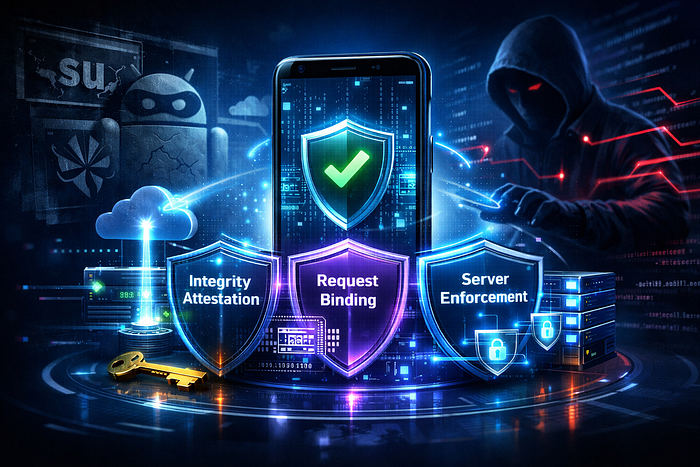
Real defenses are:
- Server-verified integrity attestation
- Request binding
- Tiered enforcement
- Device-bound cryptographic proof
- Behavioral and fraud controls
Do this, and you'll stop arguing about whether a device is rooted — and start controlling what an attacker can actually do. 🔐