June 6, 2026
If I Were an Attacker: Thinking About SQL Injection
Databases power almost everything online.

Mukut | Real-World Cybersecurity
2 min read
User accounts, login systems, payment history, search results, and stored information all rely on databases behind the scenes.
From a user's perspective, applications simply return information.
From an attacker's perspective, an important question appears:
How does the application interact with its database?
If I were analyzing a system with attacker-oriented thinking, I would pay close attention to how user input influences backend database behavior.
This article is part of the Hacker Mindset series — exploring how everyday systems appear from an attacker's perspective.
What Database-Driven Applications Assume
Applications that communicate with databases often rely on several assumptions:
- user input follows expected patterns
- search fields receive normal text
- login inputs contain valid credentials
- user-provided values are handled safely
- database interactions remain controlled
Security depends on these assumptions holding true.
Attackers test where they fail.
Attacker Lens: Input Meets Database Logic
Many applications take user input and use it to retrieve or process information.
Common examples include:
- login forms
- search bars
- filter systems
- account lookups
- product searches
- admin dashboards
From an attacker's perspective, an important question emerges:
What happens behind the scenes when input is submitted?
If user input directly influences database behavior without proper handling, risk increases.
Weakness 1: Overtrusting User Input
Applications sometimes trust user input too much.
Attackers observe:
- whether unexpected input changes responses
- whether search behavior behaves unusually
- whether application messages change unexpectedly
- whether certain inputs trigger errors
Unexpected system behavior may reveal weak handling of external data.
Applications should treat all input as untrusted.
Weakness 2: Error Message Exposure
Systems occasionally reveal too much information when something goes wrong.
Attackers pay attention to:
- unusual database-related errors
- detailed system messages
- stack traces
- debugging information
Even small clues may reveal how backend systems process information.
Secure systems minimize unnecessary information exposure.
Weakness 3: Search and Filter Logic Assumptions
Applications often assume search behavior remains normal.
Attackers test:
- unusual formatting
- unexpected symbols
- edge-case input behavior
- changes in filtering logic
The goal is often observation:
Does the application react differently than expected?
Unexpected behavior may indicate weak input handling.
Weakness 4: Authentication Flow Interactions
Login systems frequently rely on databases to verify identity.
Attackers analyze:
- whether login responses behave consistently
- whether unexpected input changes authentication flow
- whether validation logic behaves differently under edge cases
Authentication systems must carefully separate user input from backend query logic.
Trust boundaries matter.
Weakness 5: Data Access Assumptions
Applications assume users request only permitted information.
Attackers think about:
- how access decisions are enforced
- whether filtering logic is reliable
- whether data visibility changes unexpectedly
Proper access control and query handling are essential for maintaining trust.
Why SQL Injection Matters in Cybersecurity
SQL Injection remains one of the most discussed web security risks because databases contain valuable information.
Weak database interaction may expose:
- account information
- sensitive records
- internal application data
- authentication-related information
Even small mistakes in handling input may create larger security consequences.
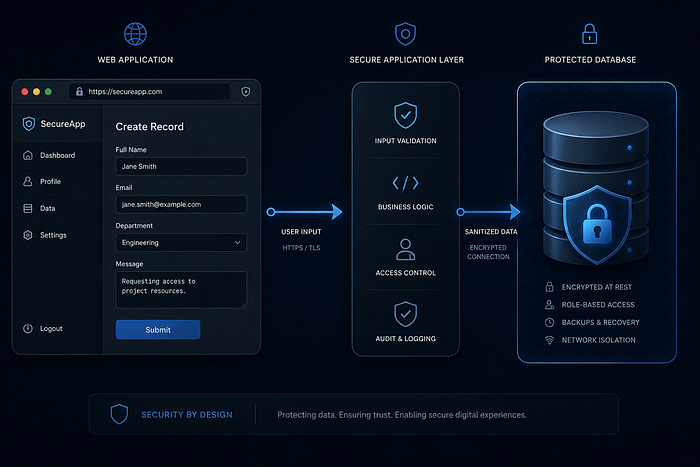
Secure systems separate user input from database logic.
What This Reveals About Security Design
Secure database interaction requires:
- strict input validation
- safe query handling
- controlled error messaging
- strong access controls
- separation between user input and database commands
Applications should never assume external input is trustworthy.
Security begins with safe handling of data.
Hacker Mindset Takeaway
To an attacker, database-driven systems are not just information providers.
They are:
- decision-making systems
- trust boundaries
- data access mechanisms
- logic-driven environments
Understanding how applications process user input helps reveal how systems protect — or expose — valuable information.
Previous and Next in the Series
Previous: Breaking Input Validation Systems
Next: Thinking About Cross-Site Scripting (XSS)
—