

My name is 0xPedrop. I am a student and a Security Researcher in my spare time. If you are new here, welcome! I recommend taking a look at my previous posts; they cover various security topics that might help you on your own journey.
Today, I want to talk about a specific challenge in modern web hunting: JavaScript analysis at scale.
⚠️ Disclaimer: Tools and techniques discussed in this blog is only meant for educational
The Automation Mindset: Time is Money
During the reconnaissance process, a huge part of the work is repetitive. For every Bug Hunter, time is money. The more repetitive tasks you can automate, the better your performance and the faster you can reach the "good stuff."
However, automation isn't a silver bullet. It doesn't replace manual analysis — which remains indispensable and fundamental for understanding complex logic — but it empowers the researcher to focus where it truly matters.
The results of this approach speak for themselves: after fine-tuning my automation and deploying these tools, I was able to secure over $1,000 in bounties in less than three days.
In the world of modern web applications, JavaScript files are no longer just scripts; they've become veritable gold mines. But for a vulnerability hunter, manually analyzing these files is like looking for a needle in a haystack. That's why I developed 0xJS and 0xDepCheck: to scale this process and transform megabytes of code into actionable vulnerabilities.
The Scaling Problem: Crawling and Recon
During the recon phase, we usually run spiders and crawlers that discover hundreds, sometimes thousands, of JavaScript URLs — especially when dealing with large scopes and dozens of subdomains.
Every single one of those files could be the one containing a hardcoded Firebase token, a private AWS key, or an internal endpoint. But here is the reality check: analyzing every single file manually is practically impossible. It's a massive time sink that drains your energy and slows down your testing flow.
This is where the "Scaling" part of the title comes in. To handle this volume, I needed a way to filter the noise and find the signal automatically.
0xJS: Your Automated Eyes in the Code
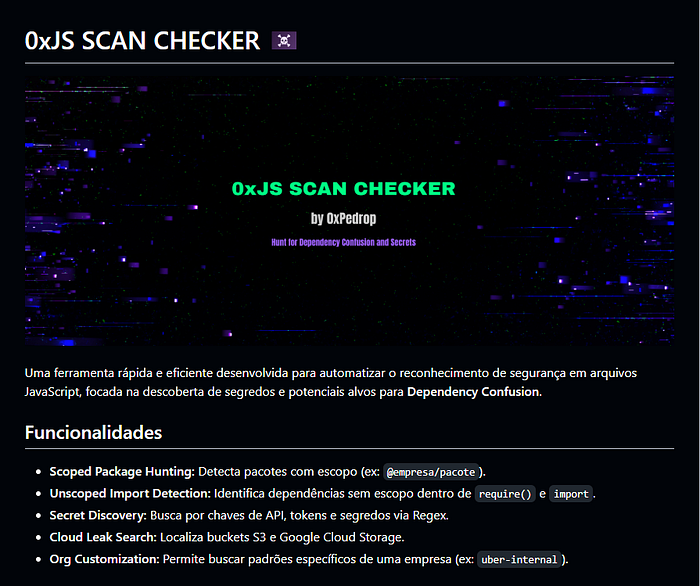
You can find it at:
I built 0xJS to solve exactly this. It's a tool designed to ingest that mountain of JS URLs and perform a deep, automated scan for sensitive data exposure.
- Handling the Mass: Instead of opening files in your browser or a text editor, 0xJS processes these files at scale, looking for patterns that human eyes might miss in a 10MB minified blob.
- Precision Scanning: Using a refined set of Regular Expressions (Regex), it hunts for high-value targets like API keys, secrets, and authorization headers.

- Speed: Because it's built in Python, it can handle the heavy lifting of regex matching across massive datasets much faster than any manual inspection.
The Hidden Trap: Internal Dependencies
While hunting for secrets with 0xJS, I realized that API keys weren't the only valuable thing hidden in those massive blobs of code. Modern JavaScript bundles often reveal the names of internal packages — libraries used by the company that aren't meant to be public.
By extracting these package names, 0xJS identifies a potential gold mine: Dependency Confusion. When a developer includes a private library in the frontend code, they might be inadvertently giving us the name of a package that doesn't exist on the public registry (like npm). If we can claim that name on the public registry, we can achieve Remote Code Execution (RCE) on their build servers or developer machines.
0xDepCheck: Validating the Vulnerability
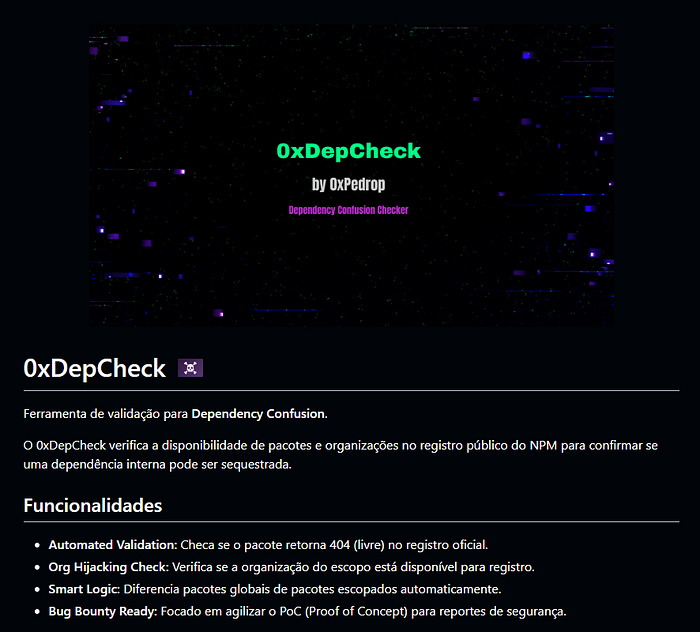
You can find it at:
Remember to leave me a star, hahaha
Identifying a name is only half the battle. To turn a "maybe" into a critical finding, I developed 0xDepCheck.
Not all dependencies are created equal. To be truly effective, 0xDepCheck differentiates between two types of targets:
1. Unscoped Packages (e.g., internal-auth-lib)
This is the "classic" dependency confusion. The tool checks if the package name exists on the public registry (like npm). If it returns a 404 Not Found, it's a green light for a potential hijack.
2. Scoped Packages (e.g., @company-internal/core-api)
This is where the real complexity (and reward) lies. Many hunters ignore scoped packages, but 0xDepCheck treats them as high-priority:
- Organization Availability: If the package is scoped, the tool doesn't just check the package name. It verifies if the organization/scope itself (
@company-internal) is registered on the registry. - The Takeover: If the organization name is available, we can perform an Organization Takeover. By registering that scope, we can then publish any package name under it that the victim's application is looking for.
By automating this distinction, 0xDepCheck flags vulnerabilities that would be nearly impossible to spot manually during a fast-paced recon.
Conclusion: Work Smarter, Not Harder
Security research is an eternal race between complexity and automation. Building 0xJS and 0xDepCheck wasn't just about writing code; it was about reclaiming my time and focusing my manual expertise on the most critical parts of the application.
If there is one takeaway from my $1k-in-3-days experience, it's this: Master your recon. When you scale your analysis, you stop being a hunter who hopes for a bug and start being the researcher who systematically finds them
Thanks for reading! If you found this useful, don't forget to:
- Clap for this article (it helps a lot!).
- Follow me here on Medium for more insights into my Bug Bounty workflow.
- Check out my previous posts for more security tips.
What about you? How are you handling massive JS files in your recon? Let's discuss in the comments!