
I still remember the moment security stopped feeling "technical" to me.
I was a software engineer in a sprint review. Everything was green. Tests passing. Features shipped. Then someone from leadership casually asked: "So… what happens if this gets breached?"
Silence.
Not because we didn't know how encryption worked. Not because we didn't understand auth flows. But because no one had actually decided what mattered most if things went wrong.
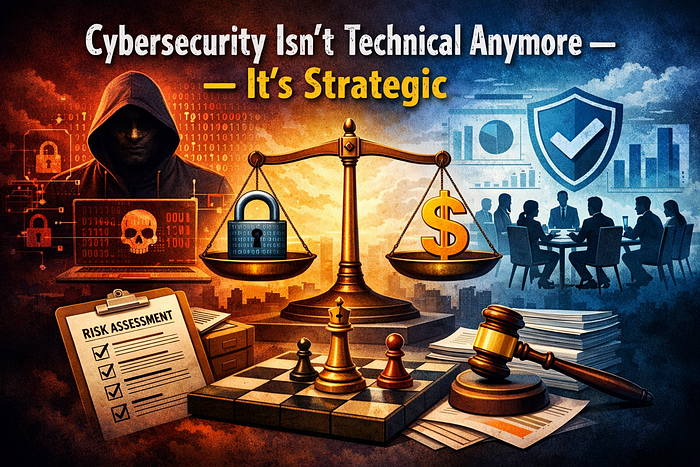
That's when it hit me Cybersecurity had quietly moved out of the server room and into the boardroom.
And most teams haven't caught up yet.
The Big Lie We Still Tell Ourselves
We keep saying cybersecurity is about
- Strong passwords
- Better tools
- Zero Trust
- AI-powered threat detection
Those things matter. Obviously.
But here's the uncomfortable truth
Most breaches don't happen because teams lack tools. They happen because teams lack clarity.
Clarity about
- What data actually matters
- What risks are acceptable
- What trade-offs leadership is willing to make
Security failures today are rarely technical failures. They're strategic failures wearing technical clothing.
Cybersecurity Used to Be a Skill. Now It's a Business Decision.
Ten years ago, security lived with
- Network engineers
- Sysadmins
- The "security guy" nobody wanted to sit next to
Today?
Security decisions shape
- Product roadmaps
- Market trust
- Regulatory survival
- Company valuation
Ask yourself
- Why do breaches tank stock prices?
- Why do customers churn after "just a data leak"?
- Why do regulators care more about governance than algorithms?
Because cybersecurity is now risk management, not just defense.
Reality Check: Attackers Are Organized. We're Still Fragmented.
Attackers
- Share tools
- Reuse playbooks
- Monetize breaches professionally
Defenders?
- Security says one thing
- Dev says another
- Product wants speed
- Leadership wants growth
Guess who wins.
Security fails not because encryption is weak — but because alignment is.
The Shift Nobody Prepared Engineers For
Engineers are trained to ask
"Is this secure?"
But modern security asks
"Is this secure enough for this business, at this moment, with these risks?"
That's a brutal mindset shift.
Because "secure enough" isn't a technical answer. It's a strategic judgment call.
And judgment requires context.
Why "Just Add More Security" Is Bad Advice
You've heard it
- "Lock it down"
- "Add more checks"
- "Harden everything"
Sounds smart. Feels safe.
But security always has a cost
- Slower development
- Worse UX
- Higher operational overhead
Every security control is a trade-off, not a free upgrade.
If you don't talk openly about those trade-offs, security becomes theater.
The Quiet Rise of Security as a Leadership Skill
The most effective security conversations I've seen didn't happen in Jira.
They happened when leaders asked
- What's the worst realistic failure?
- What would actually kill the business?
- What data would we never want leaked?
That's strategy.
Frameworks like NIST Cybersecurity Framework and ISO 27001 don't exist to teach encryption. They exist to force organizations to think clearly about risk.
Developers: This Is Why Security Feels "Annoying" Now
Security used to be
- A checklist
- A tool
- A ticket
Now it's
- Threat modelling meetings
- Risk acceptance forms
- Compliance conversations
Annoying? Sure.
But here's the honest take
If security feels political, it's because it is.
Politics = prioritization under constraints.
Welcome to adulthood.
The Most Valuable Security Skill in 2026
It's not cryptography. It's not cloud hardening. It's not even threat detection.
It's the ability to explain risk clearly.
The engineers who win now
- Translate technical risk into business impact
- Push back without being alarmist
- Know when not to over-secure
They don't just build systems. They influence decisions.
Practical, Actionable Shifts You Can Make Today
1. Stop Saying "Secure" — Start Saying "Protected From What"
Be specific.
- Insider threats?
- Ransomware?
- Regulatory fines?
Vague security leads to wasted effort.
2. Tie Every Control to a Risk
If you can't explain what risk a control reduces, it's probably security theater.
3. Learn the Language of the Business
Ask
- What's revenue-critical?
- What's legally sensitive?
- What's replaceable?
Security without business context is noise.
4. Treat Security Reviews Like Design Reviews
Not audits. Not interrogations. Collaborative thinking sessions.
5. Accept That Perfect Security Is a Myth
Resilience beats prevention. Detection beats denial. Recovery beats ego.
The Hard Truth Nobody Likes
You can't "engineer away" risk.
You can only
- Understand it
- Prioritize it
- Own it
Cybersecurity maturity isn't about fewer incidents. It's about fewer surprises.
Where This Leaves Us
Cybersecurity didn't become less technical.
It became more human.
More about
- Communication
- Trade-offs
- Trust
- Responsibility
And honestly? That's harder than writing secure code.
Let's Argue,
Do you think engineers should be more involved in security strategy? Or should this stay a leadership problem?
Clap if this made you uncomfortable — in a good way. Comment if you disagree. Share this with a developer who still thinks security is "just tools."
And save it for later — because this conversation isn't going away.