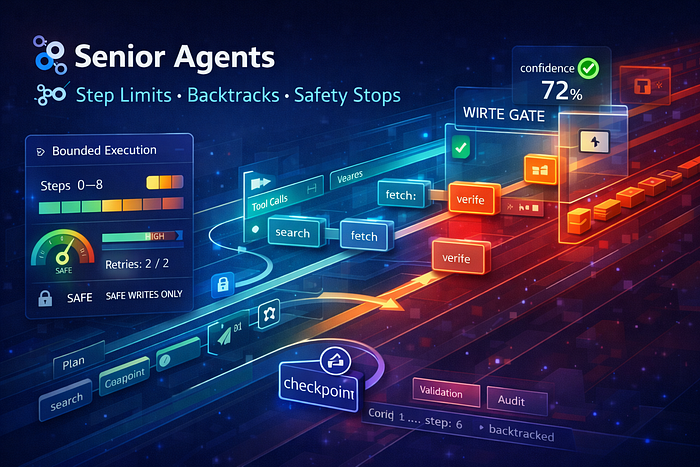

Build safer tool-using agents with step limits, backtracks, and safety stops. Patterns, architecture, and code for reliable LLM tool-calling.
Let's be real: most tool-using agents today behave like eager interns on espresso.
They will call the tool. They will call it again. They will call it with slightly different parameters 19 times because "maybe this time."
And then they'll confidently produce an answer that looks plausible… built on sand.
What you want instead is the vibe of a senior engineer: calm, bounded, reversible. Someone who knows when to stop, when to roll back, and when to say, "I don't have enough evidence."
That's the whole point of this article: building agents that use tools like seniors by implementing three reliability primitives:
- Step limits (bounded work)
- Backtracks (reversible plans)
- Safety stops (hard gates when risk increases)
You might be wondering: Isn't this just "agent guardrails"? Yes, but with a builder's mindset. Not vague policies. Concrete mechanisms you can ship.
Why Tool-Using Agents Go Off the Rails
Tool use amplifies capability, but it also amplifies failure modes:
- Infinite loops: repeated calls with tiny variations ("search again," "retry," "one more").
- Compounding errors: one wrong assumption becomes input for the next tool call.
- Silent partial success: the tool returns "something," the agent treats it as truth.
- Overreach: the agent tries actions it shouldn't (permissions, scope creep).
- Cost blowups: token spend and tool bills rise together.
So the goal isn't "tools + LLM." The goal is tools + bounded reasoning + auditability.
Senior Pattern #1: Step Limits (Work Budgets)
A step limit is not just "max tool calls." It's a budget system.
H3) What to bound
- Tool calls: e.g., max 8 per request
- Retries per tool: e.g., max 2
- Time: e.g., 20 seconds wall-clock
- Cost: e.g., max $0.02 per run
- Risky actions: e.g., max 1 write operation
H3) Why seniors love limits
Because they force prioritization. If you only have 6 steps, you stop exploring and start choosing.
Practical heuristic
- 3–5 tool calls for "simple" tasks (lookup + summarize)
- 6–10 tool calls for "workflow" tasks (multi-step reasoning)
- Anything above 12 is a smell unless it's an explicit batch job
Also: when the budget is nearly gone, the agent should switch modes:
- from "explore" → "conclude"
- from "do" → "report status + next steps"
Senior Pattern #2: Backtracks (Reversible Plans)
Backtracking is what happens when the agent realizes: "My plan was wrong."
Without backtracking, agents tend to rationalize errors. With backtracking, they can admit uncertainty and recover.
H3) The easiest form: plan checkpoints
Store:
- the plan
- the assumptions
- the tool outputs used
- the current "belief state"
Then allow the agent to roll back to the last checkpoint and try a different branch.
H3) The senior version: a "decision ledger"
Create a structured log like:
- Decision: "Use endpoint A"
- Evidence: "Docs indicate field X"
- Confidence: 0.62
- Fallback: "Try endpoint B if missing X"
When a tool response contradicts evidence, backtrack triggers automatically.
Backtracking triggers (keep it crisp)
- response schema mismatch
- tool returns empty / partial
- confidence drops below threshold
- repeated retries without new information
- policy violation risk increases
Backtracking isn't weakness. It's literally "debugging your own plan."
Senior Pattern #3: Safety Stops (Hard Gates)
Safety stops are explicit "do not proceed" checkpoints. Seniors do this naturally:
"Before we write to prod, let's verify."
Agents need the same.
H3) Common safety stops to implement
- Write confirmation gate: before any external write (create/delete/update), require:
- a dry-run summary
- a scoped diff of intended changes
- a permission check
2. Scope boundary gate: if user asks for X, agent must not expand to Y.
4. Data sensitivity gate: if tool output includes secrets / PII markers, stop and redact.
5. Uncertainty gate: if confidence low, stop and ask for missing input (or abstain).
Think of this as "seatbelts for autonomy."
Architecture Flow: A Bounded Tool-Calling Loop
Here's a practical architecture you can implement in any agent framework.
User Request
   |
   v
Intent + Risk Classifier  ---> (high risk) ---> Safety Policy Gate
   |
   v
Planner (creates Plan v1)
   |
   v
Execution Loop (bounded)
   |
   +--> Step Budget Check (calls/time/cost)
   |
   +--> Tool Router (read vs write)
   |
   +--> Tool Call + Result Validator
   |        |
   |        +--> Schema check / sanity checks
   |
   +--> Confidence Update
   |
   +--> Backtrack Controller (if triggers fire)
   |
   v
Finalizer
   |
   v
Answer + Audit Summary (what tools used, what changed)
This is the "senior agent loop": bounded, validated, reversible, and reportable.
Code: A Minimal Step-Budget + Backtrack Skeleton
Below is a simplified pattern in JavaScript/TypeScript style. It's intentionally framework-agnostic.
type ToolResult = { ok: boolean; data?: any; error?: string };
type ToolCall = { name: string; input: any; kind: "read" | "write" };

type State = {
  step: number;
  maxSteps: number;
  retries: Record<string, number>;
  maxRetriesPerTool: number;
  costCents: number;
  maxCostCents: number;
  confidence: number; // 0..1
  history: Array<{ call: ToolCall; result: ToolResult }>;
  checkpoints: Array<{ stateSnapshot: Omit<State, "checkpoints">; note: string }>;
};

function cloneSnapshot(state: State) {
  const { checkpoints, ...rest } = state;
  return JSON.parse(JSON.stringify(rest));
}

function shouldBacktrack(state: State, last?: ToolResult) {
  if (!last) return false;
  if (!last.ok) return false; // failure alone isn't enough
  // Trigger on "unexpected emptiness" or low confidence
  const empty = last.data == null || (Array.isArray(last.data) && last.data.length === 0);
  return (empty && state.step > 1) || state.confidence < 0.45;
}

function budgetExceeded(state: State) {
  return (
    state.step >= state.maxSteps ||
    state.costCents >= state.maxCostCents
  );
}

function safetyStop(call: ToolCall, state: State) {
  // Hard gate: prevent writes when confidence is low or budget nearly gone
  if (call.kind === "write") {
    if (state.confidence < 0.6) return "Blocked: low confidence for write";
    if (state.step > state.maxSteps - 2) return "Blocked: insufficient steps left for safe write";
  }
  return null;
}

async function runAgent(tools: Record<string, (input: any) => Promise<ToolResult>>) {
  let state: State = {
    step: 0,
    maxSteps: 8,
    retries: {},
    maxRetriesPerTool: 2,
    costCents: 0,
    maxCostCents: 2, // pretend 2 cents budget
    confidence: 0.72,
    history: [],
    checkpoints: [],
  };

  // Save initial checkpoint
  state.checkpoints.push({ stateSnapshot: cloneSnapshot(state), note: "start" });

  const plan: ToolCall[] = [
    { name: "searchDocs", input: { q: "endpoint schema" }, kind: "read" },
    { name: "fetchData", input: { id: "123" }, kind: "read" },
    // { name: "updateRecord", input: { id: "123", status: "ok" }, kind: "write" },
  ];

  for (const call of plan) {
    if (budgetExceeded(state)) break;

    const gate = safetyStop(call, state);
    if (gate) {
      state.history.push({ call, result: { ok: false, error: gate } });
      break;
    }

    state.step += 1;

    // Retry guard
    state.retries[call.name] ??= 0;
    if (state.retries[call.name] > state.maxRetriesPerTool) {
      state.history.push({ call, result: { ok: false, error: "Retry limit exceeded" } });
      break;
    }

    const result = await tools[call.name](call.input);
    state.history.push({ call, result });

    // Fake "cost" accounting (you'd plug real numbers here)
    state.costCents += 0.2;

    // Validate & update confidence (toy logic)
    if (!result.ok) state.confidence -= 0.08;
    else state.confidence -= 0.02;

    // Backtrack if the result contradicts expectations
    if (shouldBacktrack(state, result) && state.checkpoints.length > 0) {
      const lastCheckpoint = state.checkpoints[state.checkpoints.length - 1];
      const restored = JSON.parse(JSON.stringify(lastCheckpoint.stateSnapshot));

      state = { ...restored, checkpoints: state.checkpoints };
      state.history.push({
        call: { name: "backtrack", input: { to: lastCheckpoint.note }, kind: "read" },
        result: { ok: true, data: "Backtracked to checkpoint" },
      });

      // After backtrack, you would generate a revised plan branch here.
      break;
    }

    // Save periodic checkpoints
    if (state.step % 2 === 0) {
      state.checkpoints.push({
        stateSnapshot: cloneSnapshot(state),
        note: `after step ${state.step}`,
      });
    }
  }

  return {
    status: budgetExceeded(state) ? "partial" : "complete",
    stepsUsed: state.step,
    costCents: state.costCents,
    confidence: state.confidence,
    history: state.history,
  };
}
What this gives you (in plain English)
- The agent can't spiral: step and cost budgets stop it.
- Writes are gated: safetyStop prevents risky actions late or unsure.
- When evidence turns weird: backtrack can roll the agent to a checkpoint.
This is the "senior posture": bounded, cautious, recoverable.
Real-World Scenarios Where These Patterns Pay Off
H3) Customer support agent that issues refunds
- Step limit prevents "tool thrash"
- Safety stop ensures the agent summarizes the intended refund before executing
- Backtrack triggers when invoice data doesn't match customer ID
H3) Data ops agent that updates dashboards
- Safety stop blocks schema changes if validations fail
- Backtrack if metrics drift after a transformation step
- Step budget prevents blowing up warehouse queries
H3) Dev agent that runs CI tools
- Concurrency budget on tool calls
- Backtrack when logs don't contain expected markers
- Safety stop blocks merges without required checks
The Senior Agent Checklist (Print This Mentally)
- Budgets: max steps, retries, time, cost
- Validation: schema checks + sanity checks on tool outputs
- Backtrack: checkpoints + triggers + revised plan branch
- Safety stops: write gates, scope gates, uncertainty gates
- Audit trail: tool calls + inputs + outputs + decisions
If you implement only one thing this week, implement budgets. They change everything.
Conclusion: Reliability Is an Interface
People talk about "agent intelligence" like it's magic. In production, the real magic is simpler:
- the agent stops when it should stop
- it can admit uncertainty
- it can recover from wrong turns
- it doesn't burn money while failing creatively
That's what seniors do. And you can bake that into your tool-using agents today.
CTA: If you tell me your agent's tools (read/write) and the top failure you've seen (loops? wrong writes? cost spikes?), I'll propose a step budget + backtrack + safety stop design that fits your exact workflow.