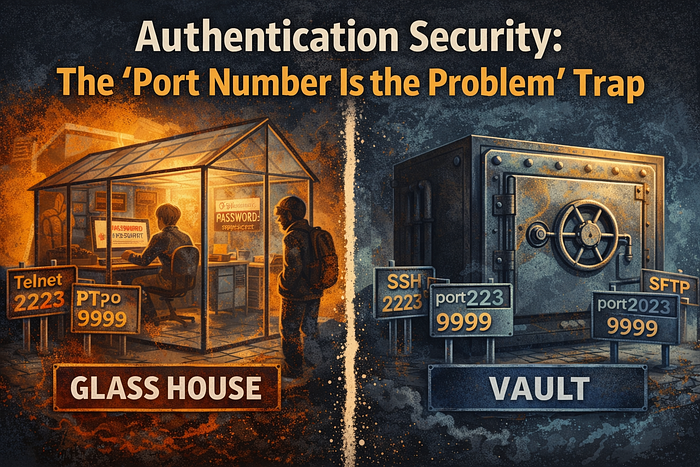

I used to think I was bein' clever by movin' services to "less obvious" ports. Run Telnet on 2323 instead of 23, tuck FTP up on 9999 instead of 21 — and I'd feel just a little safer, like I'd hidden the good silver in a different drawer. But the more I learned, the more I realized: I wasn't fixin' the security problem. I was just changin' the address on a house made of glass.
The Glass House vs The Vault
To really see the trap, picture two very different buildings.
The Glass House — Cleartext Protocols (Telnet/FTP/HTTP)
This place looks fancy from the street — big windows, clean lines, sun pourin' in. But:
- The walls are glass.
- Anyone walkin' by can see everything happening inside.
- If you sit at the table and read your password out loud, folks on the sidewalk can watch your lips, see your screen, and read every word.
Change the address all you want:
- 123 Main Street or 456 Oak Avenue.
- Telnet on port 23 or Telnet on port 2323.
- FTP on port 21 or FTP on port 9999.
At the end of the day, it's still a glass house. The problem isn't where it lives — it's what the walls are made of. Cleartext protocols expose your credentials the same way, no matter which port they ride on.
The Vault — Encrypted Protocols (SSH/SFTP/HTTPS)
Now picture a heavy, concrete vault:
- No windows, thick walls, solid door.
- You can stand outside and see the building.
- You can read the street address.
- But you can't see or hear what's going on inside.
That's your encrypted protocols:
- SSH, whether it's sittin' on port 22 or 2222.
- SFTP, wherever you map it.
- HTTPS, on 443 or a custom port.
The address is visible, but the contents are protected. The security comes from the protocol and encryption, not from a "clever" choice of port number.
Where I Went Wrong
The mental trap I fell into boiled down to this:
"If I move an insecure service to a less obvious port, I've made it safer."
So I'd:
- Shift Telnet off 23 to something higher.
- Slide FTP away from 21 to a random port.
And I'd feel like I'd done my job. But all I'd really done was:
- Take a glass house,
- Move it to a quieter street,
- And convince myself it was now "more secure."
The hard truth is:
- Telnet is still cleartext, no matter which port you pick.
- FTP is still cleartext, no matter which port you pick.
- If someone's watchin' the wire, your credentials are still layin' there in plain view.
On the flip side:
- SSH is encrypted on port 22, and it's still encrypted on 2222.
- HTTPS is encrypted on 443, and it's still encrypted if you move it.
The protocol — not the port — decides whether your secrets are protected.
The Lesson I Use Now
These days, when authentication is on the line, I don't ask, "What port am I using?"
I ask:
- Is this a glass house or a vault?
- Is this protocol cleartext or encrypted?
- Am I just changing the house number, or did I actually change the building?
Because movin' a glass house down the street doesn't turn it into a vault. And changin' ports doesn't turn Telnet into SSH or HTTP into HTTPS.
When passwords, tokens, or sensitive data are involved, the rule I live by now is simple:
Don't trust the address bar. Trust the building material. Don't rely on the port — make sure the protocol itself is doin' the heavy liftin' to keep your secrets safe.