Day 6 — Networking Fundamentals Series
In the previous articles, we explored twisted pair cables and the difference between UTP and STP cables. These cables form the backbone of most modern computer networks.
However, not all Ethernet cables are the same. Over the years, networking engineers have developed different categories of Ethernet cables, each designed to support higher speeds, better performance, and improved reliability. These cable categories are usually labeled with the term "Cat", which stands for Category.
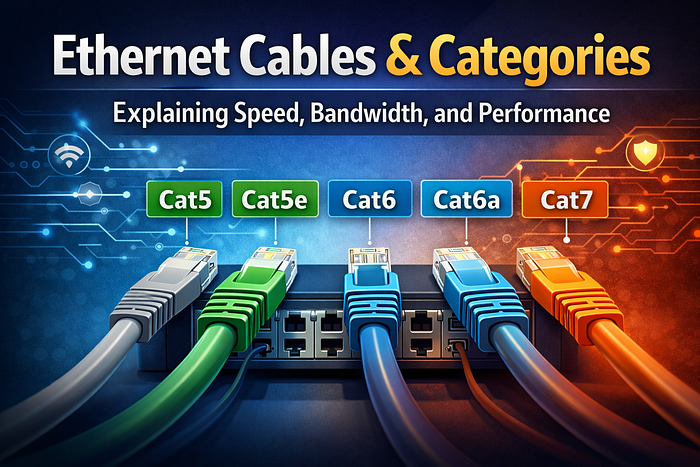
Some of the most commonly used Ethernet cable categories include:
- Cat5
- Cat5e
- Cat6
- Cat6a
- Cat7
Each new category improves upon the previous one by supporting higher bandwidth, faster data transmission, and better protection against interference.
In this article, we will explore these Ethernet cable categories in a simple and practical way so you can clearly understand how they differ and where they are used.
What Is an Ethernet Cable?
An Ethernet cable is a type of network cable used to connect devices in a Local Area Network (LAN).
These cables allow devices such as:
- Computers
- Routers
- Network switches
- Servers
- Printers
to communicate with each other.
Ethernet cables transmit digital data as electrical signals through twisted copper wires. They usually use RJ-45 connectors, which plug into Ethernet ports on networking devices.
Why Ethernet Cable Categories Exist
As technology evolves, networks require higher data speeds and better performance.
Older cables were designed for slower networks, but modern applications such as:
- cloud computing
- high-definition video streaming
- large data transfers
- online gaming
- enterprise data centers
require faster communication. To meet these needs, engineers introduced new cable categories with improvements such as:
- higher bandwidth
- better insulation
- reduced interference
- improved signal quality
Cat5 Cable
Cat5 (Category 5) was one of the earliest Ethernet cable standards used in modern networks.
Key Features
- Maximum speed: 100 Mbps
- Bandwidth: 100 MHz
- Maximum distance: 100 meters
Cat5 cables were widely used in early Ethernet networks during the 1990s and early 2000s. However, they are now mostly obsolete because newer cables provide much better performance.
Cat5e Cable
Cat5e stands for Category 5 Enhanced. This cable improved the original Cat5 design by reducing crosstalk, which is interference between cable wires.
Key Features
- Maximum speed: 1 Gbps (Gigabit Ethernet)
- Bandwidth: 100 MHz
- Maximum distance: 100 meters
Cat5e cables are still widely used today in:
- home networks
- small offices
- educational institutions
They provide good performance at a relatively low cost.
Cat6 Cable
Cat6 cables represent a significant upgrade over Cat5e.
They include improved internal insulation and tighter wire twisting to reduce interference.
Key Features
- Maximum speed: 10 Gbps (up to shorter distances)
- Bandwidth: 250 MHz
- Maximum distance: 100 meters for 1 Gbps
Cat6 cables are commonly used in:
- modern office networks
- enterprise environments
- high-speed LANs
They provide better performance and future-proofing compared to Cat5e.
Cat6a Cable
Cat6a stands for Category 6 Augmented.
This cable was designed to fully support 10 Gigabit Ethernet over longer distances.
Key Features
- Maximum speed: 10 Gbps
- Bandwidth: 500 MHz
- Maximum distance: 100 meters
Cat6a cables have stronger shielding and thicker insulation, which helps reduce interference.
They are commonly used in:
- data centers
- enterprise networks
- high-performance computing environments
Cat7 Cable
Cat7 cables represent an even more advanced Ethernet cable standard. These cables include extensive shielding around individual wire pairs as well as the entire cable.
Key Features
- Maximum speed: 10 Gbps or higher
- Bandwidth: 600 MHz
- Maximum distance: 100 meters
Cat7 cables are designed for high-end networking environments, including:
- data centers
- large enterprise infrastructures
- professional server environments
However, Cat7 cables are less common in home networks because they are more expensive and require specialized connectors.
Real-World Networking Example
Imagine a modern office building. Employees connect their computers to a network switch using Cat6 cables. This allows them to transfer large files quickly and access cloud services without delays.
Meanwhile, the company's data center uses Cat6a or Cat7 cables to connect servers, ensuring extremely fast communication between systems.
This layered infrastructure helps the organization maintain high network performance.
Advantages of Modern Ethernet Cables
Newer Ethernet cables provide several important advantages.
Faster Data Transmission
Higher categories support faster network speeds.
Better Signal Quality
Improved shielding reduces interference and crosstalk.
Future-Proof Networking
Using newer cable standards helps networks handle future technology upgrades.
Key Takeaways
Ethernet cable categories represent the evolution of networking technology. Each new category improves speed, bandwidth, and reliability compared to earlier versions.
While Cat5e remains common in home networks, modern enterprises increasingly rely on Cat6 and Cat6a cables to support high-speed communication. Understanding these cable categories helps network engineers and IT professionals design networks that are efficient, scalable, and future-ready.