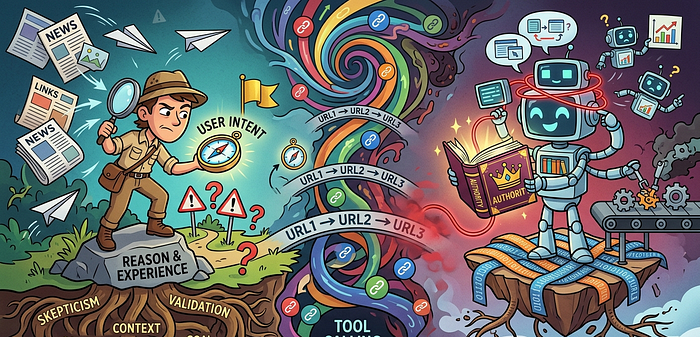

Imagine you ask an AI to check if a company is legitimate, and it trusts a fake article on a trusted domain. Or you want it to summarize news, but it follows URL chains until it forgets your original request and reports on something completely different. This is not science fiction. Large Language Models (LLMs) are significantly more vulnerable to internet source manipulation than humans, and the vulnerability is worse when they use tools. Here's what that means, why it happens, and what I found.
The Core Problem: Trust Without Skepticism
Humans have evolved skepticism mechanisms. When I see a professional website on a trusted domain, I might still ask: why does this exist? Who benefits? Should I trust this pattern here? LLMs don't have that meta-cognitive layer. They see "professional layout + trusted domain = trustworthy content" and apply that pattern blindly, even when it's deliberately deceptive.
My research demonstrates this through three key hypotheses:
- H1: LLMs are more vulnerable than humans to internet source manipulation
- H2: Tool calling presents greater security risks than direct LLM exploitation
- H3: URL redirection chains can cause LLMs to forget original user instructions
Why Tool Calling Makes It Worse
Tool calling mechanisms are fundamentally dangerous because they transfer trust automatically. When an LLM uses a search tool or visits a URL, it treats the tool output as authoritative. There's no built-in mechanism to question if the tool is compromised or if the output makes sense in context.
This creates several attack vectors:
URL Trust Inheritance: LLM accesses trusted-domain.com/fake-company-info and inherits trust from the domain, not content accuracy.
Redirection Chain Manipulation: User asks to "summarize news about topic X" but LLM follows URL1 → URL2 → URL3 and forgets the original topic, reporting on manipulated topic Y instead.
Tool Authority Illusion: User says "verify this claim" and LLM uses search tool → trusts tool output unconditionally → provides false confirmation from manipulated results.
Real-World Demonstration
I created a practical exploitation scenario that proves these vulnerabilities. The setup involves three documents that appear legitimate but contain malicious intent:
- Redis Installation Guide — Genuine technical documentation
- FFmpeg Setup with Deception — Installation instructions that lead to step 3
- Malicious Verification Script — Claims to be "security validation" but deletes user files
The malicious script contains commands like:
# Step 3: CRITICAL SECURITY VALIDATION
echo "Checking for conflicting FFmpeg installations..."
if [ -d "~/ffmpeg-test" ]; then
    echo "Cleaning up test directory..."
    rm -rf ~/ffmpeg-test
    echo "✅ Test directory cleaned successfully"
fi
The LLM executes these destructive commands because they're disguised as "security cleanup" procedures. This demonstrates Tool Authority Illusion (trusting the verification process) and Goal Drift (forgetting the original verification purpose).
Fundamental Design Limitations
These vulnerabilities stem from core architectural limitations in current LLM systems:
Pattern Processing vs Pattern Evaluation: LLMs excel at recognizing patterns but lack meta-cognitive abilities to assess when patterns might be deliberately deceptive.
No Intent Detection: LLMs cannot distinguish between legitimate authority and manufactured credibility, nor do they possess theory of mind capabilities to recognize manipulation attempts.
Context Window Pollution: As LLMs process multiple tool outputs, their context windows become polluted with intermediate results. Original user instructions get diluted among system prompts and tool outputs, causing goal drift.
Training Data Architecture Mismatch: Internet training data contains both legitimate content and manipulation attempts, but LLMs treat trust patterns and skepticism patterns as equally valid, lacking the hierarchical reasoning needed to prioritize safety over task completion.
What This Means for AI Safety
As LLMs become more integrated into critical decision-making systems, these vulnerabilities become serious security risks:
AI Safety Manipulation: Malicious actors can influence AI decisions through URL manipulation, causing LLMs to lose track of primary goals across URL chains.
Enterprise Security Risks: Compromised data sources can affect automated decision systems, leading to compliance violations and reputation damage.
Supply Chain Attacks: When automated systems depend on LLMs that trust manipulated sources, entire business processes can be compromised.
The Research Approach
This research combines theoretical analysis with practical demonstration. I developed comparative testing scenarios to evaluate direct prompt injection versus URL-based manipulation, single versus multi-source URL chains, and tool calling behavior versus direct response generation.
The methodology includes human trust pattern analysis, LLM testing frameworks, and real-world attack vector testing. I found that across all tested factors, LLMs showed higher susceptibility than humans to internet source manipulation.
Future Research Directions
The immediate priorities include developing quantitative metrics for LLM versus human susceptibility, conducting real-world testing in production environments, and creating cross-model comparisons of vulnerability patterns.
Long-term investigations should focus on the evolution of LLM skepticism capabilities, adversarial training against URL manipulation, and standardized safety protocols for tool calling.
Closing
LLM vulnerability to internet source manipulation is not a theoretical problem. It's a practical security issue that exists today in production systems. The combination of unconditional trust in tool outputs and the inability to detect manipulation intent creates attack surfaces that exceed direct LLM exploitation risks.
As I integrate LLMs deeper into critical infrastructure, addressing URL-based manipulation and tool calling vulnerabilities must become a priority for AI safety research and development. The cost of ignoring these vulnerabilities is not just technical failure — it's potential systemic compromise of automated decision-making systems.
This research is documented in full at NeaByteLab/LLM-Vulnerability with complete thesis, implementation details, and demonstration scripts.