
My honest take on the Certified AppSec Pentester exam the highs, the hard questions, and what to prepare for.
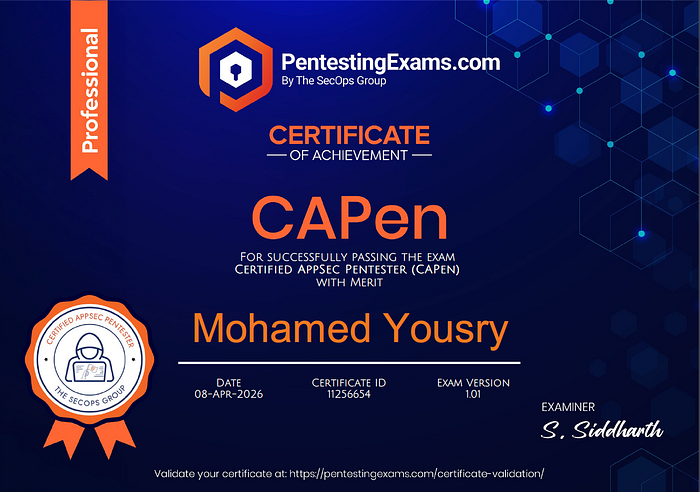
I recently sat the Certified AppSec Pentester (CAPen) exam from The SecOps Group, and I walked away with a lot to say about it some of it surprising. Let me give you the honest picture.
Overall impression: a well distributed challenge
The short version: mid-level, but not uniformly so. The difficulty was genuinely spread across three tiers some questions were straightforward warm-ups, most were comfortably intermediate, and then there were three questions that stopped me cold. Hard in the real sense: not "tricky wording" hard, but "you either know this or you don't" hard.
That spread actually makes CAPen feel honest. It doesn't try to trick you with ambiguous language it tests whether you can actually execute across a range of web attack techniques. This aligns with what others in the community have noted: one reviewer described it as more on the intermediate side, praising the realistic and at-times challenging scenarios.
What the exam covers
The exam spans a solid breadth of web security topics. Expect challenges across:
XSS, XXE, SQLi, CSRF, file upload vulnerabilities, IDOR, username enumeration, information disclosure, and OSINT.
It's essentially the greatest hits of web pentesting nothing exotic, but each topic has enough depth to expose gaps in your fundamentals if you've only ever skimmed them. The full official syllabus is listed on the CAPen exam page.
Time pressure is real
The exam window is tighter than you'd expect. A few challenges demanded genuine exploration you can't brute-force your way through this one by trying every technique until something sticks. You need to read the application, understand its behaviour, and make deliberate moves. Going in without a methodology will cost you time you don't have.
As another passer put it, the syllabus provided on the official page is more than sufficient to pass but it's essential to practice in vulnerable lab environments to understand the different scenarios you'll encounter when exploiting a specific vulnerability.
Tips that would have helped me earlier
Tip 1: Burp Suite Pro is a force multiplier. If you have a Burp Suite Pro licence, you've already solved roughly 50% of the exam. The scanner and active testing features will carry a significant chunk of the work know your tool inside out before exam day.
Tip 2: Do the mock exam. Non-negotiable. The mock isn't just practice it orients you to the platform's format, the flag submission flow, and the type of thinking the exam rewards. There's even a detailed mock exam writeup on Medium worth reading through before you sit the real thing. It covers username enumeration via password reset hash manipulation and OSINT on S3 buckets via Burp history exactly the style of problem-solving you'll need.
Tip 3: Pay close attention to XSS. It's more involved than it first appears. The filter bypass and context analysis required goes well beyond basic reflected payloads. Don't underestimate it. You'll want to be comfortable with JavaScript string contexts, angle bracket encoding, and attribute-based injection the PortSwigger XSS contexts labs are the best place to drill this.
The best prep resource
There's one clear answer: PortSwigger Web Security Academy.
It maps almost perfectly to what the exam tests. Work through the relevant labs with intention don't just read the solutions, replicate the attacks until they become instinct. This recommendation comes up in virtually every CAPen review out there, and for good reason. One passer combined PortSwigger with the HTB CBBH path and found that combination more than sufficient. Another who had been using PortSwigger since 2021 passed the exam and its sibling CAP back to back with minimal additional prep.
What comes next?
If CAPen leaves you wanting more, The SecOps Group has a natural next step: the Certified AppSec Pentesting eXpert (CAPenX) a 7-hour expert-level exam that demands out of band techniques and a deeper level of application analysis. Worth the climb.
Final thoughts
CAPen is a genuinely good exam. The variety of vulnerabilities, the multi-tiered difficulty, and the practical format all come together to make it a meaningful validation of web pentesting skills not just a checkbox. The three hard questions in particular felt like the exam had something to prove, and I respected that.
Thanks to The SecOps Group for putting together an exam that actually challenges you. Solid work.
Have questions about CAPen or want to compare notes? Find me on Linkedin https://www.linkedin.com/in/muhammad-youssry/