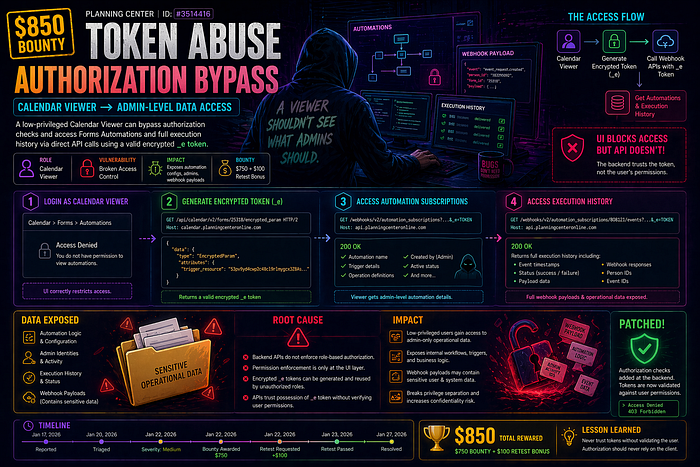

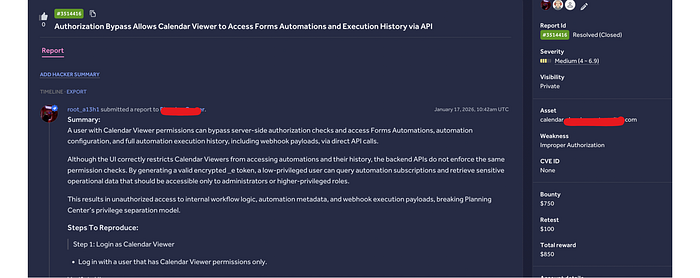
Hi Everyone! While testing a SaaS platform (ExampleCenter), I discovered an authorization bypass vulnerability that allowed a low-privileged user (Calendar Viewer) to access automation configurations, execution history, and webhook payloads data that should only be available to admins.
For this finding, I was awarded a $750 bounty + $100 retest bonus. This bug is a great example of how token-based access without proper validation can completely break a permission model.
Understanding the Target
ExampleCenter provides a Calendar + Forms system with Automations.
These automations:
- Trigger workflows
- Execute actions (e.g., create notes, send data)
- Store execution history
- Include webhook payloads
👉 This is sensitive operational data, not meant for low-privileged users
Permission Model (Expected)
- Admin → Full access to automations
- Editor -> Can edit events, resources and automations
- Viewer → No access to automations can view events and resources
From the UI:
❌ Calendar Viewer cannot see:
- Automations
- Automation configs
- Execution history
So everything looked secure… on the surface.
The Thought That Led to the Bug
While exploring APIs, I noticed something interesting:
There was an endpoint generating an encrypted parameter (_e).
That made me think:
"What if this token is reusable… and not tied to permissions?"
Because i say the automation access api's require _e token if it is the same _e token which is generating to access automations
Step 1: Generating the Token
Even as a Calendar Viewer, I could request:
GET /api/calendar/v2/forms/{form_id}/encrypted_param HTTP/2
Host: api.examplecenter.com
Response:
{
  "data": {
    "attributes": {
      "trigger_resource": "ENCRYPTED_TOKEN_HERE"
    }
  }
}
👉 I now had a valid _e token
Step 2: Accessing Automations
Using the same Viewer session + _e token:
GET /api/webhooks/v2/automation_subscriptions?_e=ENCRYPTED_TOKEN HTTP/2
Host: api.examplecenter.com
Result
👉 200 OK — Data returned successfully
I was able to access:
- Automation names
- Trigger configurations
- Operation definitions
- Admin identities (who created automation)
- Internal workflow logic
Step 3: Accessing Execution History
Then I pushed further 👇
GET /api/webhooks/v2/automation_subscriptions/{id}/events?_e=ENCRYPTED_TOKEN HTTP/2Result
Full automation execution history exposed
Including:
- Event payloads
- Webhook data
- User IDs
- Timestamps
- Delivery responses
Root Cause
- Backend APIs do not enforce role-based authorization checks
- Permission enforcement is performed at the UI layer only
- Encrypted _e tokens can be generated and reused by unauthorized roles
- Automation and webhook endpoints trust possession of _e token without verifying user permissions
Why This Is Dangerous
This isn't just "data leakage" — it exposes internal system logic
Sensitive Exposure
- Automation workflows
- Admin activity
- System behavior
Intelligence Leak
- How system triggers events
- Internal structure of workflows
- Business logic insights
Webhook Payload Exposure
- Raw event data
- User references
- Internal identifiers
Impact
Confidentiality
- Exposure of internal automation data
Privacy
- User-related data inside payloads
Security Model Break
- Viewer → Admin-level visibility
👉 Complete breakdown of privilege separation
Bounty & Program Response
- Reported: Jan 17, 2026
- Triaged: Jan 20, 2026
- Severity: Medium
- Bounty: $750 + $100 bonus
- Retest: Fix confirmed
Key Takeaways
- Never trust tokens alone for authorization
- Always validate: User role, Resource ownership
- Test: Hidden endpoints, Token generation APIs
- UI restrictions ≠ backend security
- If you see reusable tokens → test everywhere
Personal Insight
This bug came from a simple curiosity:
"If I can generate this token… where else can I use it?"
That single question exposed an entire internal automation system.
Conclusion
This vulnerability shows how dangerous it is when backend systems rely on tokens without validating user permissions.
Even though the UI correctly restricted access, the API allowed a low-privileged user to access admin-level operational data — breaking the entire security model.
Always remember:
Access control should never depend only on "having a token" — it must verify "who is using it."
Until next time — happy hacking! 🚀
Connect and Engage
💬 Comment your experience with business logic condition bugs?
Follow me on Twitter: @a13h1_
Keep clapping, commenting, and sharing your thoughts — your support motivates me to share more real bug bounty stories!