
Over the course of this series, we explored how modern attackers compromise accounts without malware, exploits, or broken MFA.
Instead, we saw something more subtle — and more dangerous.
Identity attacks today don't rely on technical failure. They rely on trust being reused in ways defenders don't expect.
This final post steps back from individual techniques and focuses on the patterns, mistakes, and lessons that consistently emerge during real investigations.
If you only take one thing from this series, let it be this:
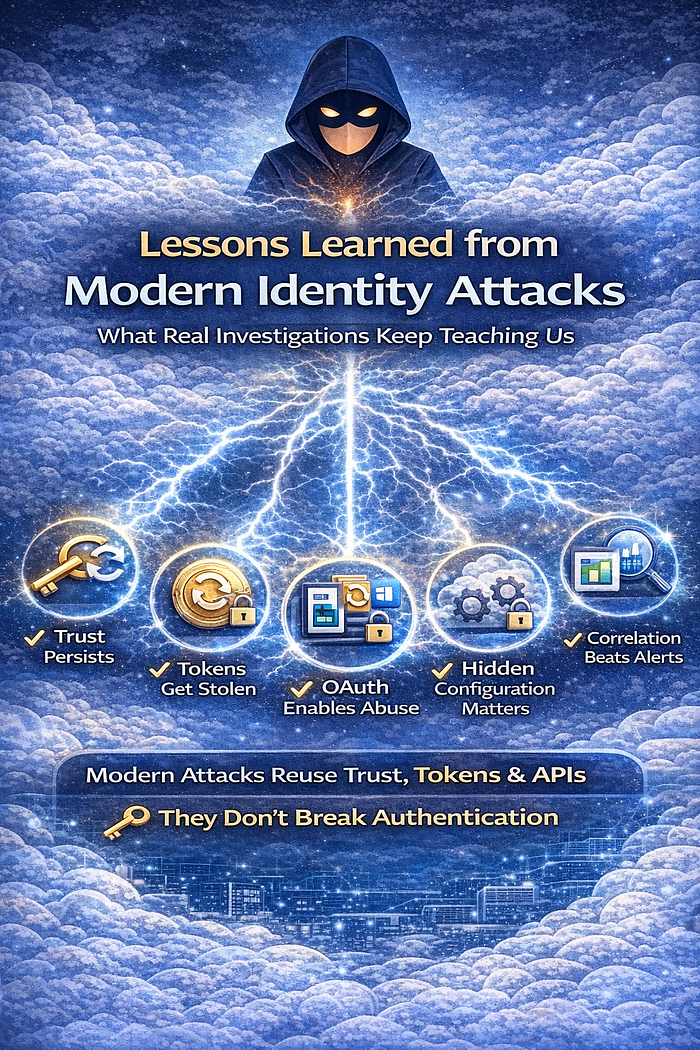
Identity attacks succeed not because defenses fail — but because trust persists.
What Changed: From Malware to Identity
Traditional breaches focused on:
- dropping binaries
- establishing endpoint persistence
- maintaining local access
Modern identity attacks focus on:
- valid authentication
- sessions and tokens
- OAuth permissions
- cloud APIs
In many incidents covered in this series:
- endpoints were clean
- MFA succeeded
- policies were enforced
- alerts never fired
Yet compromise was real.
The attack surface shifted — but detection thinking often didn't.
The Core Patterns That Repeated Everywhere
Across phishing, AiTM, OAuth abuse, session hijacking, and Conditional Access evasion, the same patterns kept appearing.
🔁 Authentication Succeeds — and That's the Problem
MFA success is often treated as the end of risk. In reality, it's often the beginning.
🔑 Tokens Matter More Than Passwords
Passwords are inputs. Tokens are proof.
Attackers target what systems trust after authentication.
🤖 OAuth Turns Apps into Attackers
Once an app is trusted:
- it doesn't need to log in
- it doesn't trigger MFA
- it survives cleanup
Persistence doesn't always look like access.
📬 Configuration Is the New Persistence
Mailbox rules, app permissions, refresh tokens, trusted sessions — these are not backdoors.
They're features used as footholds.
🛂 Policies Enforce Entry, Not Intent
Conditional Access works — but only at the checkpoint. Once trust is granted, it's reused.
Why Defenders Keep Missing Identity Attacks
Most SOC workflows still assume:
- failed logins indicate attacks
- MFA success means safety
- malware equals compromise
Identity attacks break all three assumptions.
Common gaps include:
- focusing on alerts instead of behavior
- cleaning credentials but not trust
- closing incidents too early
- assuming "policy compliant" equals benign
🧠 If your investigation ends at authentication, you're stopping too soon.
What Actually Works (Hard-Earned Lessons)
From real investigations, a few lessons stand out clearly.
🔍 Investigate After Authentication
What happens after login matters more than the login itself.
🔐 Treat Tokens Like Credentials
If tokens are stolen, resets aren't enough.
🧾 Audit Trust, Not Just Access
Permissions, apps, rules, and policies must be reviewed — not assumed safe.
🔁 Assume Persistence Until Proven Otherwise
If access reappears, assume something survived cleanup.
🧠 Correlation Beats Alerts
No single alert catches identity attacks. Patterns do.
How to Think Differently About Identity Security
Stop asking:
- "Did MFA fail?"
- "Was there malware?"
- "Were policies enforced?"
Start asking:
- "What still trusts this identity?"
- "What access survives resets?"
- "What changed quietly?"
Identity security is not event-based. It's continuous trust management.
Why This Series Exists
This series wasn't about fear or hype. It was about reflecting what analysts actually see:
- clean endpoints
- successful logins
- legitimate tools
- quiet persistence
Identity attacks don't look dramatic. They look normal — until the impact appears.
Understanding that gap is the first step to closing it.
Final Takeaway
🔑 Modern attacks don't break authentication. They reuse trust.
Defending against identity attacks means:
- shifting mindset
- expanding investigations
- and accepting that "secure by default" isn't enough
Thank you for reading this series — and for thinking critically about how identity is attacked and defended today.
Identity-Attack Series (Complete)
- Scattered Spider: Identity-First Threat Actors
- Axios-Based Account Compromise
- Adversary-in-the-Middle (AiTM) Attacks
- MFA Fatigue vs MFA Bypass
- OAuth Consent Phishing
- Mailbox Rule Abuse
- Session Hijacking in Cloud Environments
- Token Theft Without Malware
- OAuth Token Abuse vs Session Hijacking
- Conditional Access Evasion Techniques
- Identity Attacks vs Endpoint Attacks
- Lessons Learned from Modern Identity Attacks (this post)