June 2, 2026
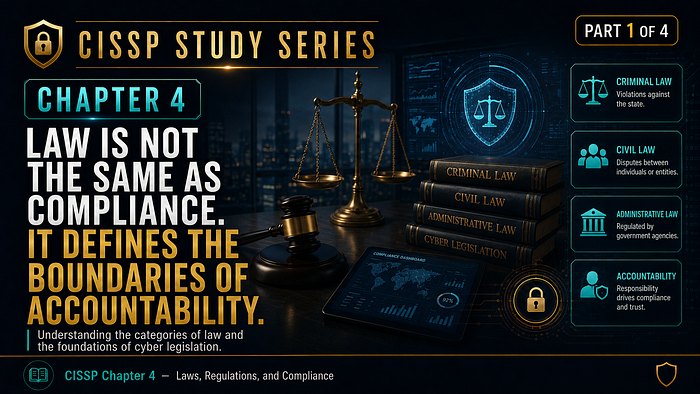
CISSP Chapter 4 — Part 1: Law Is Not the Same as Compliance.
Criminal, civil, and administrative law, the difference between legal obligation and compliance activity, and the judgment required to…

Atakan ATAK
9 min read
- 1 CISSP Chapter 4 — Part 1: Law Is Not the Same as Compliance. It Defines the Boundaries of Accountability.
- 2 Why Chapter 4 begins with categories of law
- 3 Criminal law is about offenses against the social order
- 4 Civil law shapes liability, remedy, and organizational exposure
- 5 Administrative law is where regulation becomes operational
CISSP Chapter 4 — Part 1: Law Is Not the Same as Compliance. It Defines the Boundaries of Accountability.
Criminal, civil, and administrative law, the difference between legal obligation and compliance activity, and the judgment required to understand accountability in security practice.
Security teams often use the words law, regulation, policy, and compliance as if they all point to the same thing. They do not. Law defines enforceable boundaries of conduct and accountability. Compliance is how organizations demonstrate they are operating within or in response to those boundaries. When the two are confused, leaders either underreact to legal exposure or over reduce security to a checklist culture that misses the real question of obligation.
Why Chapter 4 begins with categories of law
Chapter 4 opens with categories of law for a reason. Security professionals do not need to become attorneys, but they do need to recognize that not all legal issues arise in the same way or lead to the same consequences. Criminal law, civil law, and administrative law each operate differently, are enforced differently, and matter differently in security decisions.
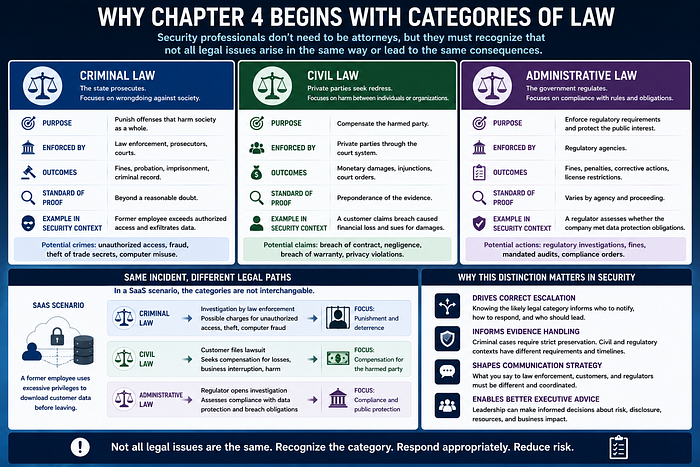
That distinction is practical, not academic. If a security leader cannot tell whether a situation is likely to trigger criminal investigation, civil liability, or regulatory enforcement, then escalation, evidence handling, communication, and executive advice may all be mishandled.
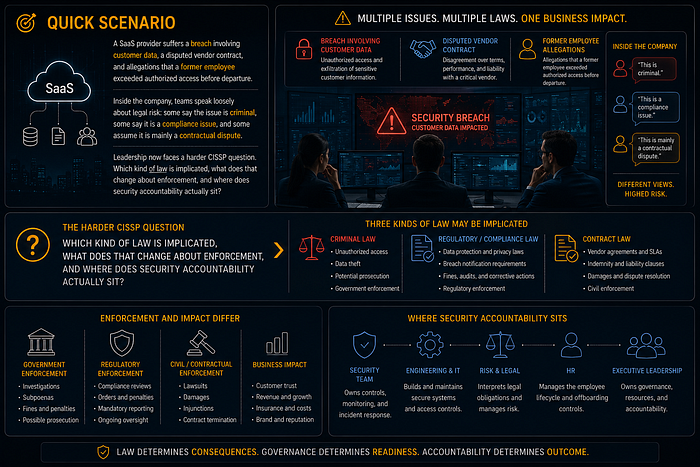
In the SaaS scenario, the categories are not interchangeable. A former employee exceeding authorized access can raise criminal issues. A customer seeking damages may trigger civil action. A regulator assessing whether obligations were met may act through administrative authority. Treating all of that simply as compliance language would be imprecise and risky.
Criminal law is about offenses against the social order
The chapter describes criminal law as the bedrock of laws that preserve peace and safety, enforced by police and prosecutors. The key point for CISSP readers is not the broad legal theory. It is the enforcement model. In criminal matters, the government brings action against the accused, and the stakes may include fines, imprisonment, and seizure of liberty.
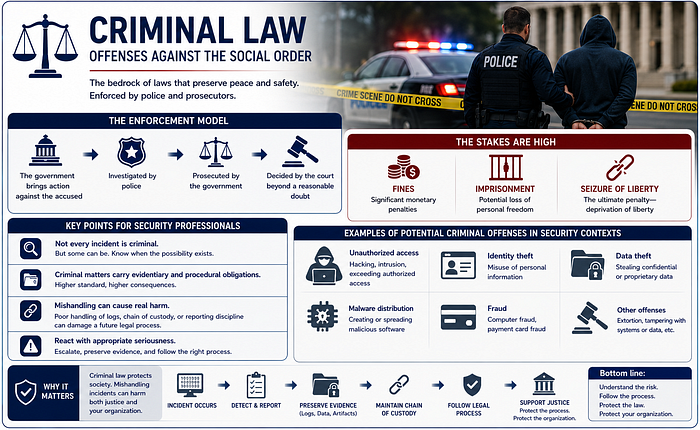
For security professionals, this means some incidents carry evidentiary and procedural consequences that are much more serious than internal policy violations. If the organization mishandles logs, chain of custody, or reporting discipline, it may damage a future legal process.
This does not mean every incident becomes a criminal matter. It means mature practitioners should know when the possibility exists and react with appropriate seriousness.
Civil law shapes liability, remedy, and organizational exposure
The chapter explains that civil law governs matters that are not crimes but still require impartial resolution, such as contracts, employment matters, and disputes among private parties. In civil matters, the person or organization claiming harm generally initiates the case rather than the state.
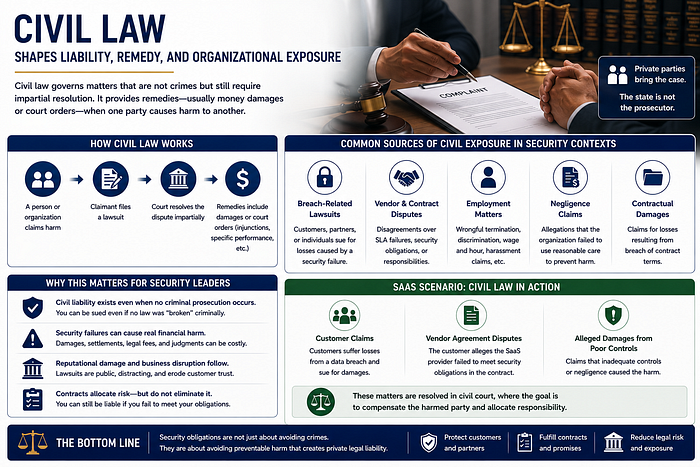
This is crucial for security because many security failures create civil exposure even when no criminal prosecution occurs. Breach-related lawsuits, vendor disputes, negligence claims, employment conflicts, and contractual damages often arise here. For leaders, that means security obligations are not limited to 'staying out of criminal trouble.' They also include avoiding preventable harm that creates private legal liability.
In the SaaS scenario, customer claims, disputed responsibilities under vendor agreements, and alleged damages tied to poor controls may all evolve through civil channels.
Administrative law is where regulation becomes operational
The chapter's treatment of administrative law is one of the most useful parts for modern security governance. Administrative law allows executive branch agencies to issue regulations, procedures, and rules within the authority granted by legislation, as long as those regulations do not contradict existing law.
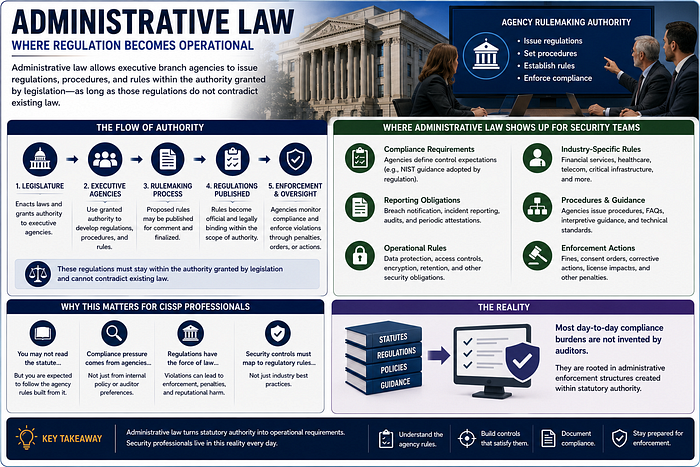
In practical terms, this is where much of day-to-day compliance pressure comes from. Agencies define expectations, procedures, reporting obligations, and operating rules that may not have been spelled out in full detail by the legislature itself. This is why security teams can feel regulated even when they are not reading statutes directly. They are often living inside the operational expression of statutory authority.
For CISSP candidates, this matters because many compliance burdens are not invented by auditors. They are rooted in administrative enforcement structures.
Law defines accountability; compliance demonstrates discipline
One of the most important conceptual distinctions in this chapter is that law and compliance are related but not identical. Law establishes what is prohibited, required, or permitted. Compliance is the organizational practice of conforming to those obligations, standards, and reporting expectations. The law answers, 'What boundaries exist?' Compliance answers, 'How do we show we are operating within them?'
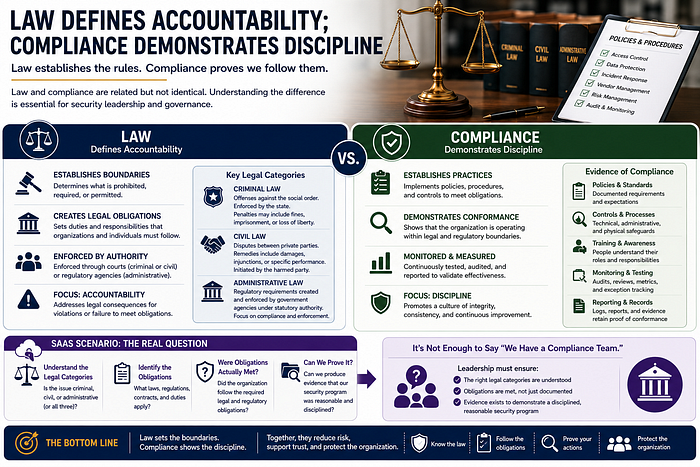
In the SaaS scenario, leadership cannot solve the problem by saying the organization has a compliance team. The question is whether the relevant legal categories are understood, whether obligations were actually met, and whether the company can prove that its security program was reasonable and disciplined.
Precision in legal language is operationally valuable
Security professionals do not gain credibility by pretending to be lawyers, but they lose credibility when they speak carelessly about legal exposure. Precision improves incident response, executive communication, vendor management, and evidence preservation. It also reduces the temptation to make sweeping assumptions such as 'this is only a policy issue' or 'this is definitely criminal' before the facts support that conclusion.
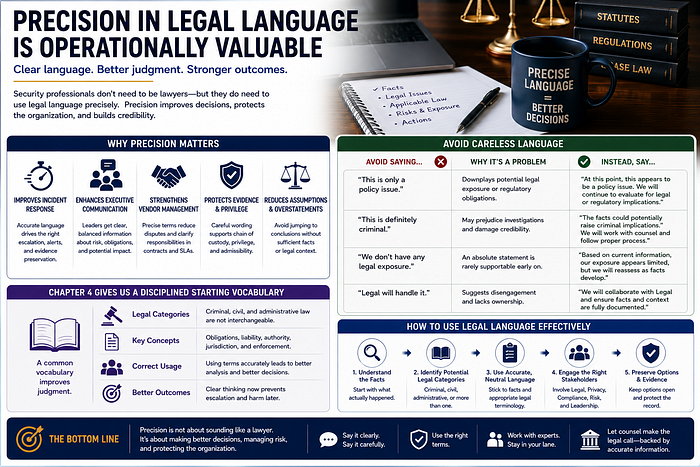
Chapter 4 is useful precisely because it gives practitioners a disciplined starting vocabulary. That vocabulary improves judgment even when legal counsel will rightly make the final legal interpretation.
Legal misunderstanding often becomes a governance weakness
When organizations confuse legal categories, they often mishandle ownership. The security team may assume legal will clarify everything. Legal may assume security already knows the control environment. Executives may assume compliance reporting equals control effectiveness. The result is fragmented accountability.
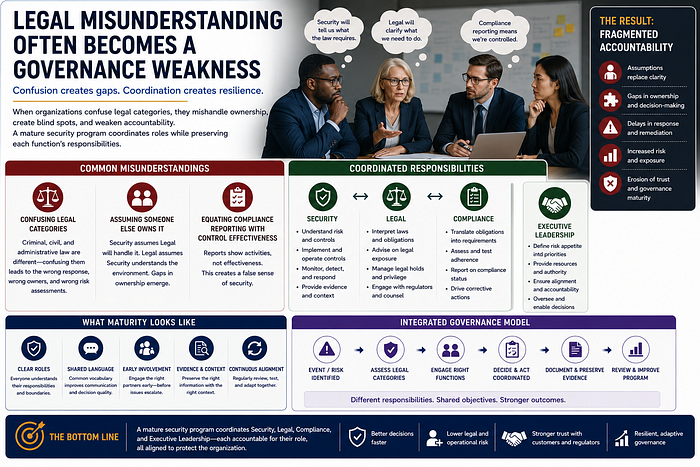
A mature security program does not collapse these domains together. It coordinates them while preserving their different responsibilities.
Practical management trade-offs in the real world
Legal precision can feel slower than operational urgency. During incidents, leaders want fast answers. But oversimplified legal framing often creates downstream cost. Mature teams balance speed with enough precision to avoid avoidable misstatements, weak evidence handling, or misplaced accountability.
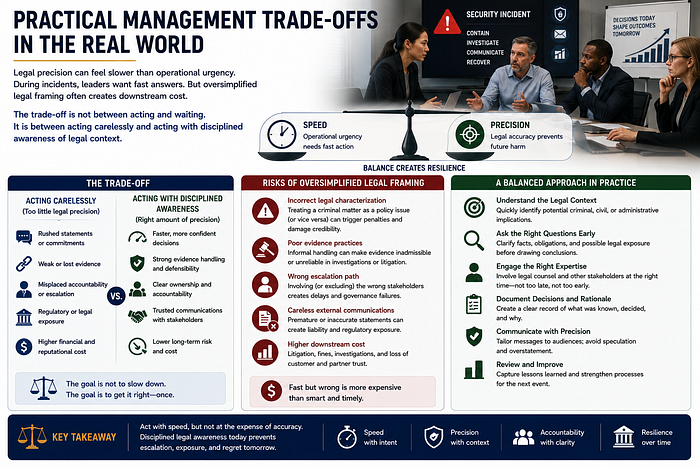
The trade-off is not between acting and waiting. It is between acting carelessly and acting with disciplined awareness of legal context.
Question set 1 — aligned with the scenario
Question 1: A SaaS provider experiences a breach involving customer data, a disputed vendor contract, and allegations that a former employee exceeded authorized access before departure. Several internal teams describe the entire situation as a "compliance issue." Why is that framing dangerous?
A. Because compliance language eliminates the possibility of civil liability B. Because different categories of law shape enforcement, escalation, evidence handling, and liability in different ways C. Because only criminal law matters when customer data is involved D. Because administrative law applies only to government agencies
This question goes to the heart of Part 1: law is not the same as compliance. If the organization collapses criminal, civil, and administrative issues into generic compliance language, it risks mishandling the incident. A former employee exceeding authorized access may raise criminal concerns, customer harm or vendor disputes may lead to civil exposure, and regulators may act through administrative authority. These categories are not interchangeable, and they directly affect how the organization should escalate, preserve evidence, and communicate with leadership. B is correct: It reflects the chapter's main argument precisely: legal categories matter because they change the enforcement model and the accountability model.
Question 2: Which statement best reflects the relationship between law and compliance in the SaaS breach scenario?
A. Compliance replaces the need to understand the legal categories behind the obligation B. Law defines enforceable boundaries, while compliance is the operational discipline used to meet and demonstrate those obligations C. Compliance matters only when the incident has already become criminal D. Law and compliance are effectively the same when a breach involves customer data
Part 1 makes this distinction explicit. Law establishes what is prohibited, required, or permitted. Compliance is how the organization structures its operations, controls, reporting, and evidence to show that it is acting within or in response to those legal boundaries. In the SaaS scenario, simply saying "we have a compliance team" does not answer whether the right legal categories were identified, whether obligations were actually met, or whether the organization can prove discipline under scrutiny. B is correct: This is the exact conceptual separation the chapter is trying to build: law is the source of obligation; compliance is the operational response.
Question 3: Leadership wants a clean internal summary of the breach. Which response best reflects a mature CISSP-style review of the scenario?
A. Treat the entire matter as a single compliance workstream to simplify decision-making B. Separate the former employee access issue, customer harm, and regulatory obligations into their respective legal categories before assigning accountability C. Focus first on public messaging and delay legal categorization until after the technical investigation is complete D. Assume the vendor contract dispute is the primary issue because contracts are usually easier to resolve than access allegations
A mature review does not blur everything into one label. Part 1 recommends mapping issues according to their likely legal dimensions. The former employee access allegation may involve criminal questions. Customer losses or disputed obligations may involve civil exposure. Reporting duties and regulator expectations may arise through administrative structures. Separating these issues improves investigation, communication, escalation, and ownership. It also prevents vague collective language from hiding who must act and why. B is correct: It aligns exactly with the scenario debrief in the chapter: legal precision improves both accountability and operational response.
What this part should make you question
This part should make you question whether your organization distinguishes clearly enough among criminal, civil, and administrative issues when incidents occur. Does your escalation model reflect that difference? Are leaders precise about whether they are facing liability, enforcement, prosecution risk, or all three? Is compliance being treated as evidence of discipline, or as a substitute for understanding obligation?
Scenario debrief: what mature review would change
A mature review of the SaaS scenario would map the issues separately. The former employee access concern would be evaluated for possible criminal dimensions. Customer harm and contract disputes would be reviewed through civil exposure. Regulatory or reporting obligations would be assessed in the administrative and compliance frame. That separation would improve both investigation and communication.
It would also force the organization to identify who owns which decision, instead of letting legal language become vague and collective.
CISSP mindset check
The CISSP mindset here is to recognize that legal categories are part of security context. A mature practitioner does not treat all legal exposure as generic compliance work. The strongest answer is usually the one that clarifies the type of obligation and the accountability model before proposing action.
Questions to carry forward
When an incident happens in your environment, do teams know which issues might trigger criminal interest, civil liability, or regulatory scrutiny? Who decides when evidence handling must rise to a higher standard? And does your compliance language clarify risk, or hide it?
Why reassessment matters
Legal exposure shifts as business models change. New services, new jurisdictions, new data types, new vendors, and new customer commitments can alter which legal categories matter most. Reassessment keeps governance aligned with the actual obligations surrounding the business, not merely the obligations it had last year.
A final operational reminder
Operationally, use compliance reporting to support accountability, not to replace it. Learn the categories. Escalate carefully. Preserve evidence with discipline. And make sure leaders understand that legal context is part of security context, not something that begins after the incident is already over.
Final perspective
If I had to summarize this first part in one sentence, it would be this: law defines the boundaries within which security decisions are judged, while compliance is how organizations prove they are operating responsibly inside those boundaries. That is why Chapter 4 begins with legal categories rather than controls.
Closing thought
In Part 2, I will move from legal categories to the statutes and frameworks security professionals encounter most often: CFAA, FISMA, Federal Sentencing Guidelines, and the NIST standards that turn legal obligation into structured control expectations.
Official references
9-48.000 - Computer Fraud and Abuse Act The Computer Fraud and Abuse Act ("CFAA"), codified at Title 18, United States Code, Section 1030, is an important law…
CSRC Topic: Federal Information Security Modernization Act | CSRC Use these CSRC Topics to identify and learn more about NIST's cybersecurity Projects, Publications, News, Events and…
NIST Special Publication (SP) 800-171 Rev. 3, Protecting Controlled Unclassified Information in… The protection of Controlled Unclassified Information (CUI) is of paramount importance to federal agencies and can…
Cybersecurity Framework Helping organizations to better understand and improve their management of cybersecurity risk
NIST Special Publication (SP) 800-53 Rev. 5 (Withdrawn), Security and Privacy Controls for… This publication provides a catalog of security and privacy controls for information systems and organizations to…