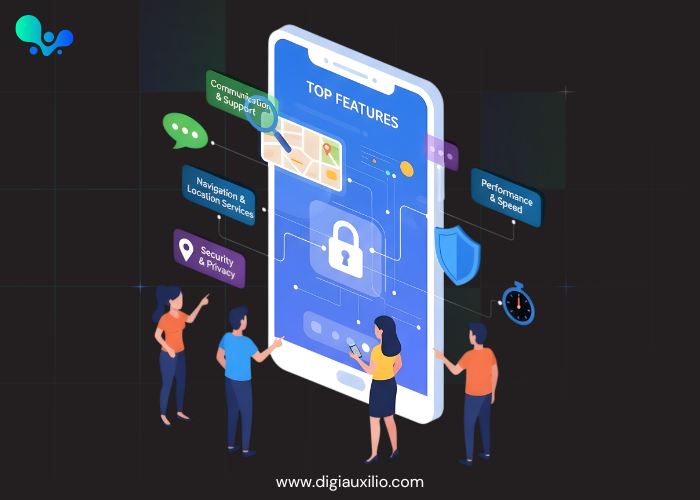

The mobile app market is growing fast. Millions of apps are available today, but only a small number of them truly succeed. What makes one app stand out while another gets deleted after the first use? The answer usually comes down to a few key features that separate good apps from great ones.
Whether you're planning to build your first mobile app or improve an existing one, knowing what users expect is the first step. At DigiAuxilio, we help businesses design and build mobile apps that people actually want to use. And from our experience, the most successful apps all share the same core features.
Let's break them down.
1. Simple and Clean User Interface (UI)
The first thing a user notices when they open a mobile app is how it looks and feels. If the design is cluttered, confusing, or hard to navigate, most users will close the app and never come back. Studies show that users form an opinion about an app within the first few seconds of using it.
A clean, simple interface makes it easy for users to find what they need without thinking too hard. Every button, menu, and screen should have a clear purpose. Good UI design isn't about making things look fancy — it's about making things work smoothly.
When building a mobile app, always design for the user first. Keep the layout simple, use readable fonts, and make sure the most important actions are easy to find and tap.
2. Fast Loading Speed
Nobody likes waiting. If your mobile app takes more than a few seconds to load, users will get frustrated and leave. In fact, research shows that most users will abandon an app if it doesn't load within three seconds.
Fast loading speed isn't just about user experience — it also affects your app's ratings and reviews. A slow app gets bad reviews. Bad reviews mean fewer downloads. Fewer downloads mean less growth.
Optimizing your app's speed should be a priority from day one. Compress images, reduce unnecessary code, and test your app's performance on different devices and network speeds before launch.
3. Strong Security and Data Privacy
Users share a lot of personal information through mobile apps — their name, email, location, payment details, and more. If your app doesn't protect that data, you lose their trust instantly. And once trust is gone, it's almost impossible to get back.
A successful mobile app must have strong security features built in. This includes data encryption, secure login options, and clear privacy policies that tell users exactly how their data is used. Apps that handle payments must meet industry security standards to protect financial information.
Data privacy isn't just good practice — in many regions, it's also the law. Building security into your app from the start is far easier and cheaper than fixing a breach after it happens.
4. Personalization
People want to feel like an app was built just for them. Personalization is one of the most powerful features a mobile app can offer. When an app remembers your preferences, suggests content you actually like, or greets you by name, it creates a stronger connection between the user and the app.
Personalization can be as simple as letting users choose their own settings, themes, or notification preferences. Or it can be more advanced — like using behavior data to recommend products, content, or features based on what the user has done before.
Apps that personalize the experience see higher engagement, longer sessions, and better retention rates. Users keep coming back because the app feels relevant to them.
5. Push Notifications (Used the Right Way)
Push notifications are one of the most effective tools for keeping users engaged with your mobile app. A well-timed notification can bring a user back to the app, remind them about an abandoned cart, alert them to a new feature, or share a limited-time offer.
But there's a thin line between helpful and annoying. Too many notifications — especially irrelevant ones — will make users turn off notifications or delete the app entirely. The key is to send the right message at the right time.
Successful apps use smart, targeted push notifications. They send fewer messages but make each one count. Personalized notifications based on user behavior perform far better than generic broadcasts.
6. Seamless Onboarding Experience
Your app might have amazing features, but if new users don't understand how to use it in the first few minutes, they'll give up. A smooth onboarding process is what bridges the gap between downloading an app and actually using it regularly.
Good onboarding walks users through the app's key features quickly and clearly. It doesn't overwhelm them with too much information at once. It lets them see value fast — ideally within the first minute of use.
The best mobile app onboarding experiences are short, visual, and interactive. They guide the user step by step without making the process feel like a chore. A strong onboarding flow reduces drop-off rates and sets users up for long-term engagement.
7. Regular Updates and Bug Fixes
A successful mobile app is never truly finished. The best apps in the market get updated regularly — adding new features, improving performance, and fixing bugs. Regular updates show users that the team behind the app is active and cares about their experience.
Apps that haven't been updated in months feel abandoned. Users notice. When an app crashes or behaves unexpectedly and there's no fix in sight, users move on to a competitor.
Set up a clear update schedule for your mobile app. Listen to user feedback and act on it. Monitor crash reports and fix issues quickly. Every update is an opportunity to make your app better and remind users why they downloaded it in the first place.
Offline Functionality
While not always possible for every type of app, offline functionality is a feature that users love. When your app works even without an internet connection — even in a limited way — it becomes far more reliable and useful. Users in areas with weak signals or limited data plans will especially appreciate this. If your app can store data locally and sync when a connection is available, you've added serious value.
Conclusion
These seven features aren't just nice to have — they're what separates apps that succeed from apps that get forgotten. A clean design, fast performance, strong security, smart personalization, useful notifications, smooth onboarding, and regular updates work together to create an app experience that keeps users coming back.
Building a mobile app with all these features requires the right team, the right strategy, and the right technology partner.
That's where DigiAuxilio comes in. We help startups and businesses build powerful, user-friendly mobile apps designed to grow with your goals. From initial concept to launch and beyond, our team is with you every step of the way.
Ready to build a mobile app that stands out? Visit DigiAuxilio today and let's bring your app idea to life.