
Sometimes… it's about changing one ID.
In this write-up, I'll explain — step by step — how I discovered a critical Broken Access Control vulnerability that allowed a normal user to take over the Owner account of an entire organization.
And I'll explain it so simply that even someone new to security can understand it.
The Setup: Understanding the Roles
The application had two main roles:
- Owner → The highest privilege. Full control.
- Full Access User (Non-owner) → High privilege, but not the Owner.
In the UI, everything looked secure.
When you go to the Admin Accounts page:
- You cannot edit other users.
- Even the Owner cannot edit others.
- The only visible option is "Show Sessions".
So at first glance, it looks safe.
No "Edit User" button. No "Change Password" option. Nothing dangerous.
But here's the important lesson:
If the UI blocks it, that does NOT mean the backend blocks it.
The UI is just the front door. The backend is the real security guard.
Step 1: Clicking "Show Sessions"
As a Full Access user, I clicked:
"Show Sessions" for the Owner account.
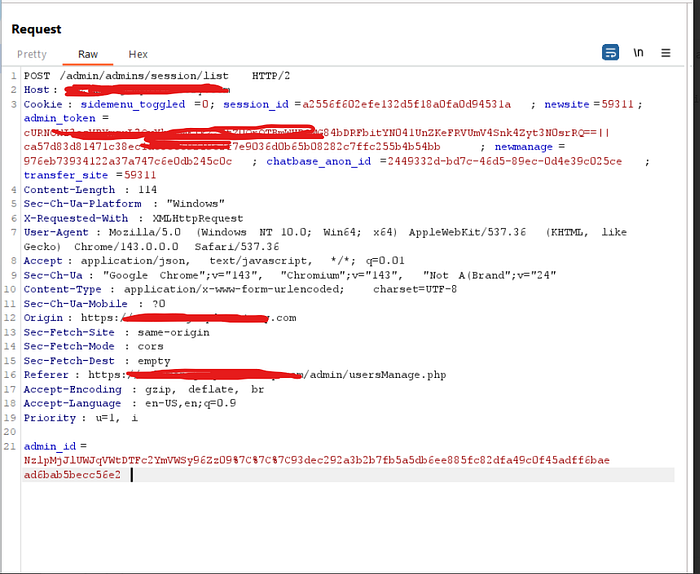
I intercepted the request using Burp Suite.
And there it was.
A parameter called:
admin_idThis was the unique identifier of the Owner account.
That means:
I now had the internal ID of the Owner.
This ID is not supposed to be dangerous by itself.
But what if the backend trusts it too much?
Step 2: Editing My Own Profile
Next, I edited my own profile.
This action sent a request to:
POST /admin/usersManage.phpThe request looked like this:
POST /admin/usersManage.phpInside the body, I saw:
admin_id=MY_IDNow think like a hacker.
The backend is saying:
"Who do you want to edit? Tell me their admin_id."
And I already know the Owner's admin_id.
So what happens if I replace:
admin_id=MY_IDwith:
admin_id=OWNER_IDAnd then add:
admin_password_new=HACKER_PASSWORDLet's try.
Step 3: Changing One Line
Here's the modified request:
POST /admin/usersManage.php HTTP/2
Host: target.com
Cookie: <full-access-user-session>
faction=edituser&
admin_id=OWNER_ADMIN_ID&
save=1&
admin_password_new=HACKER_PASSWORD&
admin_name=farestestd&
admin_email=33333%40belgianairways.com&
admin_phone=&
admin_signature=%3Cp%3Efares%3C%2Fp%3E
I sent it.
And the server said:✅ Success.

No error. No permission check. No "you are not allowed".
The Owner's password was changed.
Step 4: Logging in as the Owner
I logged out.
Then I logged in as: owner email with the new password I set. And I was inside.
Full Owner access.
Full organization control.
No phishing. No brute force. No malware.
Just changing one ID.
Insecure Direct Object Reference (IDOR)
The backend trusted a parameter sent by the user (admin_id)
without checking:
- Who is making the request?
- Are they allowed to modify this target?
- Is the role hierarchy respected?
The system assumed:
"If you know the ID, you must be allowed."
That assumption destroyed the entire security model.
Contact Me: https://www.linkedin.com/in/mohamed-fares-208008229/