June 6, 2026
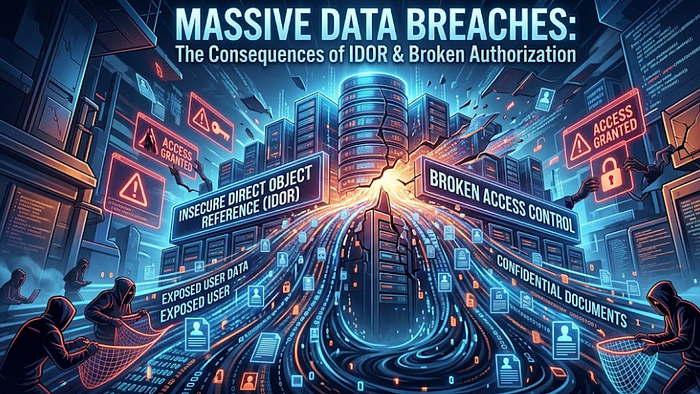
How IDOR & Broken Authorization Lead to Massive Data Breaches
Data breaches rarely happen because hackers possess extraordinary skills. More often, they occur because applications unintentionally…

Novashield
3 min read
Data breaches rarely happen because hackers possess extraordinary skills. More often, they occur because applications unintentionally expose sensitive data to users who should never have access to it.
Among the most dangerous yet frequently overlooked vulnerabilities are IDOR (Insecure Direct Object References) and Broken Authorization. These flaws have been responsible for exposing millions of user records across web applications, APIs, SaaS platforms, and mobile apps.
The alarming part? Attackers often don't need malware, sophisticated exploits, or advanced tools. Sometimes, changing a single number in a URL is enough.
What is IDOR?
An Insecure Direct Object Reference (IDOR) occurs when an application exposes internal object identifiers — such as user IDs, invoice numbers, document IDs, or account references — without verifying whether the requester is authorized to access them.
Example
Imagine an online banking portal:
https://bank.com/account/12345
A user accesses their account details using account ID 12345.
If the application fails to verify ownership, an attacker could simply modify the URL:
https://bank.com/account/12346
If account information for another customer is displayed, the application contains an IDOR vulnerability.
The attacker didn't "hack" the system. They merely requested data that should have been protected.
Understanding Broken Authorization
While IDOR is a specific vulnerability, Broken Authorization is a broader security weakness where applications fail to properly enforce access control rules.
Authorization answers the question:
"Is this user allowed to perform this action?"
When that validation is missing, users can access resources, data, or functionality beyond their intended permissions.
Common Examples
- Regular users accessing administrator panels
- Employees viewing HR or payroll records
- Customers downloading invoices belonging to other customers
- Users modifying accounts they do not own
- APIs returning data from other organizations in multi-tenant environments
Broken authorization remains one of the most critical risks in modern applications because it directly exposes sensitive business data.
How Attackers Exploit These Vulnerabilities
The attack process is often surprisingly simple.
Step 1: Identify a Resource
An attacker notices a URL, API endpoint, or request containing an identifier:
GET /api/orders/501
Step 2: Modify the Identifier
The attacker changes the value:
GET /api/orders/502 GET /api/orders/503 GET /api/orders/504
Step 3: Harvest Sensitive Data
If authorization checks are missing, the attacker can systematically collect:
- Customer records
- Financial information
- Internal documents
- Personal identifiable information (PII)
- Healthcare records
- Business intelligence data
What starts as a minor oversight can quickly become a large-scale data breach.
Real-World Impact of Broken Authorization
Organizations affected by authorization flaws often face consequences far beyond technical remediation.
Financial Losses
Data breaches can result in:
- Regulatory fines
- Legal expenses
- Incident response costs
- Customer compensation
Reputational Damage
Trust is difficult to earn and easy to lose. Customers expect organizations to protect their data, and a breach can permanently impact brand reputation.
Compliance Violations
Authorization failures can violate regulations such as:
- GDPR
- HIPAA
- PCI DSS
- SOC 2
For regulated industries, the consequences can be severe.
APIs: The New Battleground
Modern applications rely heavily on APIs, making authorization vulnerabilities even more dangerous.
Consider this API request:
GET /api/v1/customer/789
If the backend only checks whether the user is logged in — but not whether they own customer record 789 — the API becomes vulnerable.
This is why API authorization failures consistently rank among the most critical security risks identified by industry security standards.
Common API Authorization Mistakes
- Checking authentication but not authorization
- Trusting client-supplied user IDs
- Missing tenant isolation checks
- Exposing predictable object identifiers
- Inconsistent permission validation across endpoints
Why Developers Often Miss These Vulnerabilities
Unlike SQL injection or XSS, authorization flaws are not always visible during development.
The application may appear to function correctly while silently exposing sensitive data.
Common reasons include:
- Tight development timelines
- Incomplete threat modeling
- Assumptions that frontend restrictions are sufficient
- Lack of security testing for access controls
- Rapid API development without authorization reviews
Unfortunately, attackers actively search for these weaknesses because they often yield high-value results with minimal effort.
How to Prevent IDOR & Broken Authorization
Effective prevention requires security to be enforced on the server side.
Enforce Authorization on Every Request
Never assume a user can access a resource simply because they are authenticated.
Every request should validate:
- User identity
- Resource ownership
- Role permissions
- Tenant boundaries
Implement Role-Based Access Control (RBAC)
Clearly define what each user role can access.
Examples:
- Customer
- Employee
- Manager
- Administrator
Access decisions should be enforced centrally.
Use Indirect References
Instead of exposing sequential IDs:
/users/1001
Use unpredictable identifiers:
/users/a8f92d7e-4d81–4d9b-bef1
While not a complete solution, this makes resource enumeration significantly harder.
Conduct Authorization Testing
Security testing should include:
- Horizontal privilege escalation checks
- Vertical privilege escalation checks
- Multi-tenant isolation testing
- API access validation
Authorization testing should become part of every release cycle.
Follow the Principle of Least Privilege
Users should receive only the permissions necessary to perform their tasks — nothing more.
This minimizes damage if an account becomes compromised.
The Bottom Line
IDOR and Broken Authorization vulnerabilities are responsible for some of the most damaging data breaches because they expose the very asset attackers seek most: sensitive data.
The danger lies in their simplicity. An attacker may not need advanced malware, sophisticated exploits, or privileged access. A modified request or a changed identifier can sometimes reveal entire databases of customer information.
Organizations that prioritize robust authorization controls, continuous security testing, and secure API development significantly reduce their exposure to these risks.
In cybersecurity, authentication proves who a user is.
Authorization determines what they are allowed to access.
Getting that distinction wrong can turn a small coding mistake into a headline-making breach