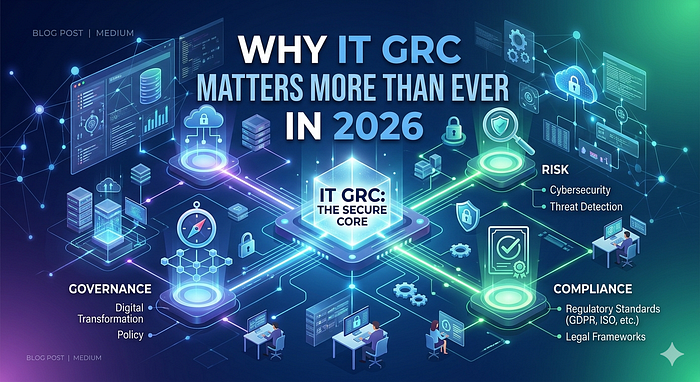
IT GRC matters more than ever in 2026 because organisations are operating in a world where AI, cloud, third parties, and regulation are all moving faster than traditional control cycles. In this environment, governance is no longer just about passing audits; it is about proving resilience, accountability, and trust at the speed the business now runs.
What IT GRC means
IT GRC stands for Governance, Risk, and Compliance. In practical terms, it is the framework that defines how technology decisions are made, how risks are identified and treated, and how the organisation demonstrates alignment with policies, standards, regulations, and contracts.
A mature IT GRC function connects policy, operations, and evidence. It ensures that controls are not just documented but actually implemented, monitored, and improved over time. That distinction is becoming critical in 2026 because boards and regulators want outcomes, not intent.
Why 2026 is different
The need for strong IT GRC has become more urgent because the technology environment is changing faster than traditional controls can keep up. AI adoption, cloud expansion, remote and hybrid work, regulatory pressure, and growing third-party dependency are all increasing the complexity of governance. At the same time, boards and regulators now expect proof, not just promises, that controls are operating effectively.
Another major shift is that compliance is becoming more continuous. Annual reviews and point-in-time audits are no longer enough when risks can change weekly through new vendors, new applications, AI tools, and new attack patterns. Organisations now need governance models that can adapt quickly while still providing evidence and accountability.
The Business Value
IT GRC is often misunderstood as paperwork, but in reality it protects revenue, reputation, and operational continuity. A mature GRC programme helps reduce incidents, avoid regulatory penalties, and build customer confidence. It also improves decision-making by showing leaders which risks are acceptable, which need treatment, and where the business is overexposed.
For example, if an organisation launches a new cloud-based customer platform without proper control mapping, it may create gaps in identity access, logging, data retention, and incident response. A strong IT GRC function would catch those issues early, assign ownership, and ensure controls are designed before the platform goes live.
Key Pressures in 2026
Several current pressures make IT GRC especially important this year:
- AI governance and shadow AI are creating new risks around data leakage, bias, model misuse, and lack of accountability.
- Cloud security complexity is increasing because organisations are using multiple platforms, services, and shared responsibility models.
- Regulatory expectations are expanding across privacy, cybersecurity, resilience, and operational risk.
- Third-party and supply chain risk are rising as businesses rely on external providers for critical services.
- Audit fatigue is growing because organisations are being asked to evidence controls more frequently and across more frameworks.
These pressures mean organisations can no longer treat governance as an annual exercise. They need a living control environment that is updated as the business changes.
A Practical Framework
A strong IT GRC programme in 2026 should be built around six practical pillars:
- Know your assets and processes. You cannot govern what you do not know. Maintain an accurate inventory of systems, data, users, vendors, and critical business processes.
- Define ownership clearly. Every key control, risk, and compliance requirement should have a named owner.
- Map obligations to controls. Link regulations, standards, and contracts to specific controls so evidence can be reused.
- Measure control effectiveness. Focus on whether controls actually work, not just whether they exist on paper.
- Automate where possible. Use tooling for evidence collection, control monitoring, vulnerability tracking, and reporting.
- Review continuously. Reassess risk when the business changes, not only during audits.
This approach makes GRC more operational and less administrative. It also helps security, legal, IT, and business teams work from a common risk language.
Common Mistakes to Avoid
Many organisations still struggle because they treat GRC as a documentation project instead of a management discipline. One common mistake is creating policies that are never translated into operational controls. Another is relying on annual audits to discover issues that should have been monitored all year.
Other mistakes include:
- Failing to align governance with business strategy.
- Keeping risk registers static and outdated.
- Using multiple frameworks without a clear mapping strategy.
- Ignoring third-party risk until a contract renewal or incident.
- Not involving senior leadership in risk acceptance decisions.
If any of these sound familiar, the organisation likely has compliance activity but not true GRC maturity.
What strong IT GRC looks like
A mature IT GRC function in 2026 is visible, measurable, and integrated into the business. It supports decisions on cloud adoption, AI usage, vendor selection, incident response, business continuity, and regulatory readiness. It also gives leadership confidence that technology growth is happening within acceptable risk boundaries.
In strong programmes, dashboards are used to show control status, open risks, overdue remediation, and audit readiness. Policies are living documents. Risk reviews are tied to change events. And security teams can show evidence quickly because governance has been built into daily operations.
Final View
IT GRC matters more than ever in 2026 because the pace of change has outgrown traditional compliance approaches. Organisations that invest in governance, risk management, and compliance as an integrated capability will be better equipped to handle AI, cloud, regulation, and cyber threats without losing control.
For professionals in the field, this is also an important career moment. Those who can translate risk into business language, build practical governance models, and connect security controls to real outcomes will be highly valuable in the years ahead.