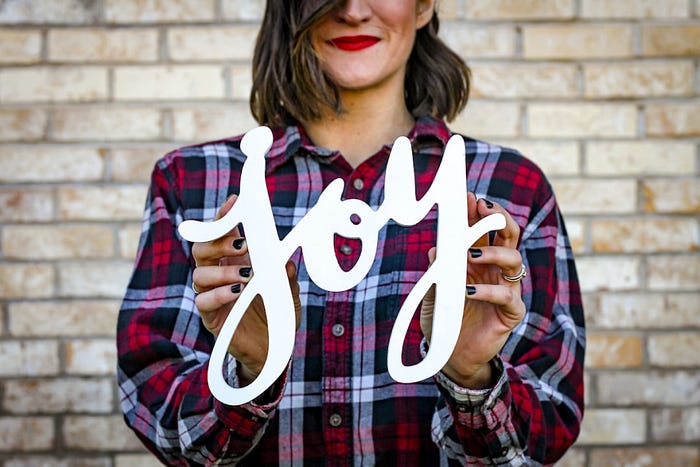


"What if the secret to joy is not in pushing away sadness, but in letting it gently sit beside us?" — Susan Cain, Bittersweet
There's something quietly disarming about that question.
It doesn't ask us to fix anything. It doesn't ask us to reframe our pain or rush toward optimism.
It simply invites us to soften. To loosen the sharp boundaries we've drawn between what we call joy and what we call sorrow.
Because if we're honest, many of us don't struggle with finding joy.
We struggle with allowing it.
Joy appears — unexpected, unguarded — and instead of welcoming it, something inside us tightens. As if joy were fragile. As if holding it too closely might cost us something later.
Don't get carried away. Don't let this go too far. This won't last.
Joy arrives, and fear follows almost immediately.
If that sounds familiar, it doesn't mean you're pessimistic or emotionally closed off. It means your body remembers. And memory lives deeper than logic.
The Fragility We Assign to Good Moments
We often talk about joy as if it's light and effortless. A reward. A peak.
But for many people, joy feels strangely delicate — like a glass you hesitate to set down because you don't quite trust the surface beneath it.
You might notice it when a happy moment unexpectedly brings tears. Or when calm feels uncomfortable instead of soothing. Or when excitement quietly turns into anxiety.
Joy doesn't just bring pleasure. It brings openness.
And openness means exposure.
If you've spent years bracing — anticipating loss, disappointment, or responsibility — that sudden softening can feel unfamiliar. Even unsafe.
The body asks, almost reflexively: Is it really okay to relax right now?
Sometimes the answer comes out as tears.
What Joy Actually Feels Like
Joy isn't always laughter or celebration.
More often, it's subtle.
It's the shoulders dropping without effort. The breath slowing on its own. The moment when nothing needs fixing.
At its core, joy carries a simple message:
Right now, you are safe enough to be here.
For some nervous systems, that message feels deeply comforting. For others, it feels suspicious.
Because safety hasn't always meant ease.
Sometimes safety meant vigilance. Staying alert. Never letting your guard down for too long.
So when joy invites you to loosen your grip, the body hesitates — not out of resistance, but out of habit.
Why Tears Appear in Happy Moments

We're taught that tears belong to sadness. But the body doesn't sort emotion so neatly.
Tears often arrive when something long-held finally releases.
Joy can unlock tension you didn't realize you were carrying. It can touch grief that never had room to surface. It can remind you how long it's been since you felt this open.
You're not crying because joy hurts.
You're crying because joy makes room.
As Rumi wrote, "The wound is the place where the Light enters you."
Sometimes joy is the light. Sometimes tears are how it enters.
Joy and Emotional Flooding Aren't the Same
This distinction matters.
Joy is expansive — but you remain present. You can breathe. You know where you are. You still feel like yourself.
Emotional flooding feels different.
It's too much, too fast. Thoughts scatter. The body goes into alarm.
The difference isn't intensity.
It's regulation.
Joy says, This is a lot — and I'm still here. Flooding says, This is a lot — and I'm disappearing.
When joy starts to feel overwhelming, it doesn't mean joy is dangerous. It means your system needs pacing, not pressure.
The Fear Beneath the Fear
Often, what we're really afraid of isn't joy itself.
It's losing it.
Because loss hurts more when you've let yourself care.
So we half-feel moments. We downplay what's good. We keep one foot out the door, just in case.
It feels protective.
But here's the quiet truth many of us come to learn:
Avoiding joy doesn't spare us grief. It simply narrows the life we're living.
Grief is the price of love. Joy is the proof that love happened at all.
Letting Joy Be Enough for Now
Joy doesn't ask for permanence. It doesn't ask for guarantees.
It asks for presence.
You don't have to take all of it in. You don't have to make it last. You don't have to justify it.
Sometimes staying open sounds like this:
This feels good. I can stay with it for a breath or two.
That is enough.
Joy doesn't need endurance. It needs permission.
An Invitation to Stay
You don't need to convince yourself that nothing bad will happen. Life rarely cooperates with that story.
Instead, you can try something gentler:
I'm allowed to enjoy this, even if it ends.
Joy isn't a promise. It's a visit.
And visits matter — not because they last, but because they happen.
The next time joy arrives quietly — through a conversation, a memory, or a stretch of calm — see if you can let it stay just a little longer than usual.
Not forever. Not perfectly.
Just long enough to say:
I'm here. You're welcome.
That's how joy learns it's safe to return. And that's how we remember that feeling good doesn't mean something bad is coming — it simply means we're alive enough to notice.
Maybe joy doesn't need to last — maybe it just needs to be let in.
If this post resonated with you — if it made you pause, soften, or see your own relationship with joy a little more clearly — I'd love for you to engage with it. You're welcome to clap, highlight a line that stayed with you, or leave a comment sharing your experience. Your attention genuinely means a lot and helps thoughtful writing find its way to others. And if you choose to follow me, I'll return the favor by reading and engaging with your work — so this becomes an ongoing, meaningful exchange rather than a one-way conversation.
References & Further Reading
Cain, S. (2022). Bittersweet: How Sorrow and Longing Make Us Whole. Crown Publishing Group.
Fredrickson, B. L. (2001). The role of positive emotions in positive psychology: The broaden-and-build theory of positive emotions. American Psychologist, 56(3), 218–226.
Porges, S. W. (2011). The Polyvagal Theory: Neurophysiological Foundations of Emotions, Attachment, Communication, and Self-Regulation. W. W. Norton & Company.
Solomon, A. (2012). Far from the Tree: Parents, Children, and the Search for Identity. Scribner.