
After publishing my first bug bounty blog about brute-forcing a 4-digit OTP, I started revisiting some of my old findings. While scrolling through my notes, screenshots, and random recon experiments, I remembered something I had discovered long back during a Bug Bounty program.
At that time, I didn't fully realize how serious it was. It felt like just another interesting recon result.
But when I looked at it again recently, I understood something scary:
This wasn't just a bug.
This was a critical PII and credential disclosure.
Sometimes, you don't hack systems. Sometimes, you just read what the internet already knows 😅
🔍 It Started With Simple Recon
Long back, while testing a target under a Bug Bounty program, I was doing what every bug bounty hunter loves: recon.
Instead of attacking the live application directly, I decided to explore the target's historical footprint on the internet. Out of curiosity, I started looking at archived URLs related to the domain.
I wasn't expecting much.
But then I saw something that made me stop scrolling.
Some archived URLs appeared to expose user-related information. At first glance, it looked like normal data.
But the deeper I looked… the worse it got.
Hacking time hahahah………
👉Steps to produce: Execute the following search query in Browser: 1) https://web.archive.org/cdx/search/cdx?url=https://www.example.com//*&output=text&fl=original&collapse=urlkey
3)Note that both queries are different and both were exposing users email id and passwords.
4) After executing above queries find the email extentions, for ex: type (@gmail.com, @outlook.com).
😅 The "This Shouldn't Be Public" Moment
As I explored further, I noticed that multiple archived endpoints were revealing sensitive data patterns. These pages were never meant to be public, yet they had been indexed and preserved by archiving services.
It reminded me of my OTP blog.
In that case, the system trusted a 4-digit OTP too much. Here, the system trusted the internet too much.
The vulnerability wasn't in the live application anymore. It was in its past.
And the internet never forgets.
😶🌫️ Then I Found Something Worse: Credentials
While digging deeper into the archived data, I stumbled upon something that changed everything.
Some of the archived pages appeared to contain actual credentials.
At first, I thought: "Okay, maybe it's test data."
But after careful verification, it became clear that the data was real.
That's when it hit me.
This wasn't just information disclosure anymore. This was a potential account takeover scenario.
If a malicious attacker had found this before me, they could have accessed real user accounts without even touching the live application.
And honestly… that thought was terrifying 😬
booomm 💣
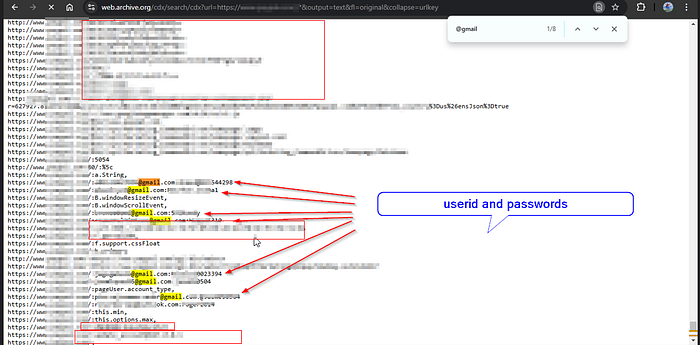
Note: All sensitive information has been responsibly handled and masked in this write-up.
🧩 Patterns That Shouldn't Exist
While analyzing the exposed data, I started noticing patterns in email domains and user identifiers. This confirmed that the issue was not limited to a single record.
If someone with malicious intent had discovered this, they could have:
- collected real user credentials
- accessed user accounts
- reused credentials on other platforms
- launch targeted phishing attacks
- build advanced attack chains
And the scary part?
All of this was possible without exploiting the live system.
No brute force. No login bypass. No fancy hacking.
Just archived data.
💣 Why This Was Critical
Information disclosure bugs are often underrated.
They don't look as cool as RCE or SQL injection. But in real-world attacks, they often act as the first domino.
In my previous blog, I broke authentication using OTP. This time, I didn't break authentication.
I found it already broken.
That's why this issue had high to critical impact in the context of the Bug Bounty program.
🛡️ Mitigation & Lessons Learned
To prevent such vulnerabilities, organizations should:
- regularly audit archived and indexed URLs
- avoid exposing sensitive information in URLs or responses
- restrict access to sensitive endpoints
- monitor third-party archiving platforms
- treat historical data as part of the attack surface
Because security is not just about what is live today. It's also about what the internet remembers forever.
🎯 Final Thoughts
Finding this bug long back taught me an important lesson:
Sometimes, vulnerabilities don't exist in the present system. Sometimes, they exist in its history 😅
After my OTP brute-force blog, this discovery reminded me that not all bugs scream for attention. Some of them quietly sit in archives… waiting for someone curious enough to notice them.
POCs and steps are added for clarity 🐞 And this is another step in my bug bounty journey.
Happy Hacking…………….