Hello, I'm Kanishka Khandelwal — an Associate Security Engineer and security researcher focused on web & API security testing, vulnerability research, and bug bounty hunting.
In this OWASP Top 10 series, I'll be breaking down:
- Real-world vulnerabilities
- Exploitation techniques
- Practical security concepts
- Modern application security
Connect with me on LinkedIn: Kanishka Khandelwal LinkedIn
And Don't forget to clap 👏…Let's start…
Introduction
Imagine entering a highly secure airport.
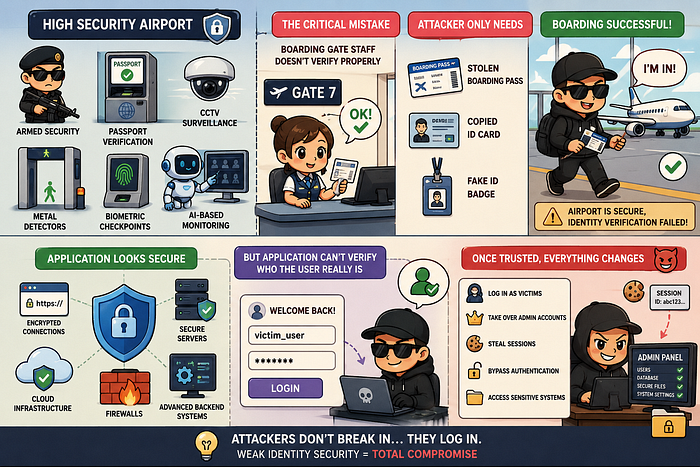
The airport has:
- Armed security officers
- Passport verification systems
- CCTV surveillance
- Metal detectors
- Biometric checkpoints
- AI-based monitoring systems
Everything appears extremely secure.
But imagine one critical mistake.
The boarding gate staff never properly verify:
- Whether the passport actually belongs to the traveler
Now an attacker only needs:
- A stolen boarding pass
- A copied ID card
- A fake identity badge
Suddenly:
- They can board flights as someone else
The airport itself was secure.
The real problem was:
- Identity verification failed
That is exactly what Identification and Authentication Failures mean.
Applications may use:
- Encrypted connections
- Secure servers
- Modern cloud infrastructure
- Firewalls
- Advanced backend systems
But if the application cannot correctly verify:
- Who the user actually is
Attackers can:
- Log in as victims
- Take over administrator accounts
- Steal sessions
- Bypass authentication entirely
- Access sensitive systems
Sometimes attackers do not hack the application itself.
They simply exploit weak identity security.
And once the application trusts them, everything changes.
What Are Identification and Authentication Failures?
Authentication is the process of verifying:
- Who a user is
Identification refers to:
- Recognizing user identity before granting access
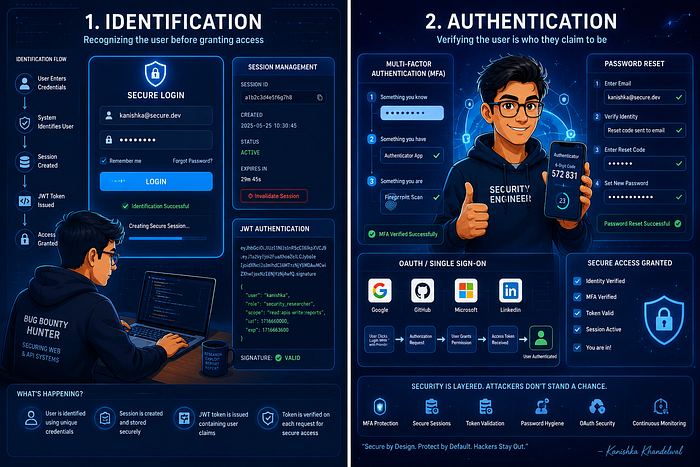
Modern applications heavily rely on:
- Login systems
- Session management
- JWT authentication
- OAuth
- Single Sign-On (SSO)
- Password reset functionality
- API authentication
- Multi-Factor Authentication (MFA)
When these mechanisms are implemented incorrectly, applications become vulnerable to:
- Account takeover
- Credential attacks
- Authentication bypass
- Session hijacking
- Privilege escalation
This vulnerability occurs when applications fail to properly:
- Verify identities
- Protect credentials
- Secure authentication tokens
- Manage sessions safely
Why This Vulnerability Is Dangerous..??
Authentication protects everything behind the login system.
If authentication fails, the attacker no longer appears as:
- An attacker
The application itself treats them as:
- A legitimate user
This makes authentication vulnerabilities extremely dangerous because:
- Attackers inherit normal user permissions
- Security monitoring becomes harder
- Compromise may remain unnoticed
- Sensitive actions appear legitimate
- Attackers can move deeper into systems silently
A single authentication weakness can expose:
- Bank accounts
- Enterprise dashboards
- Cloud infrastructure
- Healthcare systems
- Financial platforms
- Internal admin panels
In many real-world breaches, the attacker never exploited Remote Code Execution. They simply logged in successfully.
Real-World Example — Credential Stuffing
One of the most common authentication attacks is:
- Credential Stuffing
Attackers collect leaked usernames and passwords from:
- Data breaches
- Dark web databases
- Public credential leaks
Because many users reuse passwords, attackers automate login attempts against:
- Netflix
- Banking apps
- Shopping websites
- Corporate portals
- Social media accounts
Example:
A user signs up on:
- randomforum.com
Years later, that website suffers a data breach.
The leaked credentials become public:
john@example.com : Password@123Attackers now try the same credentials on:
- Gmail
- PayPal
- GitHub
- Banking portals
If the victim reused passwords, the attacker gains access immediately.
No sophisticated hacking required.
Only weak authentication hygiene.
Real-World Example — Session Hijacking
Imagine a user logs into an application.
The server creates:
SESSIONID=ABX721P91This session token proves:
- The user is authenticated
Now imagine:
- The application is vulnerable to XSS
An attacker injects malicious JavaScript:
document.cookieThe victim's session token gets stolen.
Now the attacker imports the stolen session cookie into their own browser.
The server thinks:
- The attacker is the legitimate user
No password needed. No MFA needed.
Only stolen session trust.
This is: Session Hijacking
Modern Real-World Example — MFA Fatigue Attacks
One major example involved:
- Uber Technologies
Attackers obtained employee credentials and repeatedly triggered:
- MFA push notifications
The victim continuously received:
Approve Login Request?Eventually, the employee accidentally approved one request.
That single approval granted attackers access to:
- Internal systems
- Slack dashboards
- Administrative environments
This attack demonstrated something important:
Even strong authentication mechanisms can fail when:
- Human behavior becomes the target
Real-World Example — Password Reset Vulnerability
Many applications focus heavily on:
- Login security
But forget:
- Password reset security
Imagine this vulnerable flow:
https://example.com/reset?user=kanishka&code=1234The reset code uses:
- Only 4 digits
Attackers automate requests:
0000
0001
0002
...
9999
Eventually, the reset code becomes guessable.
Now attackers can:
- Reset victim passwords
- Take over accounts
- Bypass authentication completely
The login page was secure.
The password reset system was not.
JWT Authentication Failures
Modern APIs heavily use:
- JSON Web Tokens (JWTs)
JWTs store authentication information such as:
- User IDs
- Roles
- Permissions
Example JWT payload:
{
  "user": "test",
  "role": "user"
}
Common JWT vulnerabilities include:
- Accepting unsigned tokens
- Weak secret keys
- Algorithm confusion attacks
- Long expiration times
- Improper signature validation
Imagine the server incorrectly accepts:
{
  "user": "test",
  "role": "admin"
}
Without verifying the signature properly.
Now attackers can escalate privileges simply by:
- Modifying token contents
This can lead to:
- Admin access
- Authentication bypass
- Complete application compromise
How Applications Become Vulnerable..??
Applications become vulnerable when developers:
- Implement custom authentication logic incorrectly
- Store passwords insecurely
- Disable MFA protections
- Trust client-side authentication
- Fail to invalidate sessions
- Reuse insecure session management systems
- Expose tokens publicly
- Misconfigure OAuth authentication
Sometimes developers prioritize:
- Features
- User convenience
- Rapid deployment
While authentication security becomes secondary.
But attackers almost always target:
- Authentication first
Because compromising one account is easier than compromising an entire server.
Real-World Scenario — Predictable OTP
Imagine a banking application that generates OTP codes like:
100001
100002
100003
Attackers notice:
- The OTPs are sequential
Now they automate prediction attempts.
Eventually, they predict valid OTPs for other users.
This allows attackers to:
- Bypass verification
- Reset passwords
- Perform unauthorized transactions
Weak randomness can completely destroy authentication security.
Brute Force & Password Spraying
Attackers frequently automate password attacks using tools like:
- Burp Suite Intruder
- Hydra
- Medusa
- Custom credential bots
Common techniques include:
- Brute Force
- Credential Stuffing
- Password Spraying
Password spraying is especially dangerous.
Instead of trying:
- Many passwords for one account
Attackers try:
- One common password against thousands of users
Example:
Welcome@123
Winter2026!
Company@123
If even one employee uses weak credentials, attackers gain access.
This technique often bypasses:
- Account lockout protections
OAuth & SSO Authentication Risks
Modern applications commonly support:
- Login with Google
- Login with GitHub
- Login with Microsoft
These systems rely on:
- OAuth
- Single Sign-On (SSO)
But misconfigured OAuth implementations can become dangerous.
Common mistakes include:
- Improper redirect validation
- Token leakage
- Missing state parameter validation
- Account linking flaws
Attackers sometimes abuse OAuth flows to:
- Steal authentication tokens
- Impersonate users
- Hijack accounts
Authentication today is far more than:
- Just passwords
Why Developers Accidentally Create This Problem..?
Authentication vulnerabilities often happen because:
- Authentication is highly complex
- Developers create custom auth systems
- Legacy authentication remains active
- Session management is misunderstood
- Security testing becomes incomplete
- Usability is prioritized over security
The root issue is usually:
- Poor identity security architecture
Authentication is one of the hardest parts of application security.
And small mistakes create massive risks.
How Attackers Exploit Authentication Systems..?
Attackers use techniques such as:
- Credential stuffing
- Session hijacking
- JWT manipulation
- Password spraying
- Token theft
- OAuth abuse
- MFA fatigue attacks
- Social engineering
- OTP brute forcing
Their primary goal is usually:
- Account Takeover (ATO)
Because once authenticated, attackers gain trusted access.
And trusted access is extremely powerful.
Real-World Impact
Authentication failures have caused:
- Massive account takeovers
- Financial fraud
- Cloud compromise
- Identity theft
- Administrator access breaches
- Corporate espionage
- Data leaks
- Ransomware incidents
Many large-scale breaches started from:
- One compromised account
Sometimes the biggest attack vector is simply:
- Weak authentication
How To Prevent Identification and Authentication Failures..??
1. Enforce Strong Password Policies
Require:
- Long passwords
- Unique passwords
- Password complexity
Avoid:
- Default credentials
- Weak passwords
- Predictable passwords
2. Implement Multi-Factor Authentication (MFA)
MFA adds additional verification layers such as:
- Authenticator apps
- Hardware security keys
- Biometric verification
Even if passwords leak, MFA can stop attackers.
3. Secure Session Management
Applications should:
- Rotate session IDs after login
- Expire inactive sessions
- Invalidate sessions after logout
- Use secure cookie flags
Session security is authentication security.
4. Protect Against Brute Force Attacks
Implement:
- Rate limiting
- CAPTCHA protections
- Account lockouts
- IP reputation systems
Authentication endpoints should never allow unlimited attempts.
5. Secure Password Reset Mechanisms
Password reset systems should:
- Use long random tokens
- Expire quickly
- Require additional verification
- Prevent brute forcing
Password reset security is equally important as login security.
6. Properly Validate JWTs
Always:
- Verify signatures
- Use strong secret keys
- Restrict algorithms
- Minimize token lifetime
Never trust:
- Unsigned or improperly validated tokens
7. Monitor Authentication Events
Organizations should detect:
- Unusual login behavior
- Credential stuffing attempts
- Geographic anomalies
- Multiple failed logins
- Suspicious session reuse
Authentication monitoring helps detect account compromise early.
Secure Design Mindset
Secure authentication requires:
- Identity verification
- Session protection
- Credential security
- Continuous monitoring
- Zero trust principles
Applications should assume:
- Credentials may eventually leak
The goal is to:
- Limit damage even after compromise
Authentication should never rely on:
- Trust alone
Final Thoughts
Identification and Authentication Failures remain one of the most dangerous vulnerabilities because:
- Authentication protects everything
- Users frequently reuse passwords
- Session management is complex
- Modern auth systems are difficult to implement securely
- Attackers heavily automate authentication attacks
Attackers no longer need advanced exploitation techniques.
Sometimes they simply: Log in successfully
And once attackers become trusted users, the application itself opens the door.
Because in cybersecurity:
If identity verification fails, everything behind authentication becomes exposed.
Thank You for Reading
I'll continue covering the entire OWASP Top 10 deeply with:
- Advanced exploitation techniques
- Real-world attack scenarios
- Bug bounty insights
- Practical testing methodologies
- Modern application security concepts
Checkout the complete OWASP Top 10 2021 series here: OWASP Top 10 2021 Series by Kanishka Khandelwal
Connect with me on LinkedIn:
Don't forget to clap 👏…