
This morning probably started like most mornings do. You woke up, checked the weather on your phone, opened a messaging app, maybe ordered coffee, and paid for something online. None of these actions felt complicated. You simply tapped a button and the information appeared on your screen.
But behind that simple interaction, something much more complex happened.
Several different systems running on different servers, written in different programming languages, and owned by completely different companies communicated with each other in a fraction of a second. The technology that makes this communication possible is called an API.
APIs can range from simple to complex, but their main role is to connect different parts of the digital ecosystem, enabling the creation of complex software solutions.
Once you start noticing APIs, you begin to realize they are everywhere.
Imagine you are building a simple mobile application. Your users want to log in with Google, make payments, receive weather updates, and see their location on a map. At first glance, these features may seem like standard functionality that every modern app should have. But if you think about it for a moment, each of these features represents an entire complex system on its own.
Building a global mapping service alone would require massive infrastructure and constantly updated geographic data. Creating a secure payment system involves handling financial transactions, fraud prevention, and regulatory compliance. Even something that seems simple, like displaying weather information, requires collecting data from meteorological services around the world.
Trying to build all of these systems from scratch would take years.
Instead, developers do something much smarter: they connect their application to services that already exist. Rather than reinventing the wheel, they allow their app to communicate with specialized platforms that already provide these capabilities. This communication happens through APIs.
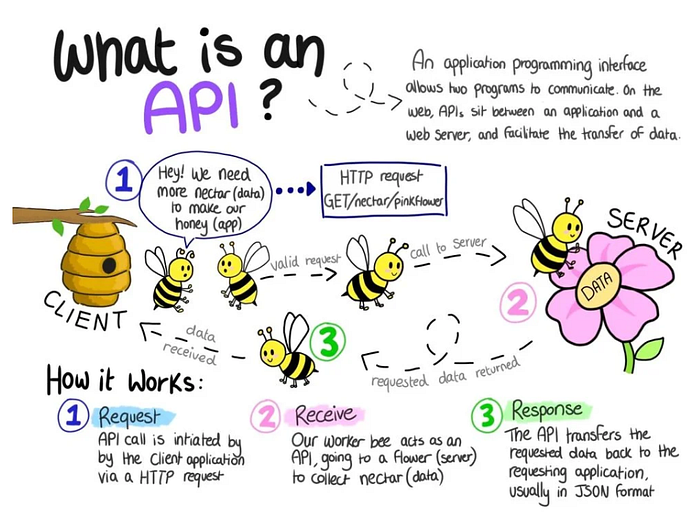
When a user opens the map in your app, the application sends a request to a mapping service. When the user makes a payment, the app communicates with a payment provider. When the weather forecast appears on the screen, the application retrieves that information from a weather data service. Each of these interactions happens through an API request.
In simple terms, an API — Application Programming Interface, is a contract that allows two pieces of software to communicate with each other.
Humans interact with software through user interfaces: buttons, screens, menus, and forms. Software, however, needs a different way to interact. Instead of clicking buttons, applications send structured requests and receive structured responses. APIs define how those requests should be made and what kind of responses should be returned.
One of the easiest ways to understand this idea is through a restaurant analogy.

When you sit at a restaurant table, you don't walk into the kitchen and cook your own meal. Instead, you look at the menu and tell the waiter what you want. The waiter takes your order to the kitchen, the kitchen prepares the food, and the waiter brings it back to your table. You never interact with the kitchen directly — the waiter handles the communication.
In this analogy, the waiter plays the role of the API. The API receives your request, passes it to the system that processes it, and then returns the result. You don't need to understand how the system works internally. All you need to know is how to ask for what you want.
Once you start paying attention, you realize how many everyday digital experiences depend on this kind of interaction. Logging into a website using your Google account, booking a ride in a taxi app, watching a video online, or seeing a map embedded on a webpage — all of these features rely on APIs quietly working behind the scenes.
In fact, modern software rarely exists as a single self-contained system anymore. Most applications today are more like networks of specialized services. One service handles authentication, another processes payments, another manages notifications, and yet another stores and analyzes data. APIs allow all of these independent services to communicate and work together as if they were one unified application.
This is one of the reasons why software development has accelerated so dramatically in the past decade. Instead of building everything from scratch, developers assemble applications from existing components and connect them through APIs. Startups that once needed years to build complex platforms can now launch sophisticated products in a matter of months simply by integrating the right services.
For data scientists, APIs are particularly valuable because they provide access to real-world data. Instead of manually downloading datasets, you can retrieve fresh data directly from platforms such as financial services, social media networks, analytics tools, or internal company systems. A simple script can collect updated information automatically, making data pipelines far more efficient.
For example, using just a few lines of Python code, you can request information from the GitHub API and receive structured data in return.

With this request, the API returns details about the specified user, such as the number of public repositories or followers. The data arrives in a structured format, typically JSON, which can be easily processed by programs and analytics tools.
APIs are not only useful for collecting data. They are also the primary way modern machine learning systems are deployed. In many real-world applications, trained models are exposed as APIs so other services can send data to them and receive predictions in return.
In practice, the architecture often looks something like this: an application sends a request to an API, the API forwards the request to a machine learning model running on a server, and the model returns a prediction. This approach allows recommendation systems, fraud detection models and AI assistants to operate at scale and serve thousands or even millions of users.
Despite their importance, APIs rarely receive much attention. Users never see them, designers rarely interact with them directly, and most people outside the engineering world are unaware they exist.
Yet APIs quietly power much of the digital world.
Every time two systems exchange information online, there is a good chance an API is involved. And once you understand how they work, the internet starts to look different — not as a collection of isolated applications, but as a vast ecosystem of services constantly communicating with each other.
If you'd like to go deeper, exploring API-related tools is a great next step
- Postman: It's one of the most popular tools for testing REST APIs, used by millions of developers and companies worldwide. Postman supports every stage of the API lifecycle, making it easy to design, test, and document APIs.
- Swagger UI: This suite of tools is excellent for API designing and supports the entire API lifecycle. It allows you to conduct API performance testing, security testing, and functional API testing.
- PyTest: PyTest is a Python testing framework known for its intuitive syntax and powerful assertion capabilities. It's widely used for API testing due to its plugin architecture and support for building reliable and scalable tests effortlessly. PyTest's simplicity and flexibility make it a preferred choice for Python developers.
I am planning to cover these tools and offer real-world examples of how to use them in upcoming articles. But for now, this is where I'll leave it.
If you have any suggestions or feedback, feel free to drop them in the comments. And don't forget to stay tuned for more content by following me!