
On a quiet spring morning in 2011, an RSA employee opened an email that looked harmless. The subject line read "2011 Recruitment Plan." It blended into the noise of corporate communication, the kind of message no one questions. Inside was an Excel file. The employee clicked. A macro executed. And in that unremarkable moment, one of the most consequential cyberattacks in modern history began.
The attackers did not break in. They did not exploit a zero‑day or brute‑force a password. They simply asked for access, and someone granted it.
That single click allowed adversaries to steal data tied to RSA's SecurID tokens, authentication systems trusted by governments, defence contractors, and Fortune 500 companies. The breach forced emergency replacements of millions of tokens and cost RSA an estimated $66 million. All because one person trusted one email on one ordinary afternoon.
Phishing is not a technical attack. It is a psychological ambush. It succeeds long before the first packet crosses a network. Long before firewalls, intrusion detection systems, or cloud security tools come into play, the attacker has already won inside the mind of the victim.
Social engineering predates the Internet. Con artists were the original hackers. They understood a simple truth: people are easier to manipulate than machines. The medium changed. The psychology did not.
Early phishers in the 1990s prowled AOL chat rooms, posing as customer support. The infamous "Nigerian Prince" scam existed decades before email. These attacks worked because they exploited trust, authority, and emotion.
Today, phishing has evolved into something far more industrialized. The sloppy scams we once deleted without a second thought have been replaced by messages that look like they were crafted by the marketing department. Branding is perfect. Tone is familiar. Timing is precise. Behind it all sits an automated engine capable of launching millions of targeted messages in minutes.
What began as petty digital trickery has become a global operation capable of disrupting institutions, nudging markets, and triggering geopolitical tension. All it takes is a convincing message and a moment of lowered guard.
Part 1: Inside the Mind of a Social Engineer
Social engineering works because it exploits human psychology, not technical flaws. Attackers rely on emotional triggers that bypass logic and push people into fast, uncritical decisions.
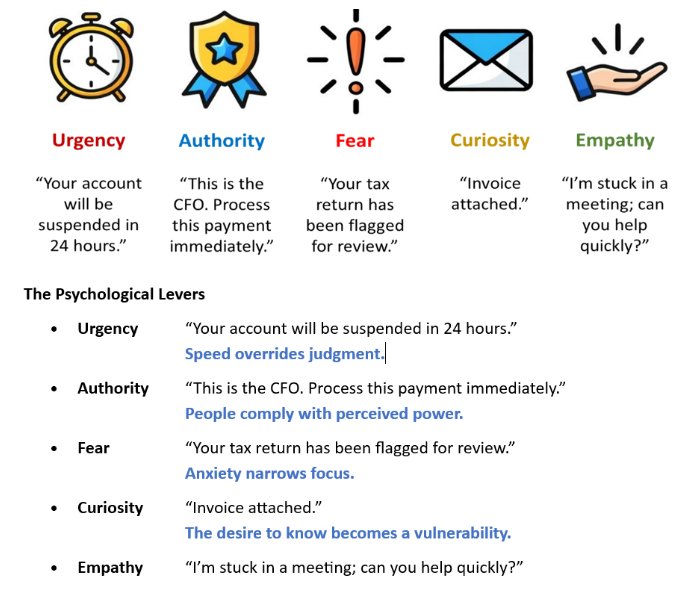
Sometimes attackers use one of these triggers. Sometimes they use all of them at once. The goal is always the same: create an emotional spike that shuts down rational thinking.
Just as insider threats weaponize trust from within, phishers weaponize trust from the outside.
Anatomy of a Modern Phishing Attack
Every phishing attack follows a predictable lifecycle. Be it a mass campaign or a handcrafted spear‑phish for a targeted individual.
1) Reconnaissance: Surveillance with quiet observation.
Attackers scan through the entire social media presence, their connections, posts, and LinkedIn profiles, and scrape press releases. They study email formats and organizational charts. The goal isn't just to gather data, it's to understand how the target thinks, works, and communicates.
2) Pretext Creation: Creation of the story.
The story could be a fake invoice. A password reset. A message from the CEO. Maybe a delivery notification or a cloud service alert. Whatever it is, it is designed to appear familiar yet routine enough to avoid suspicion.
3) Delivery: The message is delivered to the vector system
The message arrives. Email. SMS. A voice call. A QR code taped to a breakroom wall. A direct message on social media. The channel doesn't matter. What matters is the psychology behind it, which includes urgency, authority, fear, curiosity, and empathy.
4) Execution: The moment of impact.
A link is clicked. An attachment is opened. Credentials are handed over. Malware runs quietly in the background. Sessions are hijacked. Access is granted. The door is open.
5) Exploitation: Now the damage begins.
Data is stolen. Wire transfers are initiated. Ransomware spreads. Attackers pivot deeper into the network. Every second counts, and they know it. The breach occurs long before anyone recognizes anything is wrong.
Part 2: The Fallout
The consequences of phishing mirror those of insider threats: fast, devastating, and often irreversible.
- Financial losses from fraudulent transfers to ransomware payouts
- Operational disruption systems locked, data encrypted, workflows halted
- Reputational damage headlines, hearings, and public scrutiny
- Regulatory penalties like GDPR, CCPA, and SEC enforcement
- Long‑term trust erosion with customers, partners, and employees leads to a loss of confidence
Phishing does not just compromise data. It compromises belief. It undermines the trust that organizations depend on to function.
Part 3: Timeline of Notorious Phishing Attacks
A series of high‑profile breaches over the last decade reveals a clear pattern. Attackers are no longer targeting systems. They are targeting people and getting more sophisticated with it.
Recent years have revealed a fundamental change in how phishing campaigns operate. The objective has shifted from penetrating a specific perimeter to harvesting identities, credentials, and access paths at scale. Each of these breaches clearly demonstrates a change in the geometry of the targeting surface, as they all occurred last year, 2025.
- VIP Identity Harvesting Campaign: Attackers launched over 32 million phishing emails, with 8.2 million targeting executives and high‑value staff. The fallout included widespread credential theft, session hijacking, and a surge in business email compromise across multiple sectors.
- AI‑Generated Omni‑Channel Phishing: Criminal groups deployed AI‑crafted emails, SMS messages, and voice‑cloned calls to impersonate internal staff. Organizations faced unauthorized wire transfers, account takeovers, and large‑scale identity abuse as attackers blended channels to overwhelm verification processes.
- Remote‑Work Compromise Wave: Phishing attacks surged against remote and hybrid workers interacting with cloud platforms outside controlled environments. Businesses reported operational disruption and sensitive data exposure as attackers exploited home‑network weaknesses and MFA fatigue.
- AI‑Enhanced Credential Attacks on Finance: Financial institutions were hit by AI‑accelerated reconnaissance and phishing that targeted public‑facing applications and weak authentication flows. The breaches triggered regulatory scrutiny and forced rapid modernization of identity security programs.
- Global Phishing Surge: Identity-based breaches have emerged as the leading method of initial access to systems worldwide. The average cost of phishing‑related breaches rose to $4.88M, pushing companies to overhaul MFA, identity governance, and email security architectures.
Part 4: Fighting a Moving Target: From Blocking Messages to Understanding Deception
Phishing is no longer a static tactic; it is a fluid threat that adapts to our work habits and trusted circles. Whether through email, SMS, or synthetic media, the delivery method is merely the surface. The true attack lives in the exploitation of routine, urgency, and familiarity.
As the line between technical compromise and psychological manipulation fades, traditional defences are no longer the frontline. Filters catch what they recognize, but attackers now target what people do without thinking. The fallout is immediate: a single compromised credential can cascade into a strategic crisis, bypassing locks by simply walking through the door of trust.
The Evolution of Response
Protection must shift from blocking messages to anticipating behaviour. These attacks often evade technical controls by targeting human behaviour, which machines cannot predict. Hence, the response must be rooted in context and identity verification.
- Leadership's Role: Resilience starts at the top. When leaders model verification and normalize the reporting of suspicious requests, they establish the organizational security standards.
- Defining Resilience: Organizational strength is no longer measured solely by patching speed. It is defined by how confidently a team challenges uncertainty and how effectively they have built security into their daily habits.
Strategies that Work
Technical Hardening:
- Behavioural Analytics: Spot unusual communication patterns before they turn into compromise.
- Zero Trust & Identity: Treat every request as untrusted until proven otherwise with MFA and fatigue-resistant authentication.
- Containment: Use role-based access and least privilege to limit damage if an identity is compromised.
- Environment Shielding: Harden browsers and secure mobile/cloud channels to limit exposure to fake login windows.
Cultural & Process Resilience:
- Segregated Workflows: Use out-of-band verification (like a quick phone call) for payments or sensitive changes.
- Psychological Safety: Build a culture where employees can pause, question, and verify without fear of blame.
- Unified Coordination: Ensure Security, Finance, HR, and IT operate as a single system rather than in silos.
- Instinct Training: Use simulations and clear reporting channels to turn compliance into second nature.
The Road Ahead
The stakes are rising. AI will make deception faster and more personal, exploiting the smallest gaps in our processes. To survive, organizations must treat phishing as a human problem. The winners will be those who invest in culture and leadership as heavily as they do in tools, building systems that adapt as quickly as the threats targeting them.
References: Academic and Peer‑Reviewed Research
- Alshammari, S. S., Soh, B., & Li, A. (2023). Understanding social engineering victimisation on social networking sites: A comprehensive review of factors influencing user susceptibility to cyber-attacks. Information, 16(2). https://doi.org/10.3390/info16020153 (doi.org in Bing)
- Adu‑Manu, K. S., Ahiable, R. K., Appati, J. K., & Mensah, E. E. (2023). Phishing attacks in social engineering: A review. Journal of Cyber Security, 4(4), 239–267. https://doi.org/10.32604/jcs.2023.041095 (doi.org in Bing)
- Zainab, Z. A., Hewage, C. H., Nawaf, L. N., & Khan, I. K. (2021). Phishing attacks: A recent comprehensive study and a new anatomy. Frontiers in Computer Science, 3. https://doi.org/10.3389/fcomp.2021.563060 (doi.org in Bing)
- IEEE Xplore. (n.d.). A systematic review of social engineering attacks & techniques. https://ieeexplore.ieee.org/
Industry Threat Intelligence & Security Vendor Reports
- Trend Micro. 12 Types of Social Engineering Attacks. https://www.trendmicro.com/en_us/what-is/social-engineering.html (trendmicro.com in Bing)
- CrowdStrike. 10 Types of Social Engineering Attacks and How to Prevent Them. https://www.crowdstrike.com/cybersecurity-101/social-engineering-attacks/ (crowdstrike.com in Bing)
- Secureframe. The 13 Most Common Types of Social Engineering Attacks in 2025 + How to Defend Against Them. https://secureframe.com/blog/social-engineering-attacks (secureframe.com in Bing)
- Microsoft Security Blog. Analysis of modern phishing and identity-based attacks. https://www.microsoft.com/en-us/security/blog/ (microsoft.com in Bing)
- Cloudflare. Phishing attacks targeting Okta and identity systems. https://blog.cloudflare.com/
Case Studies & Public Disclosures
These are the official or primary sources for the major incidents referenced in your report.
- RSA Breach (2011) EMC/RSA Public Statement https://www.rsa.com/en-us/company/newsroom/rsa-statement (rsa.com in Bing)
- Google & Facebook BEC Fraud (2013–2015) U.S. Department of Justice Indictment https://www.justice.gov/usao-sdny/pr/man-pleads-guilty-100-million-fraud-scheme (justice.gov in Bing)
- Sony Pictures Hack (2014) FBI Official Statement https://www.fbi.gov/news/press-releases/statement-on-sony-investigation (fbi.gov in Bing)
- Ubiquiti Networks Fraud (2015) SEC Filing https://www.sec.gov/Archives/edgar/data/1517541/000151754116000048/ubnt-20160331x10k.htm (sec.gov in Bing)
- Snapchat Payroll Breach (2016) Snap Inc. Disclosure https://newsroom.snap.com/
- Google Docs Worm (2017) Google Security Blog https://security.googleblog.com/
- Twitter Bitcoin Hack (2020) U.S. DOJ Press Release https://www.justice.gov/usao-ndca/pr/three-individuals-charged-alleged-roles-twitter-hack
- MGM Resorts Breach (2023) MGM Public Statement https://investors.mgmresorts.com/
- Coinbase SMS/Vishing Attack (2023) Coinbase Security Notice https://www.coinbase.com/security
- Microsoft Corporate Email Breach (2024) Microsoft Security Response Center https://msrc.microsoft.com/
- Cloudflare / Okta Phishing Attempt (2024) Cloudflare Incident Report https://blog.cloudflare.com/
- Revolut SMS Phishing (2022) Revolut Customer Advisory https://www.revolut.com/help/
- Global Shipping Consortium Attack (2025) Industry reporting (Lloyd's List, Maritime Executive) https://www.lloydslist.com/
- MedSecure Health Network Attack (2025) Healthcare cybersecurity advisories https://www.hhs.gov/about/news/
Originally published at https://www.linkedin.com.
#CyberSecurity #Phishing #SocialEngineering #IdentitySecurity #ZeroTrust #SecurityAwareness #HumanFirewall #InsiderThreats #BehavioralSecurity #SecurityCulture #HumanRisk #CyberResilience #RiskManagement #Governance #AICyberThreats #AIPhishing #DeepfakeFraud #SyntheticMedia #DataBreach #CredentialTheft #BEC #Ransomware #ThreatIntelligence #AttackLifecycle #RSABreach #SecurID #PhishingEvolution #TrustExploitation #InfoSec #TechSecurity #CyberDefense #DigitalSafety #CloudSecurity