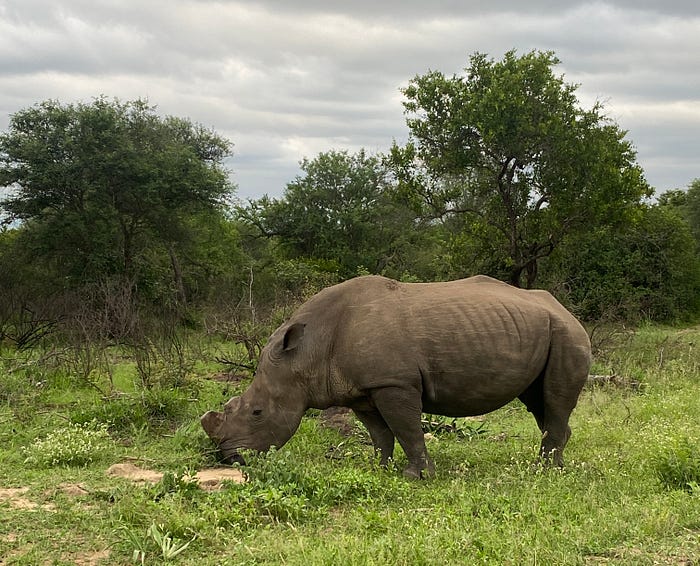

Monkey Business
It was a few days after Christmas, and a torrential storm had left the air earthy and humid. In Hoedspruit, South Africa — about an hour's drive from Kruger National Park — I traced the seams of the mosquito net knotted to my bedposts and the pattern of the lodge's thatched roof. Still submerged in the bliss of deep sleep, a sudden metallic clang followed by frantic pitter-patters jolted me upright. I clawed hazily at the mosquito net, determined to catch a glimpse of the culprits. Launching myself out of bed, I drew the curtains, scanning the area for signs of life. Only when I directed my gaze downward did I lock eyes with a family of vervet monkeys, expressions of unmistakable guilt and mischief etched across their faces.
As my primate acquaintances scampered off, I prepared for my first game drive in Kruger National Park. Safari is often envisioned as a straightforward visual pursuit: humans in vehicles scanning the bush for animals. Yet, this framing misses a whole apparatus of watching that makes safari possible. What I call safari surveillance is not a singular act of looking, but a dense and layered ecosystem of mutual watching, in which tourists, guides, technologies, and animals are all entangled in practices of observation.
Kruger and South Africa's Securitized Landscape
Kruger National Park is South Africa's first and largest wildlife reserve, spanning nearly two million hectares and receiving an estimated two million visitors each year. Entry into this vast space is tightly monitored through eight main gates. Passing through Orpen Gate, one of Kruger's primary entry points, felt less like entering wilderness than crossing a checkpoint. Before we could access the animals, there was paperwork. Indemnity forms were signed on entry and displayed again on exit, formally acknowledging risk and liability. Uniformed SANParks (South African National Parks) staff checked documents, verified bookings, and controlled the flow of vehicles into the park. Only after these procedures were complete did safari officially begin. This was no free-for-all; it was bureaucratic and methodical.
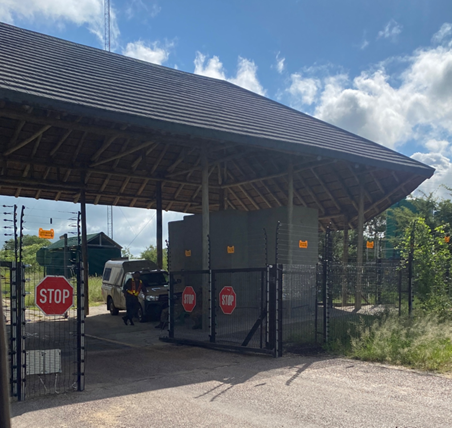
Surveillance in Kruger is typically justified in terms of conservation, but it is equally shaped by concerns about security and crime prevention. In 2017, SANParks introduced the Meerkat Wide Area Surveillance System (WASS), a mobile, solar-powered network of electro-optic and radar sensors designed to detect, classify and track human movement within the park, primarily to support anti-poaching operations. This system operates alongside aerial drones, number plate recognition, ranger patrols, and trained tracking dog units. The fact that the South Africa-Mozambique border runs, in part, through Kruger further intensifies these security logics. Together, this constellation of technologies and institutional practices form what Haggerty and Ericson (2000) describe as a surveillant assemblage — a diffuse convergence of actors in which conservation, tourism, policing, and border control blur into one another.
This assemblage does not end at the park's boundaries. In post-Apartheid South Africa, private security, gated properties, and 24/7 CCTV monitoring are routine features of everyday life in shopping centers, residential areas, and public spaces. Driving through Johannesburg, I passed homes resembling barricaded compounds — enclosed by high walls topped with razor wire, their front gates marked with signs announcing constant surveillance and armed response. Safari surveillance in Kruger is therefore not exceptional, but part and parcel of a national context characterized by expansive securitization.
Eyes on the Ground, Eyes in the Bush
Within such a technologically mediated environment, some of the most consequential forms of safari surveillance are neither digital nor distant. On game drives, guides and trackers work in close coordination, communicating over radios and group chats, exchanging fragments of information about animal sightings. Their surveillance is collaborative and anticipatory — oriented not toward the certainty of finding an animal, but toward hope and possibility.
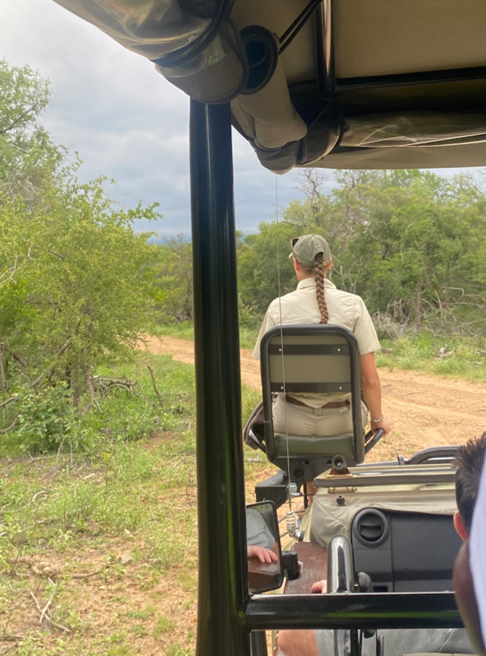
On an evening game drive, our tracker sat at the very front of the vehicle, exposed and unprotected by the relative comfort of the jeep. With laser focus, she scanned the terrain ahead. Broken branches, imprints in the mud, and piles of dung all became data points. From these traces, trackers determine not only which animal passed through, but how recently and in which direction. Time and movement are inferred rather than directly observed. This is surveillance without screens, reliant on intimate knowledge of animal behavior — what French and Smith (2016) describe as embodied dispositifs of capture: situated practices that render movement, presence, and possibility legible through skilled bodily attunement rather than through technological mediation. For passengers, the tracker's work often fades into the background, eclipsed by the euphoric moment an animal finally comes into view. Yet, without reading the language of the bush, there might be little to see at all.
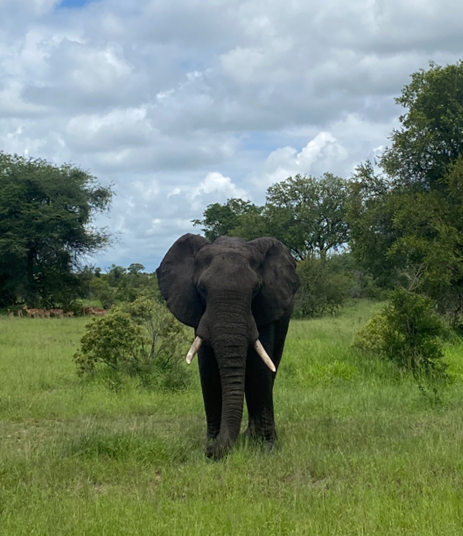
Long before any animals come into view, however, they are already watching us. Or smelling. Or listening. The low hum of the jeep engine, whispered voices between passengers, vibrations in the ground — these signals are acutely registered by wildlife before they are detected by the human eye. Absence, too, is meaningful: animals not seen may have already sensed our presence and retreated. In this way, animals are not passive objects of the safari gaze, but sensing subjects with their own regimes of surveillance. Their forms of watching are multisensory and finely attuned to threat and proximity. When animals do look back, it is often after a split-second risk assessment that has deemed us, at least for the moment, safe enough to observe.
When the Jeep Returns
At the end of each game drive back at the lodge, the question du jour is: what did you see? In a playfully competitive spirit, guests regale one another with tales of a leopard in a tree or a pride of male lions sprawled lazily in the shade. What you see — or fail to see — becomes the currency of safari surveillance. Yet, in a park as vast as Kruger, no amount of surveillance — bureaucratic, technological, or embodied — can guarantee an animal encounter. Sightings are contingent and up to chance as much as skill. Perhaps that is the quiet lesson of safari: to watch is never to fully control, and to be seen in return is always part of the experience.