June 3, 2026
The Biggest Cybersecurity Risk in 2026 Isn’t AI , It’s Human Trust
Organizations spend millions on tools and platforms. Yet attackers keep winning. The reason isn’t technical ,it never was.

Vinura_Gunathilaka
1 min read
"Every week, a new breach. Every breach, the same question: how do we improve our technology? But that question is the wrong one."
Firewalls. Endpoint detection. SIEM platforms. Cloud security tools. Threat intelligence feeds. Organizations have invested millions and attackers keep succeeding anyway.
The reason is simple, and it predates every technology ever invented: most cyberattacks do not begin with a vulnerability. They begin with trust.
AI has made social engineering unrecognizable
Traditional phishing attacks were relatively easy to catch. Poor grammar. Suspicious links. Obvious inconsistencies. Employees were trained to look for the mistakes.
Those mistakes are gone. Today, AI generates professional emails, hyper-personalized messages, fake executive communications, and voice impersonations that are indistinguishable from the real thing at scale, in seconds.
Employees are no longer identifying typos. They are trying to distinguish between reality and AI-generated deception. That is a fundamentally harder challenge, and most organizations are nowhere near ready for it.
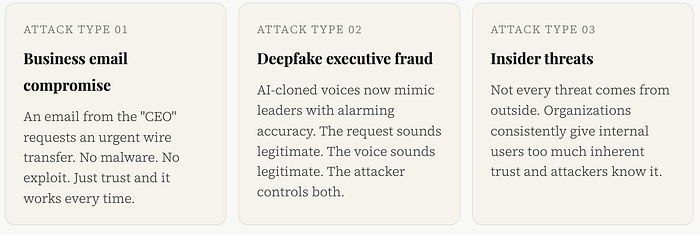
The three attack types growing fastest
Annual training is not a strategy
Many organizations run security awareness sessions once a year. Employees complete a module, pass a quiz, receive a certificate, and return to work unchanged.
Attackers, however, learn every single day.
Security culture cannot be built through annual presentations. It is built through repetition phishing simulations, incident reporting practice, verification drills, and ongoing conversations about data protection responsibilities.
"Culture is built through repetition, not presentations."
Zero trust is a mindset, not just a framework
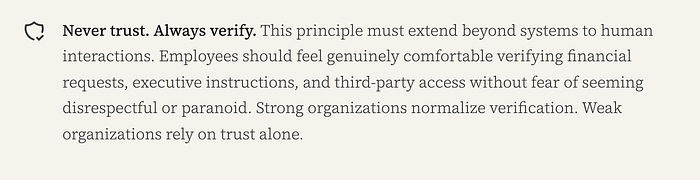
Zero Trust is widely discussed as a technology architecture. But its most powerful principle is psychological:
The future of security leadership is human
The most effective security leaders of the next decade will not be defined by technical depth alone. They will understand human behavior, organizational culture, risk communication, and change management.
Cybersecurity is no longer just an IT function. It is a business function. Technology protects systems. People protect organizations.
In 2026, your strongest cybersecurity control is not a firewall. It is a workforce that knows when not to trust.