June 3, 2026
RBI IT Governance for NBFCs: Why the Middle Layer Matters More Than Most People Think
When people think about cybersecurity in banking and financial services, they usually imagine hackers trying to steal money from customer…

Little_Sun4lower
2 min read
When people think about cybersecurity in banking and financial services, they usually imagine hackers trying to steal money from customer accounts. While that threat is real, the bigger challenge is ensuring that financial institutions remain secure, resilient, and trustworthy every single day.
This is where the Reserve Bank of India (RBI) steps in.
RBI is not just India's central bank; it is also the regulator responsible for ensuring that banks and Non Banking Financial Companies (NBFCs) operate securely and responsibly. To achieve this, RBI issues various guidelines and regulatory frameworks. One of the most important among them is the IT Governance and Information Security framework, often referred to through RBI's Master Directions and regulatory guidance.
Why Does RBI Care So Much About IT Governance?
Modern financial institutions run on technology.
Loan approvals, customer onboarding, digital payments, mobile banking, credit assessments, and even customer support depend heavily on IT systems. If these systems fail or are compromised, the impact goes far beyond financial losses.
RBI's focus is to ensure:
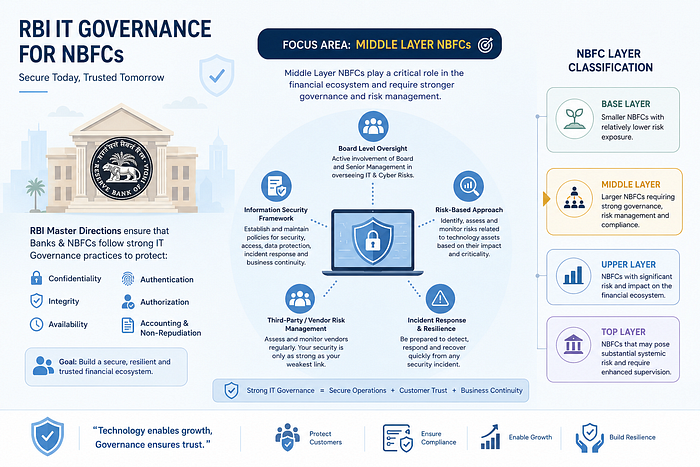
- Confidentiality of customer information
- Integrity of financial data
- Availability of critical services
- Strong authentication and authorization controls
- Accountability and auditability of actions
- Protection against fraud and cyberattacks
Simply put, RBI wants financial institutions to be secure before an incident happens not after.
Understanding NBFC Layers
To regulate NBFCs effectively, RBI follows a scale-based regulatory framework consisting of four layers:
1. Base Layer (BL) : Smaller NBFCs with relatively lower risk exposure.
2. Middle Layer (ML) : Larger and more systemically important NBFCs that require stronger governance and risk management controls.
3. Upper Layer (UL) : NBFCs identified by RBI as having significant risk and impact on the financial ecosystem.
4. Top Layer (TL) : A layer reserved for institutions that may pose substantial systemic risk and require enhanced supervision.
Among these, the Middle Layer is particularly interesting because it marks the point where governance expectations become much more rigorous.
RBI's IT Governance Focus for Middle Layer NBFCs
For Middle Layer NBFCs, cybersecurity is no longer just an IT department responsibility. It becomes an organizational responsibility.
Board-Level Oversight
RBI expects the Board of Directors and senior management to actively oversee technology and cyber risks.
Cybersecurity decisions should not remain confined to technical teams. Leadership must understand risks and ensure proper controls are implemented.
Information Security Framework
NBFCs are expected to establish documented policies covering:
- Information Security
- Access Management
- Incident Response
- Data Protection
- Vendor Risk Management
- Business Continuity
Security controls must be reviewed regularly rather than treated as one-time compliance activities.
Risk Based Approach
Every technology asset carries a different level of risk.
For example, a loan management system processing customer financial data requires stronger controls than an internal employee portal. RBI expects institutions to identify, assess, and continuously monitor these risks.
Third Party and Vendor Risk
Many NBFCs rely on external vendors for cloud services, applications, and infrastructure support.
RBI requires institutions to assess vendor risks because an attacker does not always target the organization directly. Sometimes the weakest link is a third-party service provider.
A Real World Scenario
Imagine an NBFC using a third party platform to process loan applications.
The NBFC's internal systems are secure, employees follow security policies, and regular audits are conducted. However, the third party vendor leaves an administrative account exposed.
An attacker gains access through that vendor, extracts customer information, and disrupts services.
In such a situation, customers do not blame the vendor first. They blame the NBFC.
This is exactly why RBI emphasizes governance, oversight, and third-party risk management. Security is only as strong as the weakest connection in the ecosystem.
Final Thoughts
RBI's IT Governance framework is not just a compliance checklist. It is a blueprint for building trust in India's financial ecosystem.
For Middle Layer NBFCs, the message is clear: cybersecurity must be embedded into governance, risk management, and business decision-making. Technology enables growth, but governance ensures that growth remains secure and sustainable.
In an industry where trust is the real currency, strong IT governance is not merely a regulatory requirement, it is a business necessity.