
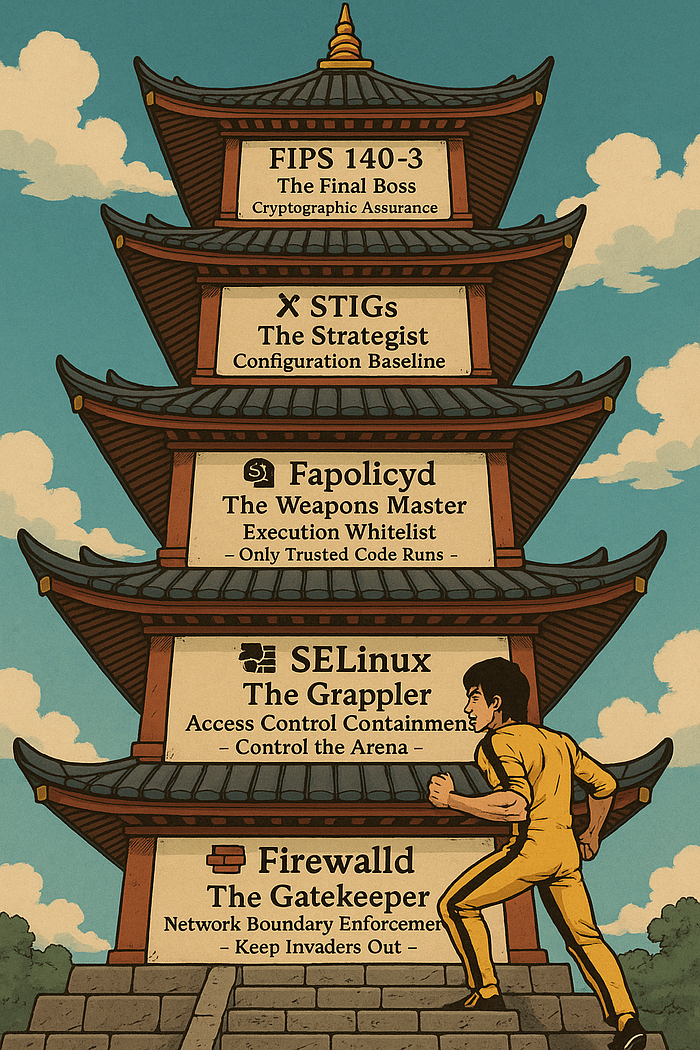
By the fourth floor of the pagoda, raw skill is no longer enough.
In Game of Death, this is where discipline, preparation, and strategy determine the outcome. Every movement is calculated. Every mistake is punished.
In cybersecurity, this level belongs to STIGs. Not a tool. Not a daemon. A doctrine.
What STIGs Actually Are
Security Technical Implementation Guides (STIGs) are often misunderstood as:
- Checklists
- Compliance paperwork
- "Audit requirements"
STIGs represent codified operational lessons derived from:
- Real incidents
- Known attack patterns
- Repeated system failures
They define how systems must be configured to behave predictably under stress.
Configuration Is a Security Control
Misconfiguration remains one of the leading causes of compromise.
STIGs address this by enforcing:
- Secure service configurations
- Strong authentication policies
- Proper file permissions
- Required auditing and logging
- Disabled unnecessary functionality
From a control standpoint, STIGs align with:
- NIST SP 800–53 — CM family
- IA, AC, AU, and SI controls
- POA&M reduction initiatives
Discipline at Scale
STIGs are not about perfection — they are about consistency.
In DoD environments:
- Systems are built by different teams
- Maintained over long lifecycles
- Operated under mission pressure
STIGs ensure that:
- Security posture does not drift
- Systems remain auditable
- Risk decisions are intentional and documented
Automation (Ansible, OpenSCAP) transforms STIGs from static documents into living controls.
STIGs and Defense-in-Depth
STIGs reinforce every other layer:
- Firewalld rules are standardized
- SELinux remains enforcing
- Fapolicyd policies are consistent
- FIPS settings are preserved
Without STIGs, layers erode over time.
With STIGs, discipline is maintained even as systems change.
Operational Reality
STIG compliance does not eliminate risk — it reduces unknown risk.
It creates an environment where:
- Deviations are visible
- Exceptions are documented
- Audits validate posture, not scramble for evidence
Closing Reflection
In Game of Death, the strategist doesn't fight harder — they ensure the opponent never gains advantage.
STIGs do the same for your systems.
Discipline before deployment prevents chaos after compromise.