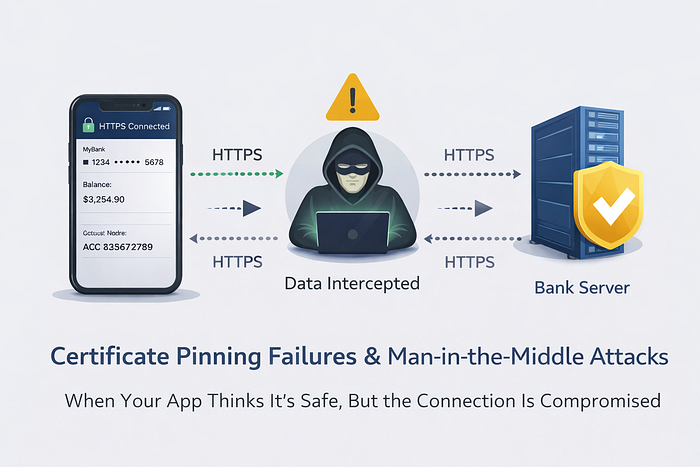

Your mobile banking app is open. The connection shows HTTPS. Everything looks encrypted and secure. What you cannot see is that somewhere between your phone and the bank's server, a silent observer is reading every request and response as clearly as if the encryption were never there.
This is not science fiction. It is what a successful Man-in-the-Middle attack looks like in practice. Certificate pinning failures are one of the primary reasons it remains possible against apps that appear to be doing everything right.
Here is the everyday version. You need to have a private phone conversation with your bank. You dial the number, someone answers and sounds exactly like your bank's representative, gives you the correct branch name, and greets you professionally. You assume you are speaking to your bank and share your account details openly. What you did not know is that your call was silently forwarded through a third party who listened to everything before passing it along. The bank eventually received your call. The conversation appeared normal on both ends. But everything said in between was captured. That third party in the middle is exactly what this attack creates. The victim believes they are communicating directly with a trusted server. The server believes it is communicating directly with a legitimate client. Neither party is aware that every message passing between them is being intercepted, and in some cases modified, in transit.
HTTPS was designed to prevent this. When your app connects to a server, the server presents a digital certificate that proves its identity. Your device checks that certificate against a list of trusted certificate authorities, organizations that are permitted to issue valid certificates, and if the check passes, the encrypted connection is established. The system works well for browsers. For mobile apps, it has a known gap.
Any certificate issued by any trusted certificate authority on the device will pass that standard validation check. An attacker who can install a custom certificate authority on the target device, or who operates in an environment where they control the network, can issue their own certificate that passes the device's standard trust check. The app sees a valid certificate, establishes what it believes is a secure connection, and begins sending data. The attacker holds the decryption keys for that connection and reads everything.
Certificate pinning was designed to close this gap. Instead of trusting any certificate that passes the device's general certificate authority validation, a pinned app carries a copy of the specific certificate or public key it expects to see from its own server. If the certificate presented during the connection does not match the pinned value exactly, the app refuses to connect. An attacker's intercepting certificate, even if it passes general device validation, will not match the pin and the connection will be rejected.
The vulnerability enters when pinning is implemented incorrectly, incompletely, or not at all. An app that pins certificates on its primary API endpoints but forgets to pin on analytics, logging, or third-party SDK endpoints leaves those channels open for interception. An app that catches pinning failures silently and falls back to standard validation defeats the entire purpose. An app that uses a pinning library without validating that it is correctly configured for every network call provides a false sense of protection. And an app that was never pinned at all, which is more common than the industry acknowledges, relies entirely on the device's certificate authority trust store being clean, which is an assumption that does not hold in every environment a mobile app encounters.
This is not limited to banking apps. Any mobile application that transmits sensitive data deserves certificate pinning. Healthcare apps sending patient information. HR platforms syncing payroll data. Legal tools transmitting confidential documents. Logistics apps carrying shipment and pricing data. The attack is equally viable against any app that handles information worth intercepting.
In fintech, the data flowing through these connections is precisely what attackers want most. Authentication tokens, OTP values captured mid-transit before the user enters them, account balances, transaction histories, payment card details, and API responses containing customer financial profiles. A single successful interception session on a compromised network can yield enough data to facilitate account takeover, fraudulent transactions, and identity theft.
A realistic scenario: a security researcher sits in the lobby of a busy financial district coffee shop and sets up a rogue WiFi access point with a name similar to the coffee shop's legitimate network. Several professionals connect to it without noticing the difference. The researcher runs a proxy tool that intercepts HTTPS traffic. For apps that are correctly pinned, the connections fail and the app shows a network error. For one fintech app that skipped pinning on its session refresh endpoint, the connection succeeds. The researcher's proxy decrypts the traffic, captures active session tokens refreshing silently in the background, and gains authenticated access to those users' accounts. The users saw nothing unusual. Their apps appeared to be working normally.
Implementing certificate pinning correctly requires pinning against the public key rather than the full certificate where possible, since public keys remain stable across certificate renewals while full certificate pins break every time a certificate expires and is replaced. 1. Pin every network endpoint the app communicates with, not just the primary API, including third-party integrations and analytics endpoints if they carry any session context. 2. Never fail open on pinning errors. A failed pin check should terminate the connection and surface a clear error rather than falling back silently to standard validation. 3. Build a pin rotation mechanism into the app update process so that when server certificates change, updated pins ship with the next app release before the old certificate expires. 4. Test pinning implementation explicitly during security reviews by running the app through an intercepting proxy and confirming that every sensitive connection is rejected when an unauthorized certificate is presented.
Encryption protects a conversation from being read by outsiders. But it only works if both parties are certain they are actually talking to each other. Pinning is the certainty for mobile applications.
A locked door means nothing if you cannot confirm who is standing on the other side before you open it.
#CyberSecurity #CertificatePinning #ManInTheMiddle #MobileSecurity #NetworkSecurity #ApplicationSecurity #FintechSecurity #BankingAppSecurity #CTOInsights