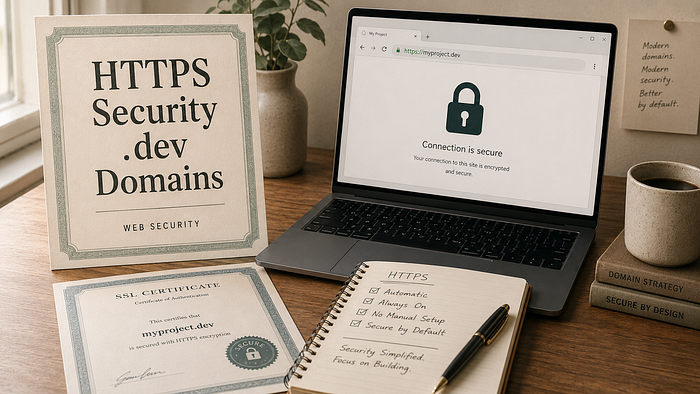
June 6, 2026
Why .dev and .app Domains Make HTTPS Non-Negotiable (And Why It Matters)
Your browser is already rejecting websites that don’t use HTTPS. Google is already ranking them lower. So why are you still building on…

Julian Neagu
6 min read
Your browser is already rejecting websites that don't use HTTPS. Google is already ranking them lower. So why are you still building on domains that require you to manually configure security?
The answer is simple: most developers haven't realized that entire domain extensions can be "secure by default." And when they are, it changes everything.
The HTTPS Problem Nobody Talks About
For years, HTTPS was optional. Now it's mandatory but only if you configure it yourself.
When you register a domain on a traditional extension like .com or .net, you own the responsibility. You need to get an SSL certificate. You need to set up redirects from HTTP to HTTPS. You need to renew that certificate before it expires. You need to make sure your developers don't accidentally load insecure content on secure pages.
One mistake in any of these steps breaks trust signals. Your users see security warnings. Search engines see a half-secured site. Your conversion rates drop.
Over 96% of web traffic now flows over HTTPS, yet thousands of teams still manage SSL certificates manually, adding operational overhead for zero business value.
But what if you didn't have to do any of that?
How .dev and .app Domains Changed the Game
Google Registry created several domain extensions that enforce HTTPS at the infrastructure level, not the application level.
When Google Registry launched .dev in 2014 and .app in 2015, they made a decision that most companies wouldn't make: they forced HTTPS on the entire TLD before it ever existed in the wild. Every single domain on .dev and .app was automatically added to the HSTS preload list — a list that browser developers maintain to block insecure connections before they even try to happen.
Here's what that means in human terms: when you type something.dev into a browser, the browser already knows it should only load over HTTPS. It doesn't even try HTTP first. There's no redirect. There's no moment where an attacker could intercept the connection because TLS security is built into the experience. The security is baked in.
HSTS preload means the browser never allows an unencrypted connection to .dev or .app domains not even on the first visit.
The other Google Registry extensions that share this protection are .page, .new, and .foo. But .dev and .app are the ones that matter for building real products.
The Comparison: Why .dev and .app Win
Here's how .dev and .app stack up against the alternatives:
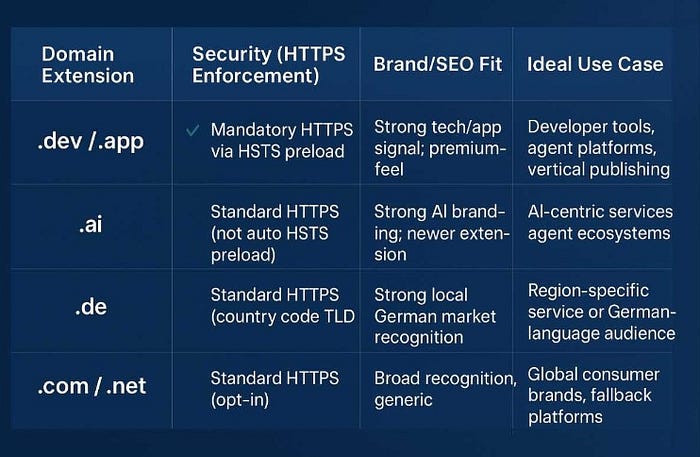
The real difference isn't technical specs. It's expectation management. Users expect .dev sites to be developer tools. They expect .app sites to be applications. A .com could be anything. When you meet user expectations at the domain level, everything that follows feels right.
Why Google Registry Made This Non-Negotiable
Google didn't do this out of kindness. They did it because they understood something that most domain registrars still don't: security is a feature, not a burden.
When you register a .dev or .app domain, Google's registration requirements are clear: you must use HTTPS. You don't have the option to run HTTP-only. The infrastructure assumes you're operating a real business, not a hobby project. That's the signal it sends to browsers, search engines, and users.
This wasn't a gentle suggestion. This is policy written into the TLD itself.
The effect is immediate:
- No mixed-content warnings when you load images, scripts, or stylesheets
- No browser security indicators that scare away users
- No SEO penalty for using an unencrypted protocol
- No certificate renewal chaos (more on that in a moment)
Google confirms that HTTPS is a lightweight ranking signal and .dev/.app domains inherit this advantage automatically.
The Vercel Multiplier Effect
If HSTS preload is the foundation, Vercel is the accelerant.
When you deploy to Vercel (which takes about three minutes for a new project), the platform automatically provisions a free SSL certificate for any domain you point at it. You don't fill out forms. You don't wait for validation emails. You don't pay a subscription. The certificate appears, updates itself, and works.
This is the invisible infrastructure layer that makes .dev and .app domains actually useful at scale.
Here's the workflow:
- Register a .dev or .app domain
- Point its nameservers to Vercel
- Deploy your code to Vercel
- Verify the domain in Vercel's dashboard
- Your site is live over HTTPS with a valid certificate
The entire process takes less than ten minutes. No manual certificate renewal. No cryptographic key management. No certificate expiration reminders at 3 a.m. on a Sunday.
Compare that to traditional workflows where you're either paying a subscription to Let's Encrypt, managing manual renewal cron jobs, or paying per certificate with a commercial CA. The friction vanishes.
Why This Matters for AI Agents and Contributor Platforms
The real advantage emerges when you're building platforms that move fast and scale differently.
Imagine you're launching an AI agent that runs as a SaaS product. Your users need to trust that their data is encrypted. You need to add new deployment regions without reconfiguring SSL. You need to spin up staging environments without certificate headaches. You need to know that every single instance is secure by default, no exceptions.
.dev and .app domains eliminate an entire category of infrastructure decisions. You're not debating whether to use HTTPS in production. You're not dealing with developers who accidentally left HTTP enabled in staging. You're not scrambling when a certificate expires because someone didn't get the renewal notification.
For contributor platforms places where developers fork code, submit changes, or build plugins this matters even more. Contributors care about security signals. They read the browser bar. They see green locks. A .dev or .app domain says "this team takes security seriously" without you saying anything.
The same applies to publishing workflows. If you're building a content platform where SEO and trust matter, .dev and .app domains give you wins on both fronts before you publish a single post.
The SEO Advantage Nobody Mentions
HTTPS is a ranking signal. So is domain clarity.
When Google's algorithm evaluates sites, it rewards HTTPS usage. But it rewards it more when the choice was intentional rather than accidental. A .dev domain signals that whoever built the site knew what they were doing. It's technical credibility written into the domain extension itself.
But there's a deeper play here.
Keyword-rich .dev and .app domains amplify search intent alignment. A domain like nutrition.dev or valuation.app tells users exactly what they're getting. It's specific. It's memorable. It uses the vertical's language. When combined with the secure-by-default architecture, it becomes a brand asset that compounds over time.
- Users remember nutrition.dev easier than nutrition-tools-123.com
- Search engines recognize the intent match between the domain and the content
- Security indicators reinforce that this is a legitimate resource, not a phishing site
- The .dev or .app extension itself carries weight in tech-forward communities
The VisionVix Model: Pre-Built Infrastructure Plus Domains
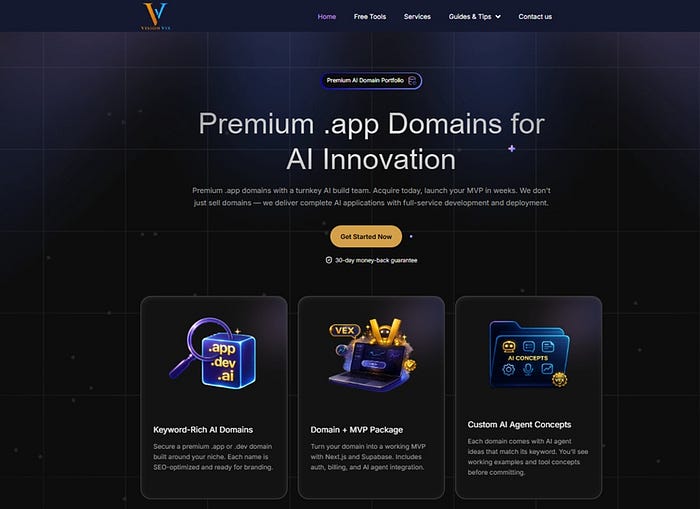
This is where theory becomes actual products.
VisionVix operates a marketplace that bundles premium keyword-focused .dev and .app domains with pre-built AI agents and SaaS products. Instead of starting from scratch, you're starting with:
- A domain that's already secure by default
- A product that's already built and market-tested
- An infrastructure architecture that's already optimized
- A brand that already has SEO authority (in some cases)
The portfolio includes products like aistatistics.app, testlatency.app, debugcss.app, fixbugs.app, and debugtool.app. Each one uses the .app extension to signal that it's a functional application, not a landing page or documentation site.
You can lease these domains and products monthly or purchase them outright. The lease model makes sense for experiments. The purchase model makes sense for things you're building long-term.
Technical Considerations and Mixed-Content Blocking
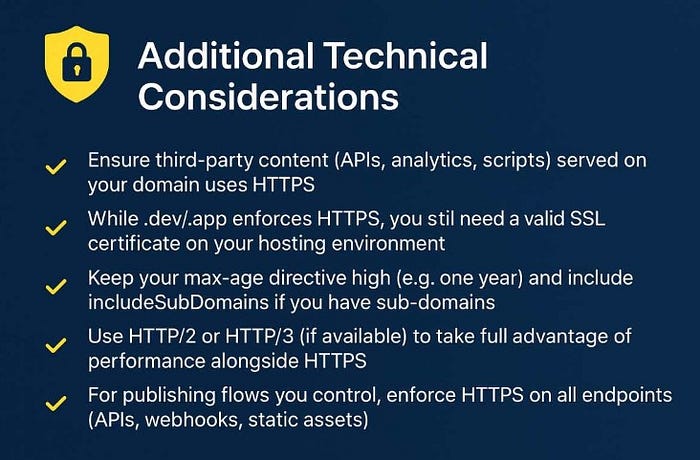
One thing that matters: if you're loading third-party content, it needs to be HTTPS too.
Because .dev and .app domains enforce HTTPS at the browser level, any resource you try to load over unencrypted HTTP will be blocked. This is a feature, not a bug it protects your users but it means you need to be intentional about your dependencies.
If you're embedding analytics, ads, or external APIs, verify they support HTTPS. If they don't, the browser will silently block them. No warnings. No fallback. Just silence.
This is why HSTS preload is both powerful and strict. It assumes you've thought through the full stack.