
و الصلاة و السلام على أشرف الخلق أجمعين سيدنا و حبيبنا و شفيعنا محمد صلى الله عليه و سلم
رمضان مبارك علينا و عليكم تقبل الله منا و منكم الصيام و القيام و جعلنا من عتقاء هذا الشهر الكريم اللهم امييين
اللهم لا علم لنا إلا ما علمتنا إنك أنت العليم الحكيم
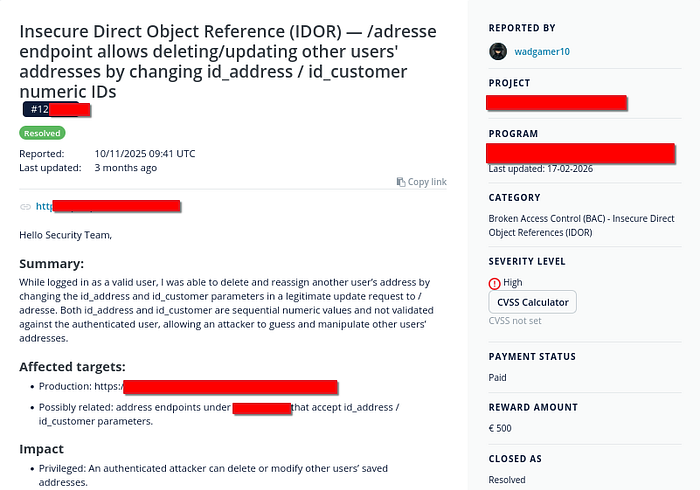
Hello Hunters, This is a new Write up about another exiting finding ,Its about How A Critical IDOR Vulnerability Allowed Deletion & Modification of (Any) User's Address.
Lets start …
Introduction
In modern web applications, authorization flaws remain one of the most dangerous yet commonly overlooked vulnerabilities. Among them, Insecure Direct Object Reference (IDOR) — or more formally, Broken Object Level Authorization (BOLA) — can lead to devastating consequences when sensitive user-controlled identifiers are not properly validated.
In this write-up, I will walk through a critical IDOR vulnerability that allowed:
- Unauthorized modification of other users' data
- Permanent deletion of victim addresses
- Mass exploitation due to predictable identifiers
This issue demonstrates how a seemingly simple flaw can escalate into a platform-wide integrity compromise.
Vulnerability Overview
The application exposes a feature that allows authenticated users to manage their saved addresses:
https://example.com/adressesWhile interacting with this functionality, it was discovered that:
- Each address is identified using a numeric
id_address - Each user is identified with
id_customer - Both values are sequential and predictable
- The backend fails to validate ownership of the address
This results in a classic IDOR / BOLA vulnerability.
Technical Details
Test Setup
Two accounts were created:
Attacker Account:
id_customer = 45230
id_address  = 46061
Victim Account:
id_customer = 45231
id_address  = 46063
Browser isolation was achieved using tools like PwnFox to simulate separate sessions.
Vulnerable Request
When updating an address, the application sends the following request:
POST /adresse?id_address=46061 HTTP/1.1
Host: example.com
Content-Type: application/x-www-form-urlencoded
Cookie: session=ATTACKER_SESSION
id_address=46061&id_customer=45230&alias=Home&firstname=Test&lastname=User&address1=test&postcode=11111&city=test&id_country=8&submitAddress=1
Exploitation
The vulnerability arises because the server trusts user-supplied identifiers.
By modifying both instances of id_address:
POST /adresse?id_address=46063 HTTP/1.1
Host: example.com
id_address=46063&id_customer=45230&...
Where:
46063belongs to the victim
Impact
This simple modification resulted in:
- Unauthorized Actions
- Deletion of the victim's address
- Overwriting victim data
- Data Reassignment
- The deleted address ID (
46063) was reassigned to the attacker
- Mass Exploitation Potential
Because:
- IDs are sequential
- No authorization checks exist
An attacker can:
- Enumerate all
id_addressvalues - Systematically delete or modify all user addresses
Business Impact
This vulnerability is critical due to:
- Data Integrity Loss: Users lose saved addresses permanently
- Account Data Corruption: Unauthorized modifications
- Trust Damage: Users cannot rely on stored data
- Scalability of Attack: Entire user base can be targeted
In real-world scenarios, this could lead to:
- Order delivery disruptions
- Fraud scenarios
- Customer churn and reputational damage
Rewarded
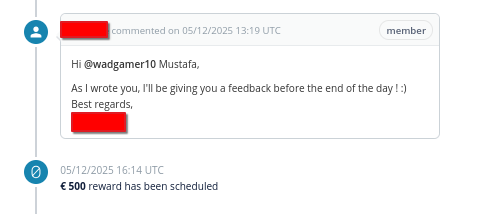
Real Bounty Comparison (€500 vs Industry)
To objectively evaluate the reward, let's compare with real-world IDOR payouts:
Industry Data
- Average IDOR bounty: ~$1,285 (~€1,200)
High-impact IDORs:
$3,500 (banking data exposure)
$10,500 (account-level abuse)
$12,500 (critical platform manipulation)
Real disclosed case:
- $3,000 IDOR (address manipulation) https://pwnpanda.github.io/Bug_Bounty_Reports/reports.html
Platform Benchmarks
- Typical High severity range:
- $1,000 — $5,000+
Critical severity:
- Can exceed $10,000+
Root Cause Analysis
The issue stems from:
- Missing Authorization Checks
The server does not verify:
Does this address belong to the authenticated user?- Trust in Client Input
Critical identifiers are fully user-controlled:
id_addressid_customer
- Predictable Identifiers
Sequential numeric IDs make enumeration trivial.
Vulnerability Classification
- Type: IDOR (Insecure Direct Object Reference)
- OWASP Category: Broken Object Level Authorization (BOLA)
- OWASP Top 10: A01: Broken Access Control
Recommended Fix
- Enforce Ownership Validation
On every request:
if address.user_id != current_user.id:
    deny_access()
- Remove Trust from Client Input
- Do NOT rely on
id_customerfrom user requests - Derive user identity from session/authentication context
- Use Indirect References
Replace sequential IDs with:
- UUIDs
- Random tokens
- Implement Access Control Middleware
Centralize authorization checks across endpoints.
- Logging & Monitoring
Detect:
- Repeated ID enumeration
- Suspicious modification patterns
Final Thoughts
This vulnerability highlights a critical lesson:
"Authentication alone is not security — authorization is mandatory"
Even with valid sessions, users must only access resources they own.
IDOR vulnerabilities are often easy to exploit but extremely impactful — making them a top priority for both attackers and defenders.
Thanks for reading. And i hope that you learned something new.
If you wanna following me on social media :-
https://t.me/wadgamaraldin (Telegram Channel For — Writeups — Blogs — Bug Bounty Tips — YouTube Videos )
https://www.linkedin.com/in/wadgamaraldeen/
https://twitter.com/wadgamaraldeen/
https://www.facebook.com/wadgamaraldeen/
About Me
Mustafa Adam
Bug Bounty Hunter
- HackerOne / Zerocopoter / Standoff365 / Google VRP / Private Programs
- Focus: Web Application Security