

If you are a beginner struggling to find bugs, this article will help you change how you think and guide you toward finding your first easy P1 bug.
You are not failing because bug bounty is hard. You are failing because you are looking for bugs instead of understanding how systems trust user input.
In this article, you will learn:
- How to think like an attacker instead of a user
- What companies actually care about
- How to choose better targets
- The difference between normal and skilled hunters
- How to break assumptions and find weak points
- How to analyze applications and requests deeply
- A practical workflow to identify and validate real bugs
Most beginners don't quit bug bounty because it's too hard.
They quit because nothing happens.
You pick a target, open Burp Suite, test endpoints, try payloads… and everything looks normal. No signal. No bugs.
After a while, it feels like bug bounty is luck.
It's not.
The problem is simple:
You are using applications like a user. Hackers question applications like attackers.
Bug bounty is not about tools. It is about how you think.
Step 1: Mindset Shift (Think Like Hacker vs User)

A normal user:
- Uses features
- Trusts responses
- Follows the intended flow
A hacker:
- Questions inputs
- Breaks flows
- Challenges trust
Instead of asking: "Does this work?"
Start asking:
Questions to ask yourself (Mindset level):
- What is this feature trusting?
- Can I control this input?
- What happens if I break this flow?
- Is this validated on frontend or backend?
- What is the worst thing that can happen here?
Applications don't break randomly. They break where trust is misplaced.
Step 2: What Companies Care About

Companies do not care about:
- UI issues
- Minor glitches
They care about:
- User data exposure (PII)
- Unauthorized access
- Account takeover
- Payment or refund abuse
This is why IDOR is powerful.
Because it directly affects:
- Data
- Access
- Business risk
A bug is valuable only when: An attacker can do something harmful with it.
Step 3: Choosing the Right Target
Avoid:
- Highly crowded bug bounty programs
- Mature, heavily tested applications
Focus on:
- Smaller or self-hosted applications
- Newly launched features
- APIs and backend systems
Instead of randomly picking targets, use structured discovery methods like bug bounty dorks.
Repository: https://github.com/sushiwushi/bug-bounty-dorks
This repository contains curated Google dorks to find self-hosted programs, responsible disclosure pages, and hidden targets that are less explored.
Most beginners fail not because of lack of skill, but because they choose the wrong targets — crowded platforms lead to duplicates and frustration.
Using dorks shifts your approach from random hunting to targeted hunting, increasing your chances of finding real vulnerabilities.
After selecting a target, don't just test the homepage — go deeper into less explored areas.
Look into:
- JavaScript files (hidden endpoints and API calls)
- API documentation (Swagger / open API specs)
- Old endpoints using Wayback Machine
For JavaScript hunting: https://medusa0xf.medium.com/hunting-api-keys-in-javascript-files-a-bug-hunters-guide-01940b7dd6ef
For high-impact endpoint recon: https://github.com/Cyb3rGu4rd14n5-T/Bug-bounty-Resources/blob/main/high-impact-endpoint-recon.md
Less tested surfaces always have a higher probability of containing vulnerabilities.
Step 4: Normal vs Pro Hunter (Thinking Difference)
Normal hunter:
- Tests randomly
- Uses payloads
- Stops when nothing works
Pro hunter:
- Understands application logic
- Tracks data flow
- Breaks assumptions
Pro hunters ask deeper questions:
- Where is access control happening?
- What parameter decides this data?
- Can I become another user?
The difference is not tools.
It is how deeply you analyze the system.
Step 5: Breaking Assumptions (Core of All Bugs)
Developers assume:
- Users will not change IDs
- Requests only come from frontend
- Users follow the correct flow
Attackers test the opposite.
Your questions (Assumption breaking):
- What if I change this ID?
- Can I skip this step?
- Can I send this request manually?
- Can I access someone else's data?
Why Developers Make These Mistakes
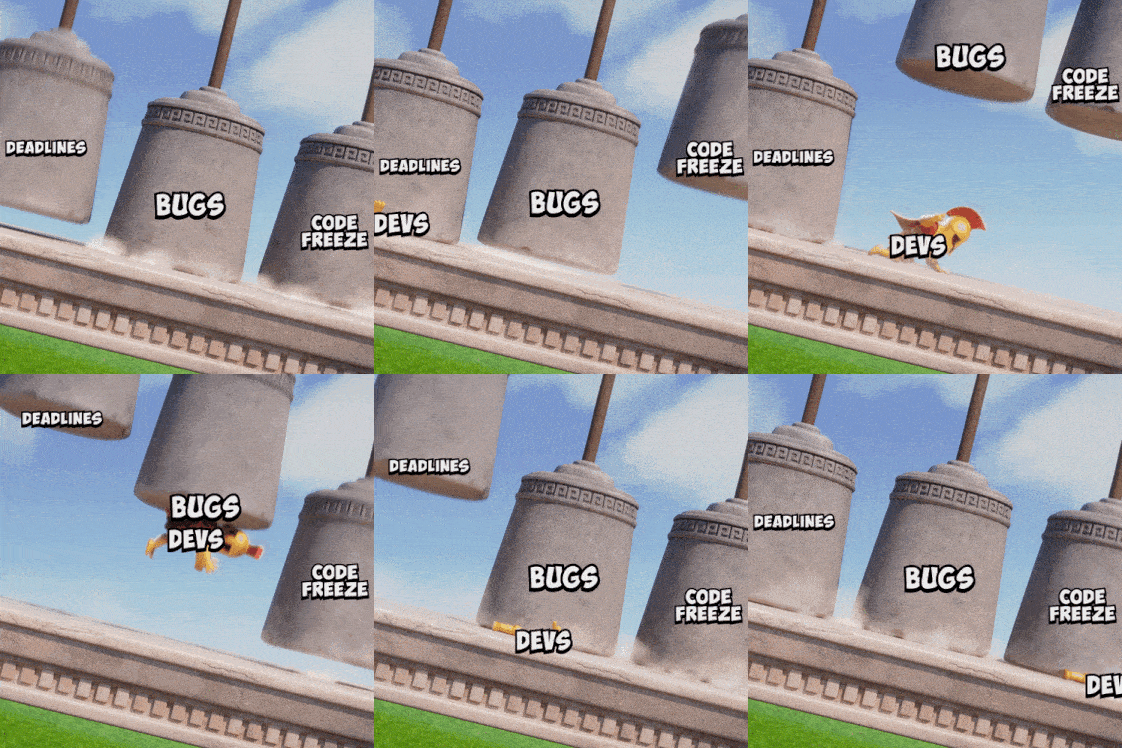
Developers are not careless. They are under constraints.
- Tight deadlines force focus on functionality over security
- Business pressure prioritizes shipping features quickly
- Frontend validation is wrongly trusted as sufficient
- Backend authorization checks are sometimes incomplete
- Complex systems make access control harder to manage
- Internal APIs are assumed to be safe from abuse
- Security testing is limited before release
Result: The feature works, but access control is broken.
2FA Bypass Example (Flow Broken)
A real-world example of broken authentication logic can be seen in this 2FA bypass case, where the application trusted that the second factor was completed, but the backend never properly verified it, allowing attackers to skip OTP entirely: https://infosecwriteups.com/2fa-bypass-a-case-of-insecure-implementation-8b9e44f3d68c
Developers assume(About this article):
- User will complete OTP step
- Flow cannot be skipped
Attacker:
- Skips OTP step
- Sends request manually
- Gains access
The system has two locks but only checks one.
Technical Questions(u should ask yourself)
- Is authorization checked server-side?
- Is this ID mapped internally?
- Can I chain requests?
- Is there a hidden parameter controlling access?
Step 6: Use the Application Deeply
Before testing:
- Register accounts
- Use all features
- Perform real actions
Then:
- Capture requests (Burp Suite)
- Identify parameters
- Modify them
Understanding comes before exploitation.
IDOR Example
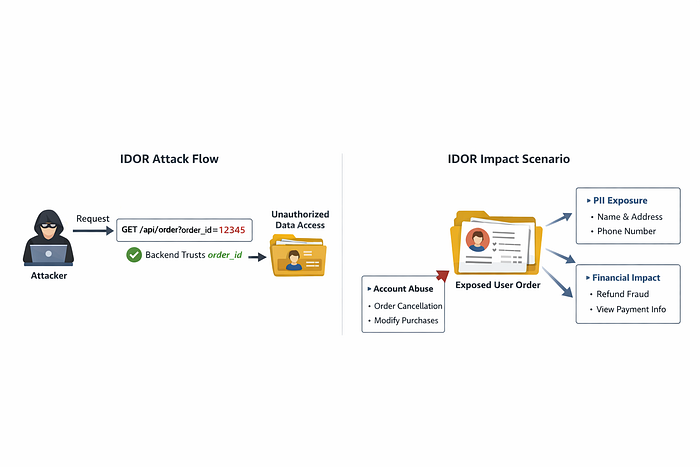
GET /api/order?order_id=12345
Authorization: Bearer token
Test:
GET /api/order?order_id=12346
Authorization: Bearer same_token
If another user's data is returned, it is an IDOR.
Root cause: Backend trusts order_id without verifying ownership.
Step 7: Focus on IDs (High Probability Area)
Look for:
- user_id
- order_id
- invoice_id
- file_id
- ticket_id
Example:
GET /api/order?order_id=12345If you control the ID, you may control access.
Anywhere an identifier controls data → test it.
Step 8: Hunt IDOR Smartly
IDOR is not limited to URLs.
Check:
JSON:
POST /api/order/details
{
  "order_id": "839274"
}
Hidden APIs:
- Mobile endpoints
- Internal APIs
Headers and parameters:
- Custom identifiers
- Secondary inputs
IDOR is not about location.
It is about missing authorization.
Step 9: Practical Hunting Flow
Use a structured process: Observe → Question → Modify → Analyze → Validate
Start by using the application as a normal user to understand how it works. Capture requests while performing actions and identify where identifiers are used. Modify those identifiers and send the request again.
Analyze the response carefully to check whether unauthorized data is returned. If access is granted to data that does not belong to you, confirm the issue and assess its impact.
Final operational questions: Did the server verify ownership? Did I get unauthorized data? Can I prove real impact?
Why IDOR Is an Easy P1 Bug for Beginners
IDOR is considered easy because:
- No payloads required
- No complex exploitation
- Only parameter manipulation
But impact is high:
- Access to other users' data
- Account-level actions
- Sensitive information exposure
Simple bug + high impact = critical severity.
Real Article Insight (4-Digit Bounty Case)
https://medium.com/@Tanvir0x1/critical-idor-vulnerability-leads-to-user-information-disclosure-b0bb7f06aef5
Key learnings from above IDOR report:
- Backend did not verify user ownership
- Changing user ID exposed sensitive data
- No advanced tools were required
- Real user data was accessible (PII)
- Multiple accounts were used for proof
- Clear proof of concept increased credibility
- Strong impact explanation resulted in high bounty
Real-World IDOR Reports That Will Change How You Think
If you are serious about finding IDORs, reading real reports is not optional — it is required.
Because IDOR is not a payload-based bug. It is a thinking-based bug.
Below are curated real-world reports and collections. Don't just read them — study how each hunter approached the application.
🔗 25 Real IDOR Report Resources
- https://corneacristian.medium.com/top-25-idor-bug-bounty-reports-ba8cd59ad331
- What You Will Understand After Reading These
If you actually go through these reports carefully, you will notice patterns:
- IDOR is rarely obvious in URL parameters only
- Many bugs exist in APIs, JSON requests, and hidden endpoints
- Attackers don't guess randomly — they follow application logic
- Most vulnerabilities happen due to missing authorization checks
- The same bug appears in different forms across different apps
NoTe: After reading these, your thinking will shift from "where is ID?" to "where is access control broken?"
Where Hunters Actually Find IDOR (Not Just URLs)
Most beginners only check:
/api/user?id=123
If it fails → they stop.
But real hunters check everywhere:
- API endpoints (
/api/v1/...) - POST body parameters
- JSON data (
"user_id": 123) - GraphQL queries
- File download endpoints
- Invoice systems
- Order systems
- Hidden mobile APIs
- Background requests
NoTe: IDs are not just visible — they are everywhere inside the application flow.
Where Beginners Skip (And Miss Bugs)
Most beginners skip:
- Testing POST requests
- Modifying JSON values
- Replaying requests
- Testing after login flows
- Checking secondary endpoints (like invoices, exports)
- Trying old / deleted / different user IDs
They test surface level.
IDOR lives deeper.
The Mindset You Learn From These Reports
After reading these reports, one thing becomes clear:
Normal thinking:
- "Let me change ID and see"
Real thinking:
- "How is access control implemented here?"
Normal thinking:
- "ID not working → no bug"
Real thinking:
- "Where else is this ID used?"
Normal thinking:
- "This feature works fine"
Real thinking:
- "What is this feature trusting?"
IDOR Hunting Techniques (Must Study)
To go deeper, use this resource:
👉 https://github.com/Cyb3rGu4rd14n5-T/Bug-bounty-Resources/blob/main/IDOR%20Hunting%20Techniques
This covers:
- Parameter manipulation
- ID fuzzing
- Access control testing
- Advanced IDOR cases
- Real hunter methodologies
Every IDOR in these reports exists for one reason — the application trusted an identifier without verifying ownership.
Where Beginners Fail
- Testing blindly without understanding flow
- Not proving real impact
- Using only one account
- Stopping after first failure
- Ignoring APIs and hidden endpoints
Final Thought
Do not ask: Where is the bug?
Ask: What is this system trusting?
Because every system trusts something.
And every vulnerability exists where that trust fails.