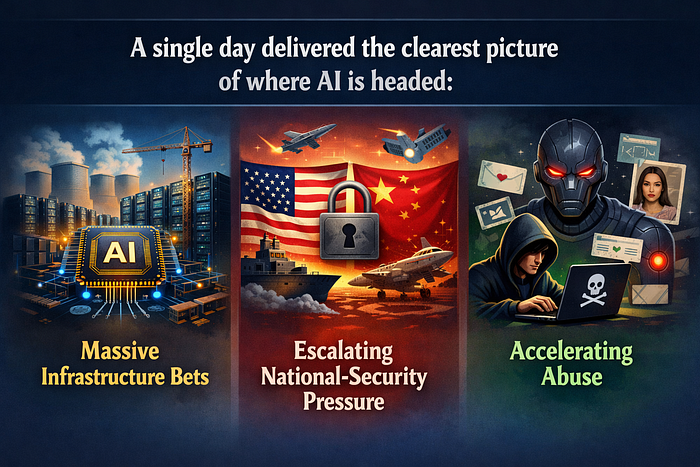

A single day delivered the clearest picture of where AI is headed: massive infrastructure bets, escalating national-security pressure, and accelerating abuse — all at once.
If you build software for a living, this is the part that matters: the AI story is no longer "model X is smarter." It's chips, policy, and threat actors.
- Signal: Meta just signed a multi-year AI chip deal with AMD measured in tens of billions — a concrete shift in the GPU power map.
- Implication: The U.S. Pentagon is pushing AI vendors toward "all lawful uses," even when companies claim ethical red lines.
- What to do: Treat AI like critical infrastructure: budget it, govern it, and design for adversaries — because they're already using it.
The chip war just got real: AMD–Meta isn't a press release, it's a power shift
Reuters reported that AMD secured a major deal to supply Meta with up to $60B worth of AI chips over five years, plus an arrangement that could let Meta build an ownership position in AMD.
Other coverage emphasized the deal could reach higher totals depending on options and structure.
Two details make this bigger than "another GPU contract":
- Scale is measured in gigawatts, not units.
- Meta's order is tied to roughly 6GW of compute capacity over time — data-center physics, not marketing.
- It's also a hedge against Nvidia concentration.
- Even before this, investors were watching for signs that hyperscalers would diversify away from a single supplier. This deal is that sign, in ink.
Translation: "AI leadership" is getting priced in infrastructure, and infrastructure is getting priced like geopolitics.
The Pentagon–Anthropic clash is the second front: who controls the guardrails?
Associated Press reported that Defense Secretary Pete Hegseth warned Anthropic to allow the military to use Claude "as it sees fit," or risk losing government business — while the Pentagon signaled it could escalate pressure via supply-chain tools.
Axios previously reported the Pentagon considered labeling Anthropic a "supply chain risk," which would force contractors to certify they aren't using Claude.
The story here isn't "ethics drama." It's a governance collision:
- Companies want brand safety + risk containment.
- States want capability + optionality, especially for national security.
- Everyone wants to win the AI race.
If you've been treating "AI policy" as something for lawyers, 2026 is changing that. This is product strategy now.
The money is obscene — and that's the point
Bridgewater estimates Alphabet, Amazon, Meta, and Microsoft will invest about $650B in AI infrastructure in 2026, up from roughly $410B in 2025.
Barron's notes this level of spend is reshaping cash flow dynamics (and buybacks), because AI is forcing megacaps into a more asset-heavy posture.
That's why Nvidia earnings this week are being framed as a macro event: investors want proof that the spending cycle still prints returns.
Quote-worthy line:
AI isn't "software" anymore. It's a capital project.
Labor reality check: the Fed is openly talking about AI unemployment
Fed Governor Lisa Cook warned AI is triggering "generational" labor market change and could raise unemployment in a way that rate cuts don't fix.
Atlanta Fed President Raphael Bostic echoed concerns about structurally higher unemployment that monetary policy can't offset.
Whether you agree or not, the signal is loud: AI is now a central-bank topic, not just a tech Twitter topic.
Meanwhile, attackers aren't waiting for regulation
CrowdStrike's 2026 Global Threat Report says AI is helping adversaries move faster and scale operations — reporting an 89% rise in AI-enabled adversary activity year-over-year in 2025, and "breakout times" measured in minutes.
And the FBI has been issuing public guidance about AI-enabled impersonation and deepfake-style scams, including campaigns targeting officials.
This is the part most product teams underprice: AI amplifies offense as much as it amplifies productivity.
Europe is reacting too: Spain is escalating scrutiny on AI-generated child abuse content
Spain's Fiscalía accepted the government request to investigate the spread of AI-generated child sexual abuse material on social platforms, using a specialized cybercrime unit.
That matters for builders because it's a preview of where platform liability arguments go next: algorithms + generative tools + distribution at scale.
The developer experience is also shifting fast (and quietly)
Cursor's changelog shows "cloud agents with computer use," meaning agents can run in isolated VMs, test changes, and ship reviewable PRs with artifacts.
LinkedIn's "Skills on the Rise 2026" highlights fast-growing skills across markets — an official signal that the workforce is being pushed toward adaptability and AI-adjacent competency.
This is how the AI boom becomes real inside companies: not with a "strategy doc," but with tooling that changes what a normal workday looks like.
What would change my mind
I'd be less skeptical about the durability of this cycle if we saw:
- Transparent unit economics for AI infrastructure (cost per task down while usage scales up).
- Clear, enforceable norms on military and surveillance use that don't require brinkmanship between the state and vendors.
- Measurable workforce transition policies (reskilling that actually lands jobs, not PDFs).
- Security baselines that assume AI-accelerated adversaries by default.
Practical: what to do this week (if you build with AI)
- Write an AI cost ceiling (monthly inference budget + what happens when you hit it).
- Create an "AI data redline" (what can never leave your systems: secrets, PII, regulated docs).
- Add an AI kill-switch (feature flag + rollback + audit logs).
- Threat-model deepfakes + impersonation for your org (finance approvals, HR, vendor onboarding).
- Assume prompt injection and hostile inputs in any agent flow (sandbox + least privilege).
- Track one labor metric: tasks reduced vs roles reduced (don't confuse productivity with layoffs).
- Don't bet on one supplier if AI is core to your product roadmap (chips and policy can both break you).
If you want more of this kind of analysis (less hype, more incentives + constraints), follow me.
Next: "AI Is Becoming a Utility — And Utilities Always Get Regulated."
Sources & limitations
This piece summarizes reporting published Feb 24, 2026 (plus a few relevant earlier advisories). Some claims in social circulation (exact deal ceilings, stock moves, "ultimatums" details) vary by outlet; I anchored the big facts to primary reporting and official statements where available.
If I build a paid "AI Reality Pack" (domain + course platform), what should be Module #1?
Comment:
- Cost & infra math
- Guardrails + policy
- Threat model + defenses
- Agent workflows (Cursor, etc.)
- Also tell me your stack: iOS / web / backend / data.