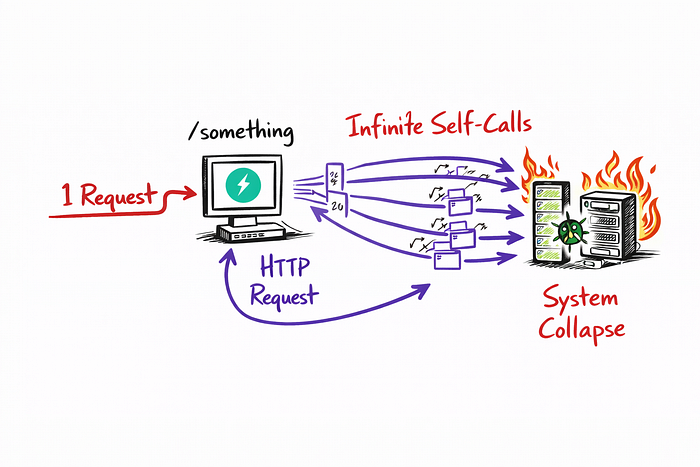

A single misconfigured endpoint, retry loop, or webhook can quietly turn into an unbounded feedback loop. What looks like one extra request becomes a system-wide failure.
It Looks Harmless
@app.get("/")
def root():
    requests.get("http://localhost:8000/")
    return "ok"
At a glance, nothing seems wrong. It's just making an internal call.
But this creates a loop:
- Request comes in
- Endpoint calls itself
- That request triggers another
- And it keeps going
This isn't recursion. It's amplification.
Different Ways This Fails
1) Direct recursion (safe failure)
def root():
return root()- Stack grows
- Python throws
RecursionError - Fails fast
→ Contained and predictable
2) Sync HTTP self-call
requests.get("http://localhost:8000/")- Threads get blocked
- Requests pile up
- Server becomes unresponsive
→ Slow collapse under load
3) Async HTTP self-call (worst case)
await httpx.get("http://localhost:8000/")- No blocking → faster request generation
- Event loop overwhelmed
- System crashes quickly
→ Fastest path to failure
4) Multi-worker setup (production reality)
With Gunicorn/Uvicorn workers:
- Each request spawns another
- Workers saturate
- CPU spikes
- Memory grows
→ You've built a self-DDoS engine
What Breaks First
In most systems, the failure sequence looks like:
- Worker/thread exhaustion
- Connection pool limits hit
- Latency spikes
- Timeouts cascade
- Process crash or restart loop
The system doesn't "see" the loop — it just sees more traffic.
Where This Happens in Real Systems
This isn't theoretical. It shows up as:
- Webhooks pointing back to the same endpoint
- Infinite retry loops
- Circular microservice calls (A → B → A)
- Misconfigured service mesh routing
The pattern is always the same:
The system loses track of who is calling whom.
Why It's Dangerous
Local recursion fails fast.
Network recursion doesn't.
It:
- consumes real resources
- scales with traffic
- spreads across workers and services
By the time you notice, it's already an incident.
Simple Guards That Prevent This
You don't need complex solutions — just boundaries.
- Add timeouts to all outbound calls
- Limit retries (never infinite)
- Pass request IDs to detect loops
- Block internal re-entry via headers
- Avoid synchronous self-calls entirely
The Rule
If a service calls itself over the network, it must be:
- intentional
- bounded
- observable
Otherwise, it's a failure waiting to happen. Function recursion crashes your code. HTTP recursion crashes your system.
If you're building data platforms, exploring analytics, or just love thinking about how data actually tells a story, feel free to follow or leave a clap 👏R. t's a small signal, but it helps me keep writing honest, example-driven content about data modeling, fact tables, dimensions, and the patterns that make analytics work.
Thanks for reading and for keeping curiosity alive ❤️.