- Modern software teams don't fail at security because they ignore it.
- They fail because security models haven't evolved at the same pace as software development.
Applications today are built continuously, deployed frequently, and composed of many moving parts.
Secure SDLC exists to ensure security evolves with this reality — not after it.
1. Modern Applications Are More Than Just Source Code
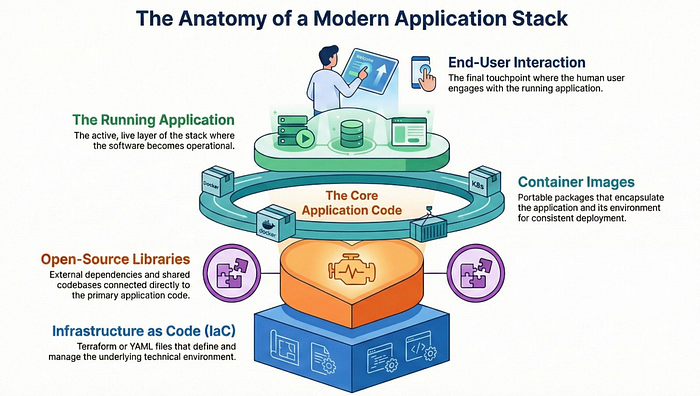
Today's applications are not a single codebase running on a server. They are a combination of multiple interconnected artifacts:
- application source code
- open-source libraries and dependencies
- infrastructure defined as code (Terraform, ARM, CloudFormation, YAML)
- container images and deployment manifests
- cloud runtime services and environments
A vulnerability in any one of these layers can compromise the entire application.
Secure SDLC matters because it secures everything that is built and deployed as code, not just application logic.
2. Why Traditional Security Models No Longer Work
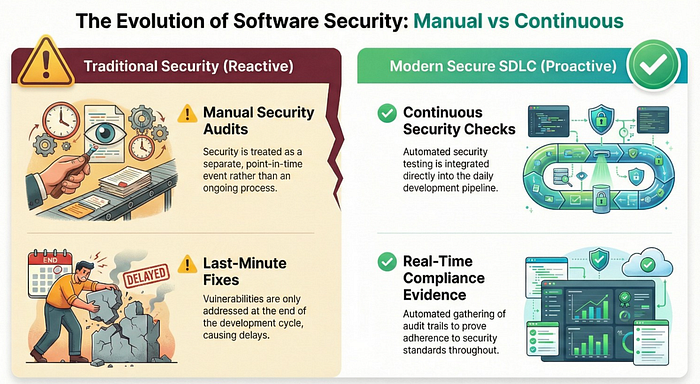
- Traditional security approaches were designed for slower, linear development cycles.
- Security was treated as a separate, point-in-time activity, usually performed near release.
This leads to:
manual audits instead of continuous checks
late discovery of vulnerabilities
rushed fixes under release pressure
Modern development pipelines move too fast for this model.
Secure SDLC replaces reactive security with continuous, built-in security controls.
3. Two Paths to Production: Risk vs Stability
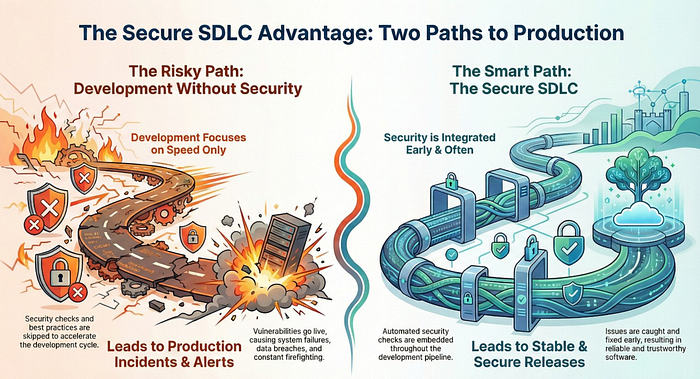
When security is not integrated early, development may move fast — but risk accumulates silently.
This results in:
- vulnerabilities reaching production
- operational incidents and alerts
- emergency patching and firefighting
With Secure SDLC, security checks are embedded early and often, leading to predictable and stable releases.
4. What Secure SDLC Is Actually Built On
- Secure SDLC is not a collection of tools.
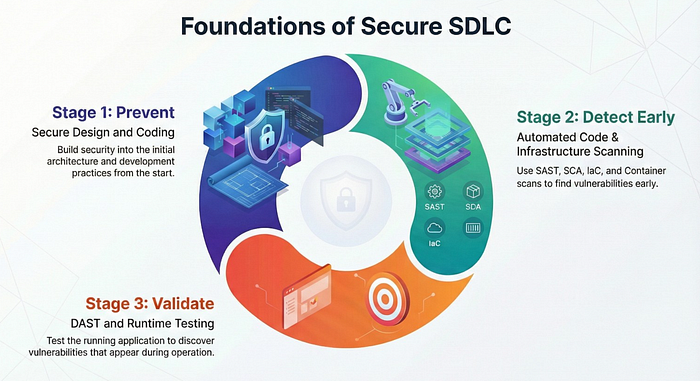
- It is a control strategy built on three foundational principles:
- Prevent — Secure design and secure coding from the start
- Detect Early — Automated scanning during development
- Validate — Testing running applications before release
- Preventive and early-detection controls form the foundation.
- Later controls exist, but they are reinforcing controls, not the base.
5. The Economics of Early Security
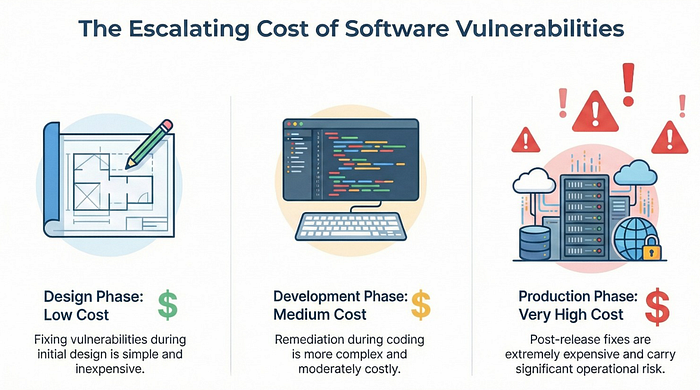
The later a vulnerability is discovered, the more expensive it becomes to fix.
- Design phase fixes are simple and low cost
- Development phase fixes require rework
- Production fixes are expensive and risky
Secure SDLC shifts security left, where fixes are faster, cheaper, and safer.
6. The Business Case for Secure SDLC
Secure SDLC is not just a security decision — it is a business decision.
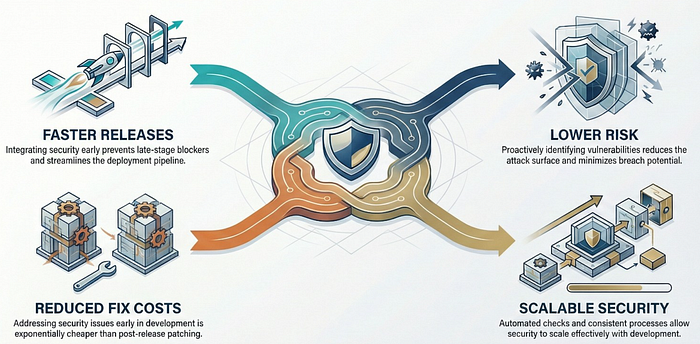
Organizations that adopt Secure SDLC benefit from:
faster and more predictable releases
lower long-term remediation costs
reduced breach and incident risk
scalable security that grows with development
Security becomes an enabler, not a blocker.
7. Secure SDLC in Action: CI/CD Integration
Secure SDLC operates through automation, not manual effort.
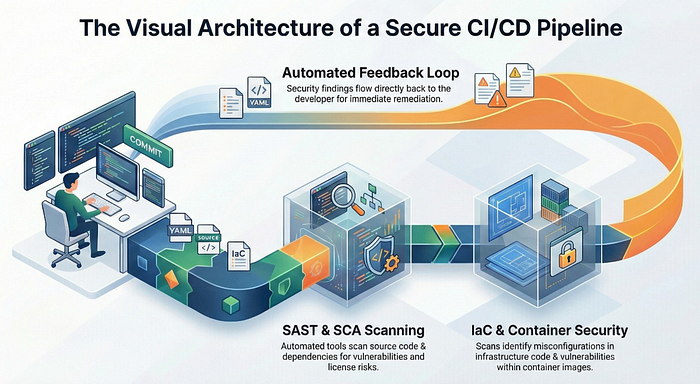
In a secure CI/CD pipeline:
- code, IaC, and YAML commits trigger pipelines
- SAST and SCA scan source code and dependencies
- IaC and container scans detect misconfigurations early
- findings flow back to developers immediately
Security becomes part of the development workflow — not an interruption.
8. Secure SDLC Is a Shared Responsibility
Secure SDLC works because it distributes responsibility correctly:
Developers write and remediate secure code
Security engineers define policies and guardrails
Operations teams secure infrastructure and respond to incidents
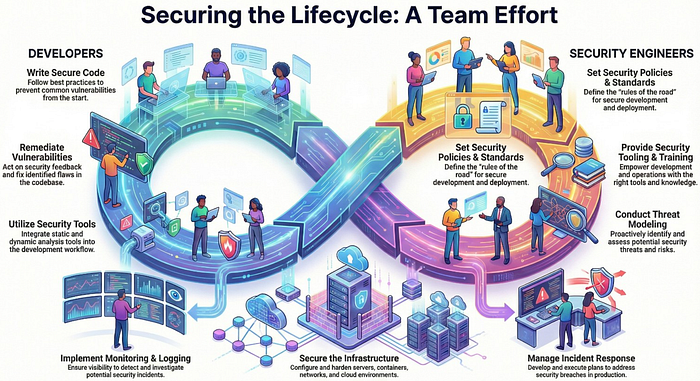
Security is enforced by process and automation, not individuals.
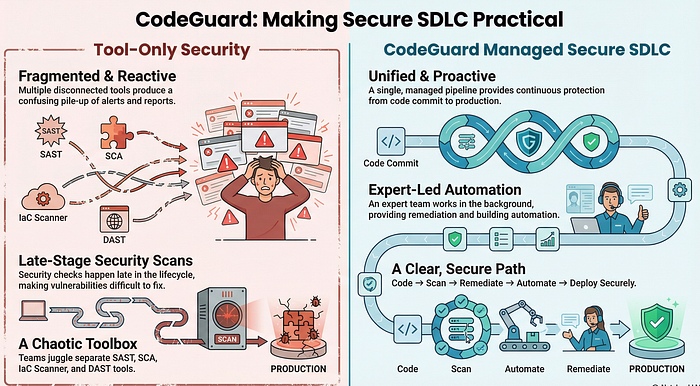
9. CodeGuard: Making Secure SDLC Practical
- Secure SDLC explains what needs to be done.
- CodeGuard focuses on getting it done.
CodeGuard is a managed Secure SDLC service that:
quietly works alongside development teams
secures source code, dependencies, IaC, containers, and runtime behavior
performs expert-led remediation and framework upgrades
integrates security into CI/CD pipelines
automates scans to prevent vulnerable code from reaching production
CodeGuard turns Secure SDLC from a strategy into day-to-day execution, with minimal disruption to development velocity.