June 3, 2026
Beyond the Gatekeepers: Replacing Bureaucracy with Golden Paths and Absolute Ownership
From the vantage point of a technology delivery firm specializing in software development, ERP advisory, data science, organizational…

Namir Sagheenanajar
5 min read
From the vantage point of a technology delivery firm specializing in software development, ERP advisory, data science, organizational effectiveness, and developer advocacy, the current macroeconomic operating environment looks less like a strategic evolution and more like a collective hallucination. By early May 2026, technology industry layoffs surpassed 100,000, driven by a sweeping corporate trend to restructure workforces around artificial intelligence. This aggressive retrenchment is not occurring due to a collapse in demand, but rather due to a desperate capital reallocation backed by the thirst of corporate greed. Corporate boards are systematically funneling every available dollar toward AI infrastructure, cloud capacity, and high-end model compute. While software labor was historically treated as the most expensive commodity of the technology stack, the massive compute bills associated with AI have emerged as a punishing, permanent fixed cost. Consequently, enterprises are aggressively sacrificing present organizational stability to buy future leverage, often eliminating entire strategic layers under the assumption that automated agents will seamlessly bridge the gap.
This systemic pivot relies on the false belief that immediate headcount reductions will automatically translate into an operational return on investment. Empirical evidence suggests this assumption is highly flawed. A study of 350 global business executives at companies generating at least 1 billion dollars in annual revenue revealed that while 80 percent of organizations deploying autonomous capabilities reported workforce reductions, these cuts did not yield superior business returns. In reality, the rate of staff reduction was nearly equal between enterprises reporting robust returns and those seeing mediocre or failing outcomes. Dismissing employees may temporarily clear budget space on a quarterly balance sheet, but it does not make technology useful. The high-performing organizations that actually realize measurable returns are those that keep human judgment in the loop, investing in operating models that allow experienced professionals to guide, check, and expand autonomous systems.
The Compensation Anomaly of the Reluctant Contributor
A direct byproduct of this management purge is the forced migration of highly experienced software development managers back to the ranks of individual contributors. Stripped of their strategic oversight roles during the flattening process, these veteran leaders are transitioning back to technical execution roles. Shockingly, these professionals are securing individual contributor positions at compensation packages that are equal to, or frequently higher than, their previous salaries as managers. This phenomenon is driven by the structure of modern engineering pay scales, where competitive compensation bands for Staff and Principal Engineers heavily overlap with line-management and director-level salaries. When enterprises eliminate a manager, they often find themselves forced to hire that same level of expertise as a high-level technical architect to keep their systems from collapsing, paying a premium for domain authority.
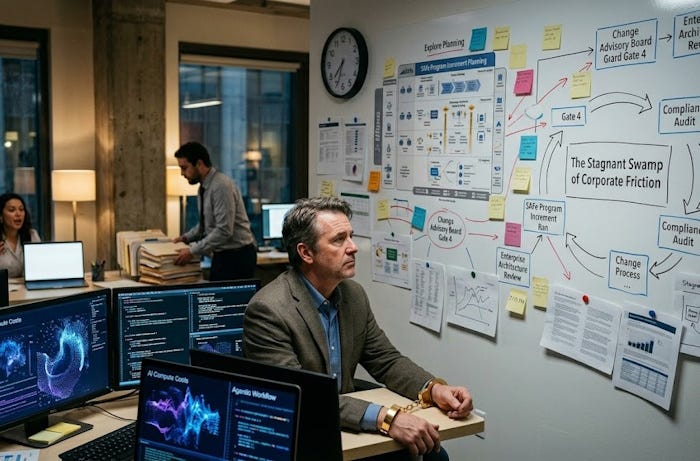
This compensation overlap creates a profound misalignment of incentives. While these returning contributors are handsomely rewarded, they are placed in environments that actively restrict their ability to drive meaningful outcomes. Many of these individuals are seasoned organizational architects who understand how to unblock teams, design clean workflows, and coordinate complex delivery pipelines. Instead of being empowered to leverage these skills, they are forced to sit idle in highly restrictive roles, watching projects flounder under massive bureaucratic burdens, highly centralized administrative layers, and the dreaded political theater. Having previously possessed the autonomy to call their own shots and lead high-performing teams, they now find themselves trapped in golden handcuffs, unable to deploy their leadership capabilities to resolve the delivery bottlenecks happening directly in front of them.
Navigating the Stagnant Swamp of Corporate Friction
The primary source of frustration for these overqualified contributors is the compounding friction embedded in modern developer workflows. Rather than building an environment optimized for execution, bloated enterprise IT structures have introduced an array of administrative hurdles that paralyze progress. When analyzing developer experience, three core dimensions dictate productivity: flow state, cognitive load, and feedback loops. Research indicates that developers who have dedicated, uninterrupted time carved out for deep focus feel fifty percent more productive than those whose days are fragmented. However, in most enterprise environments, this focus time is systematically destroyed by constant meeting overload, endless status updates, and a barrage of real-time communication interruptions.
Furthermore, the volume of cross-functional collaboration has become a major driver of cognitive load. When a developer must collaborate with more than seven or eight people outside their immediate sphere to complete a task, their perceived productivity plummets. This over-collaboration is frequently paired with tool sprawl, opaque security review processes, and unclear requirements, forcing developers to spend more time navigating the organization than writing code. Former managers, who are highly sensitive to these inefficiencies, must watch as highly paid engineering talent is wasted on resolving basic logistical hurdles and waiting on manual approvals, knowing exactly how much velocity could be gained if the frontline had the autonomy to self-service their needs.
How Scaled Agility Became a Waterfall in Disguise
The roots of this administrative paralysis can be traced directly to fragmented and bloated organizational structures, often managed by overzealous players who prioritize process over output. Many enterprises have attempted to solve coordination challenges at scale by adopting heavy, prescriptive frameworks like the Scaled Agile Framework. While these methodologies are marketed as tools to harmonize processes and maintain alignment across dozens of teams, they frequently introduce a stifling layer of bureaucracy. Practices like Program Increment planning and the introduction of multiple coordination roles, such as Release Train Engineers and portfolio managers, often create a rigid hierarchy that mimics traditional Waterfall project management.
Under these heavily managed systems, decision-making becomes highly centralized. Engineering teams are forced to wait for signoffs from review boards and principal engineers who are several steps removed from the actual codebase and contextual realities of the work. This structure optimizes for process consistency at the direct expense of throughput and velocity, turning software delivery into a massive bottleneck. Even efforts to prepare for the agentic era often turn into complex organizational design challenges. For example, when enterprises attempt to automate approvals and workflows, they often layer these automated agents over legacy, approval-heavy compliance systems. This creates an environment where developers spend their days filing tickets and navigating permissions rather than executing code, completely neutralizing any potential speed gains offered by modern tools.
Replacing Gates with Guardrails and Reviving Absolute Ownership
To reverse this downward spiral of productivity, technology leaders must fundamentally redesign how authority and execution are distributed across the enterprise. Surviving the current economic environment requires a deliberate shift away from centralized gatekeeping and toward decentralized decision-making. Shifting strategic and operational choices directly to the software engineers who perform the work significantly reduces decision latency, increases product development flow, and boosts developer motivation. Rather than treating every decision as a major risk requiring committee approval, organizations should adopt a framework that categorizes choices based on their complexity, reversibility, and impact on core business domains. Under this approach, operational and highly reversible decisions are executed in full autonomy by frontline practitioners, while only high-cost, irreversible strategic decisions require broader alignment.
To support this decentralized model without risking system-wide drift, organizations must replace manual gates with automated guardrails. This is achieved by investing in platform engineering and establishing Golden Paths, which are pre-approved, highly automated self-service workflows that encode security, compliance, and architectural standards directly into the development environment. By utilizing Golden Paths, a developer can provision infrastructure, request access, or deploy a new service through a single, automated action without filing a ticket or waiting for a manual approval chain. This approach removes the administrative burden from the developer experience, shields teams from unnecessary cross-functional meetings, and allows highly paid technical talent to focus on deep, creative problem-solving.
Ultimately, what is needed is a major reduction in corporate bureaucracy and a restoration of absolute ownership to those closest to the tangible work. Removing bloated middle-management layers is only a sustainable strategy if executive leadership simultaneously decentralizes authority, pushes operational decisions down to the frontline, and builds automated channels for tracking information flow and system health. By replacing overmanaged, fragmented agile frameworks with clear local decision rights and automated guardrails, enterprises can transform their engineering departments from bottleneck factories into highly agile, high-velocity engines of business growth.
Thank you for reading until the end. Before you go:
- Please consider clapping and following the writer! 👏
- Follow us on Twitter(X), BlueSky, Truth Social, Substack, and LinkedIn.