June 6, 2026
THE FUTURE OF ELECTRONICS
Electronics is the modern branch of physics which deals with the manipulation and control of flowing electrons to generate or transmit…

Nidhinigamlko
4 min read
Electronics is the modern branch of physics which deals with the manipulation and control of flowing electrons to generate or transmit information or power. It started off in the early 1900's , when John Ambrose Fleming (the scientist behind the Left-Hand/Right-Hand Rule) pioneered the vacuum tube , or what is known today as the backbone of electronics, diode, which is a device consisting of two electrodes used to control charge. In 1947, William Shockley from Bell Labs in New Jersey, along with Walter Brattain and John Bardeen, pioneered the transistor . This replaced the earlier bulky and fragile vacuum tubes, revolutionizing electronics by making devices smaller and far more efficient. Today, electronics is used almost everywhere in this digital age, from our laptops to home appliances and to the rockets on space missions , etc.
However the growing usage of AI (Artificial Intelligence) has led to a move in the electronic industry to revolutionize itself. The need of the hour has transitioned to making more efficient and power-saving technologies of use in the future. In such a case, research has turned over to a new and futuristic branch- spintronics, which is aimed at delivering more energy for information supply without much wastage. First discovered in 1988–89, when Albert Fert (France) and Peter Grünberg (Germany) independently discovered Giant Magnetoresistance (GMR), this new technology can and will be of major importance to the global industry.
WHAT IS SPINTRONICS?
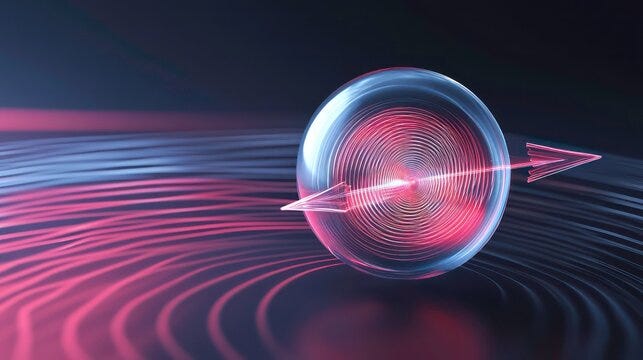
All of us must have studied about electron spin in school. It is the property of intrinsic spin, or angular momentum, of an electron, resulting in up and down electrons. Pauli's Exclusion Principle states that no two electrons can have all same quantum numbers. This means that two adjacent electrons can have the same subshells or orbitals, but not the same quantum property of up and down. The Spin Quantum number assigns +1/2 and -1/2 to the electron spin of different electrons.
Spintronics is the study of the same electron spin to generate energy for processing and storing data, using the magnetic moment created (a tiny magnetic field around the electron) by the Zeeman effect. Unlike traditional electronics, where the electron moves for it to be controlled, spintronics ensures the spin of the electron causes its "state" to be dynamic, thus reducing energy loss. It eliminates the need to constantly refresh data (unlike traditional DRAM), which vastly reduces energy consumption and heat generation.
HOW TO GENERATE POWER FROM SPIN?
- Spin-Seebeck Effect
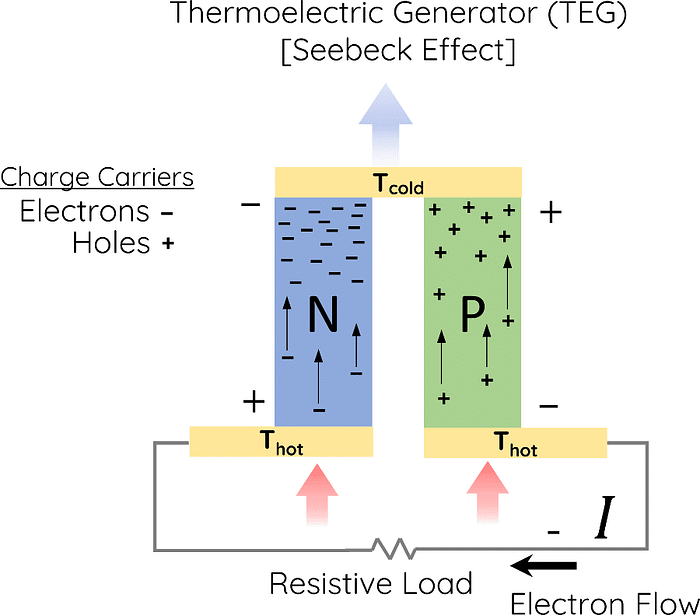
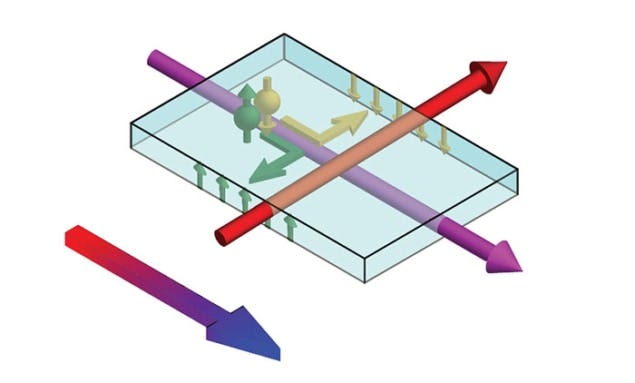
The Seebeck effect, discovered by Thomas Johann Seebeck, discusses the generation of electrical energy from heat applied on a conductor. The Spin-Seebeck Effect, discovered by Eiji Satoh and K Uchida in 2008, discusses the generation of a spin current in a magnetic material using heat, having no accelerated electronic charge.
When spin current is generated, it is then injected into a non-magnetic heavy metal like Platinum with high spin-orbit coupling. The ISHE (Inverse Spin Hall Effect) is a natural process which then converts spin current to electric voltage perpendicular to the magnetic field and spin flow.
APPLICATIONS- A possible thermoelectric generator which uses waste heat to form more electricity to power itself, thus increasing efficiency.
2. The Spin-Nernst Effect
Walther Nernst, one of the pioneers of electrochemistry, found that electric voltage can be generated perpendicular to an external magnetic field and heat applied on a conductor or semiconductor- The Nernst Effect. Similarly, in 2017, researcher Sebastien Gonnenwien found out that transverse spin current can be generated from longitudinal heat flow in Platinum — The Spin Nernst Effect.
When heat is applied on a Platinum thin film, the quantum spin waves, known as magnons, move from the hot to cold side. The up and down properties ensure that the electrons deflect in opposite directions, which leads to electron accumulation. This generates transverse spin current, without external magnetic field.
APPLICATIONS- Everyday electronics, like laptops and smartphones, can easily recharge using their own waste heat!
HOW IS ELECTRON SPIN DIFFERENT FROM ELECTRONIC CHARGE IN CARRYING CHARGE?
Electric spin is more efficient, because it allows for information transport without electron movement physically, eliminating significant energy waste due to heat and friction.
Traditional electronics operates by charge movement, which can lead to energy loss due to heat/friction. Spintronics can transmit the 'state'' without moving the electron physically, which extremely reduces the energy waste. This is known as 'Zero-Motion Data Transfer'.
Spintronic devices require less energy for power between 0 and 1, compared to MOSFET devices. Also, they retain information without much continuous power supply.
CONCLUSION
In the future, Spintronics has the maximum possibility to replace or to evolve classical electronics. It has revolutionized electronics by incorporating electron spin as a new alternative to the physical movement of charges. It has and will enable faster and more energy-efficient devices, with applications ranging from data storage and retention to information retrieval. As the need for AI and future technologies evolve, Spintronics can ensure the balance between old-school and new-school ways of science and technology by incorporating elements from both of them.