
It sounds simple, but it usually is not.
Numerous people assume panic hardware is required on every commercial exit door. It is not. In reality, the answer depends on a few key variables: how the space is used, how many people it serves, whether the door is part of the means of egress, and which code applies in that jurisdiction.
That is precisely why this topic creates so much confusion. There is no one-size-fits-all rule that works for every opening.
Here is a practical way to understand when panic hardware is typically required, when it usually is not, and what you should check before making assumptions on a project.
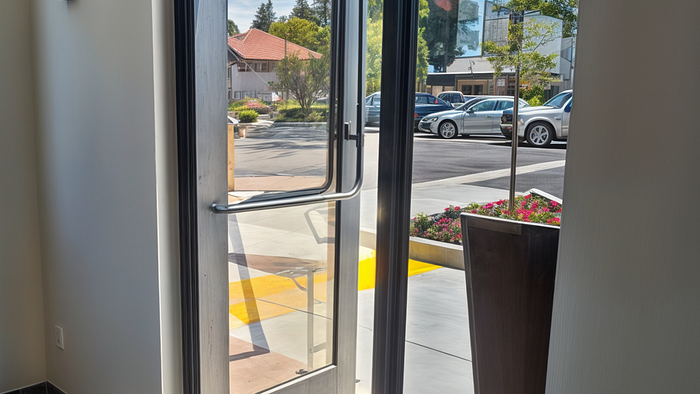
First: panic hardware is not required on every door
This is the most important place to start.
Not every commercial door needs panic hardware. Even in commercial buildings, many openings will never trigger that requirement. The fact that a project is large, public-facing, or code-sensitive does not automatically mean every exit door must have an exit device.
In most cases, panic hardware becomes relevant when a door is part of the means of egress and also has a lock or latch that must be released for someone to exit. If a door does not function that way, the requirement may not apply in the same way—or at all.
So before looking at the hardware itself, the better question is, what role does this door play in the life-safety strategy of the building?
The main factors that usually determine the answer
When code officials, architects, and door hardware professionals evaluate whether panic hardware is required, they usually come back to the same core factors.
1. Occupancy type
A door serving a private office is not treated the same as a door serving a school, an assembly space, or a high-hazard area.
That distinction matters because codes tend to require panic hardware more often in occupancies where fast, intuitive egress is especially important.
2. Occupant load
The number of people using a space is often a deciding factor.
As occupant load increases, the risk associated with delayed or obstructed egress also increases. That is why many panic hardware requirements are tied to specific occupant-load thresholds.
3. Whether the door is part of the egress path
Not every door in a building serves as part of the required exit system.
A door may exist within a commercial project without actually being part of the primary means of egress for a space. If it does not serve that function, the panic hardware requirement may not be triggered.
4. Whether the door has a lock or latch
This is one point people often overlook.
If a door is part of an egress route but operates as a simple push/pull opening without a latching mechanism, panic hardware may not be required in the same way. Codes often focus on doors where hardware must release a latch to allow immediate exit.
5. Special room conditions
Some doors require panic hardware not because of the occupancy of the building as a whole, but because of the specific use of the room they serve.
Electrical rooms are a good example. In certain conditions, the equipment inside the room can trigger the need for panic hardware even when the rest of the project would not.
What the IBC typically requires
Under the International Building Code (IBC), panic hardware is commonly required on doors serving certain occupancy groups when those doors are part of the means of egress and equipped with a lock or latch.
In practical terms, the rule most often shows up in:
- assembly occupancies
- educational occupancies
- high-hazard occupancies
For assembly and educational spaces, the threshold commonly referenced in modern IBC editions is 50 occupants or more. That means the requirement is tied less to whether a building is "commercial" in a broad sense and more to the actual function and occupant load of the space.
High-hazard occupancies are usually treated more strictly. In those cases, panic hardware may be required even at lower occupant loads because the risk is tied to the nature of the materials or operations inside the space.
That said, the IBC is only part of the story. The adopted edition and local amendments can change how the rule is enforced in real projects.
How NFPA 101 changes the analysis
If the project is governed by NFPA 101, the overall logic stays similar, but the thresholds can be different.
Under NFPA 101, panic hardware is typically required on doors with a lock or latch serving:
- assembly occupancies
- educational occupancies
- Daycare occupancies
In numerous instances, the threshold is 100 occupants or more, which is different from the IBC approach.
That difference is exactly why code review can feel inconsistent from one jurisdiction to another. A door that clearly requires panic hardware under one adopted code may be evaluated differently under another.
So instead of memorizing a single number, it is more useful to remember the bigger principle: panic hardware requirements depend on the adopted code, the occupancy type, and the occupant load served by that opening.
What about electrical rooms?
This is where many people get caught off guard.
Panic hardware is often associated with schools, auditoriums, and public exits, but some technical rooms can also trigger the requirement. Electrical rooms are one of the most common examples.
In these cases, the analysis is usually tied to factors such as:
- the type of equipment in the room
- voltage or amperage conditions
- Control equipment present
- whether the door falls within the required working clearance
When those conditions are met, code may require listed panic hardware—or, in some cases, fire exit hardware—even if the building's general occupancy would not have triggered the same requirement.
That is why these rooms should never be evaluated by occupancy classification alone. Sometimes the room function matters more than the building type.

When is panic hardware usually not required
It is just as important to understand the situations where panic hardware is not typically required.
Common examples include:
- doors that do not have a lock or latch
- lower-occupancy spaces that do not meet the threshold
- secondary interior doors that are not part of the main egress route
- Openings where the code triggers simply are not present
This matters because over-specifying panic hardware can create unnecessary cost, complexity, and coordination issues.
The safest mindset is not "all commercial doors need it," but rather, check the occupancy, the load, the door function, and the applicable code before deciding.
The requirement does not end with "yes"
Even once you determine that panic hardware is required, the work is not done.
The hardware still has to comply with the operating and installation requirements that apply to that opening. That can include details such as:
- actuating portion dimensions
- mounting height
- release force
- restrictions on added locks or devices
- compatibility with fire-rated assemblies
In other words, you cannot just install any exit device and assume the opening is compliant. The hardware selection and the full door assembly still have to match the application.
If the door is fire-rated, the conversation may shift from panic hardware in general to fire exit hardware, which introduces another layer of requirements.
Why the AHJ always matters
Even when national model codes provide the framework, the final interpretation often comes down to the Authority Having Jurisdiction (AHJ).
Two projects that look nearly identical on paper can still be reviewed differently if they are located in different cities, states, or jurisdictions with different code adoptions or local amendments.
That is why rule-of-thumb answers are risky.
The better approach is to verify:
- Which code has been adopted
- Which edition is in force
- How the occupancy is classified
- whether local amendments apply
- whether the AHJ has project-specific interpretations
That step can save many costly mistakes later.
Final takeaway
Panic hardware is not a universal requirement, but it is essential in the right situations.
Most of the time, the answer depends on a combination of occupancy type, occupant load, egress function, latching condition, and applicable code. In some projects, technical rooms like electrical spaces add another layer of requirements that cannot be ignored.
The good news is that once you understand those triggers, the question becomes much easier to answer. Instead of guessing based on the building type alone, you can evaluate the actual conditions of the opening and make a much more confident decision.
And in code-driven work, that kind of clarity matters.