
as You Will Know Them
Every week I still meet a few analysts during my office hours.
But the conversations have changed.
Nobody asks "Will AI make my role redundant?" anymore. That question feels like asking whether electricity would replace candles. Technically accurate, entirely beside the point.
What they ask now is different. Sharper. More interesting.
"How do I know if the agent got it right?"
"Who owns the decision when the system makes the call?"
"What does it mean to be good at this job now?"
These are not the questions of people afraid of the future. These are the questions of people already living in it.
Where We Are
It is 2030. The autonomous analytics systems that felt like science fiction in 2025 are now as unremarkable as a dashboard once was.
Agents monitor. Agents diagnose. Agents push readouts before anyone thinks to ask.
The weekly review meeting, the one where a senior analyst would pull data, spot the dip, trace the cause, and present the summary, that meeting is mostly gone. Not cancelled. Replaced. The agent does that work continuously, at a cadence no human team could match.
What surprised everyone is not what disappeared. It is what emerged in its place.
The New Work
The analysts who thrived did not become AI prompt engineers. They did not reinvent themselves as machine learning specialists. They did something quieter and harder.
They became the people the system cannot replace: the ones who ask whether the question being answered is the right question.
An agent can tell you that conversion dropped 14% on Tuesday. It can trace it to a pricing change. It can model three recovery scenarios and rank them by expected lift.
What it cannot do, reliably, accountably, consequentially, is tell you whether you are optimizing for the right thing in the first place.
That judgment lives with humans. It always did. We just did not need to name it until the machines took everything else.
The Two People in the Room
In most analytics orgs today, you will find two kinds of people.
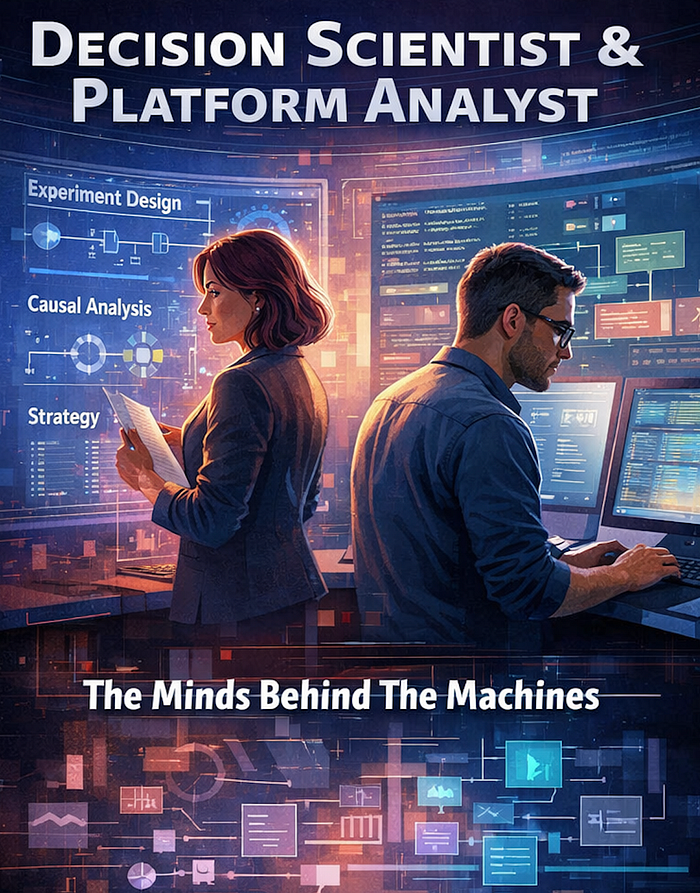
The Decision Scientist sits at the intersection of data and strategy. Their job is not to run analysis. Their job is to govern the intellectual contract between what the data says and what the business does. They design experiment frameworks. They catch causal errors the agent misses. They know when a correlation is meaningful and when it is noise that happens to have a clean chart.
They are, in the oldest sense, scientists. The job finally caught up to the name.
The Platform Analyst builds and governs the systems that everything else runs on: the metric registries, the semantic layer, the agent pipelines. They think like an engineer and a product manager at once. They know that a poorly defined metric at the foundation does not produce one wrong answer. It produces thousands of wrong answers, every hour, without anyone noticing until the damage is done.
They are the ones who, in 2025, volunteered for the governance work nobody fought over. Metric standardisation. Data quality frameworks. Semantic layer design.
At the time it felt like overhead.
Now it is the most critical infrastructure in the company. And the people who built it are the ones who designed the system everyone else relies on.
What Got Left Behind
The profile most exposed was the one that felt safest at the time: decent SQL, solid dashboards, good at presenting findings in the weekly review.
Capable at every step of the old process.
Dependent on the old process existing.
When the process became automated, the value attached to executing it evaporated with it. Not because the person was not good. Because the goodness was in the doing, and the doing moved to machines.
The lesson is not that technical skills do not matter. It is that skills attached to a specific workflow are only as durable as the workflow. The skills that compound: causal reasoning, experiment design, metric stewardship, systems thinking. Those were never really about analytics. They were about understanding how things actually work.
Machines learn patterns. Humans understand mechanisms. That gap is where the new work lives.
The Organisation Looks Different
The pyramid did not just invert. It collapsed into something flatter and stranger.
Headcount in analytics is smaller. Leverage per person is larger. One Decision Scientist governing a fleet of agents produces more analytical output than an entire traditional team once did.
But the interesting shift is not headcount. It is accountability.
When an agent makes a call that turns out to be wrong, someone has to answer for it. That someone is human. The Decision Scientist who validated the model, the Platform Analyst who built the metric definition, the leader who signed off on the governance framework. The accountability did not disappear when the human left the loop. It moved upstream.
This is what nobody fully anticipated in 2025: autonomous analytics did not reduce human responsibility. It concentrated it.
What the First Analysts Know
First Analysts, the ones who stepped into this new world rather than waiting to be pushed, share a few things in common.
They are deeply comfortable with uncertainty. An agent gives you a confident readout. The First Analyst asks: confident about what, exactly? They know that precision in an answer is not the same as accuracy. They hold the two apart, always.
They own their metrics completely. Not just the definition: the lineage, the edge cases, the known biases, every adjacent metric it touches. When an agent makes an error, the First Analyst finds it because they know the territory better than the system does.
They think in systems. Not just what is happening, but why, and what happens if we change this variable, and what the second-order effects look like, and where the model breaks down. This is not a skill you develop by running queries. It is a skill you develop by caring about being right.
And they are comfortable being the conscience in the room. When the agent recommends scaling an experiment, and the numbers look clean, and the business team is excited, the First Analyst is the one who asks whether we have thought through the failure modes. Not to slow things down. Because that question, asked before the decision, is worth a thousand post-mortems after it.
The Thing That Did Not Change
Here is what surprised me most, looking back from here.
The best analysts in 2030 are good at the same fundamental thing the best analysts in 2015 were good at: they are genuinely curious about how the business works, and they care about getting the answer right more than they care about looking like they already know it.
The tools changed completely. The underlying character did not.
The analysts who struggled were not the ones who lacked technical skills. They were the ones who were attached to being the person who did the analysis, who derived identity from the process rather than the outcome. When the process automated, they lost something that felt like themselves.
The analysts who flourished were the ones who were always really attached to the outcome: to the decision getting made correctly, to the experiment being designed honestly, to the insight actually landing with the person who needed it.
That attachment transferred. It always does.
A Note to the Analysts Still Figuring It Out
The transition is not a cliff. It never was.
The skills that make you a First Analyst: causal reasoning, experiment design, metric ownership, systems thinking, the willingness to do governance work before it feels important. None of these appear overnight. They compound. Slowly, then suddenly.
The agents running your analytics infrastructure today learned from clean, well-annotated, governed data. Someone built that. Someone made the unglamorous decisions about what a metric means, and documented the edge cases, and argued for version control when it felt like overkill.
Those someones are, right now, the most important people in the room.
The question, the only question, is whether you will be one of them.
The last analysts as we knew them were not replaced. They were promoted: to architect, judge, and conscience of a system that does more analysis in a day than a team once did in a year.
The first analysts as we know them now accepted that promotion.
The rest is just the work.
This piece was inspired by Atif Umar's essay The Last Analysts, which mapped the shift from humans doing analysis to agents running it with remarkable clarity. Atif described the transition. This is one practitioner's attempt to imagine what the other side of it looks like.