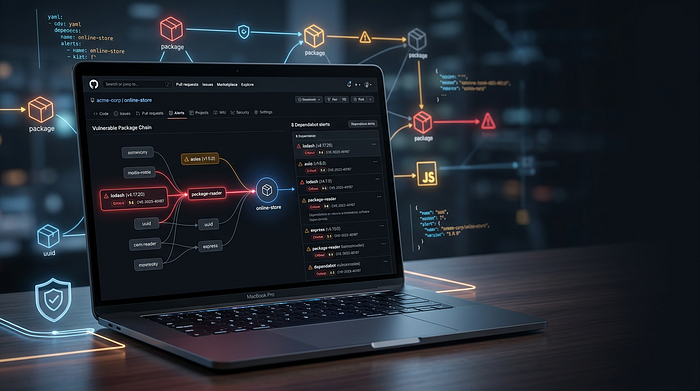

When we talk about application security, most developers think first about vulnerabilities in their own code. But in many real projects, some of the biggest risks come from the packages and libraries the application depends on. That is why dependency security matters so much. If one of your dependencies has a known vulnerability, there is a chance your application could be affected too, even if your own code looks perfectly fine.
A dependency vulnerability is a known security issue in a package, library, or component your project relies on. That risk can come from a direct dependency you installed yourself, or from an indirect dependency pulled in by another package. In the course demo, the example starts with a web app that depends on a framework, and that framework depends on many other packages. If one of those packages is vulnerable, the risk can flow upward into the framework and then into the application itself. That does not always mean your app is definitely exploitable. It means there is a possible security problem that you need to investigate and understand.
Why This Matters
Modern software rarely stands alone. Most applications are built on open-source frameworks, SDKs, package managers, and transitive dependencies, which save time but also expand your attack surface. This means you are not only responsible for the code you write. You also need visibility into the code your project pulls in from elsewhere, because a vulnerable dependency can expose your app to issues like denial of service, crashes, or other security weaknesses depending on how that dependency is used.
A Simple Example
Imagine you are building a Node.js app and your project uses a framework. That framework may depend on several other packages behind the scenes, and one of those packages could contain a high-severity vulnerability. At that point, your application may inherit the risk even though you never installed that vulnerable package directly. This is one of the reasons dependency vulnerabilities can be easy to miss if you only review your own source code. The same idea applies across ecosystems. In the demo, package-manager-specific tools are shown for both JavaScript and .NET, which highlights how every ecosystem has its own way to inspect vulnerable packages manually.
Why Manual Checking Gets Messy
You can use ecosystem tools such as npm audit or the .NET package listing commands to inspect vulnerabilities, but that approach changes depending on the language or package manager you are using.
Once you work across multiple stacks, keeping track of all of that manually becomes inconsistent and time-consuming. You need one place to identify issues, monitor them, and work toward remediation.
That is exactly where GitHub becomes useful. GitHub can track dependencies, alert you to known vulnerabilities, and help teams manage supply chain risk from inside the same platform where the code already lives.
How GitHub Helps
GitHub's software supply chain security capabilities are designed to help teams detect vulnerable dependencies, prioritize important alerts, and fix issues earlier in the development workflow. GitHub also positions Code Security and Advanced Security as built-in ways to catch risks early, reduce security debt, and integrate security into normal developer workflows instead of treating it like a separate system. For developers, that matters because security becomes easier to adopt when it is part of the repository experience. Instead of jumping between tools, you can review dependency-related risk closer to the code and pull requests you already work with every day.
What To Do When You Find One
Finding a vulnerable dependency is the start of the process, not the end. A vulnerability alert tells you there may be a security problem, but you still need to review whether your application actually uses the affected code path and how serious the impact is in your context. In some cases, the right fix is to upgrade the dependency to a patched version. In other cases, the issue may be mitigated by changing configuration or avoiding the vulnerable behavior entirely. The key is to avoid ignoring the alert. Even when exploitation is not guaranteed, dependency vulnerabilities are signals that your software supply chain deserves attention.
Final Thoughts
Dependency vulnerabilities are one of the clearest reminders that software security is bigger than the code we write ourselves. Every package we install brings value, but it can also bring risk. The good news is that GitHub gives teams a more consistent way to discover, track, and address these issues across repositories and ecosystems. That makes dependency security much more manageable than trying to handle everything manually with separate commands and tools.
Summary
In this article, you learned what a dependency vulnerability is, why indirect packages matter, and how GitHub helps developers identify and respond to vulnerable dependencies before they become bigger problems.