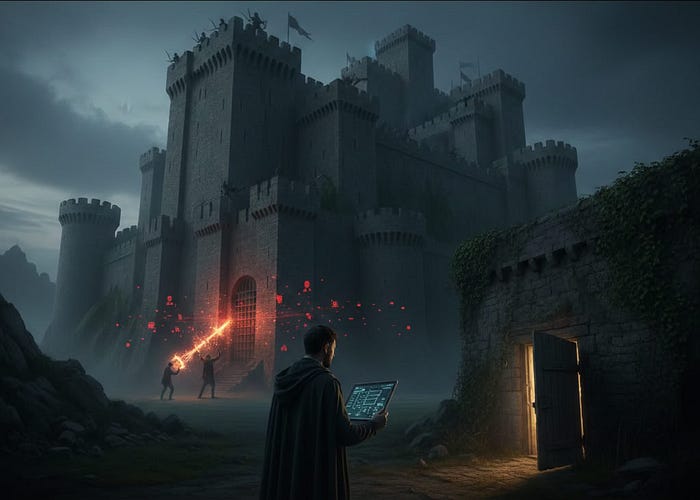

🌍 The Story of the Castle and the Forgotten Door
Imagine a gigantic castle.
Thick walls, imposing towers, guards at every entrance. From the outside, it seems impregnable. Yet, at night, a small service door sometimes remains ajar.
It doesn't resemble a heroic breach. No crash, no feat worthy of a movie.
Just human error. In cybersecurity, it's exactly the same. Most intrusions aren't the result of a spectacular hack. They stem from forgotten configurations, services left in testing mode, neglected subdomains. Doors that exist… but that no one takes the time to look for. That's where reconnaissance and enumeration become essential.
🧠 The myth of the Hollywood hacker
Popular culture has shaped a false image of piracy:
👉 A hacker in black typing at lightning speed 👉 A magical feat that unlocks a secret door 👉 A system that collapses in seconds
The reality is more understated.
And far more interesting. Most cybersecurity successes don't rely on complex zero-day exploits.
They are based on common mistakes:
✔ A test server accidentally exposed
✔ An open port that should never have been open
✔ A service running with a default configuration
✔ A subdomain forgotten after a project was completed
Listing them reveals these details. It's meticulous work.
Not spectacular.
But crucial.
📊 Junior vs Senior: the invisible difference
In pentesting and offensive security, the distinction between beginner and expert is not always visible on screen.
Junior
- Launch automated tools
- Expect immediate result
- He worries if he doesn't see anything quickly
Senior
- Spends most of the time understanding the target
- Map the attack area
- Analyze the relationships between services
- Accept that knowledge precedes action
As the community often says:
You cannot protect (or attack) what you cannot see.
An incomplete list is an unfinished map.
And an unfinished map is a territory where one gets lost.
☁️ An attacking surface that keeps growing
With the cloud and shadow IT, organizations no longer have complete control over their infrastructure. Services are deployed in just a few clicks. APIs remain open. Test environments become public. The attack surface is no longer a castle with a single gate. It's a network of paths. Enumeration involves identifying them.
📚 What the research actually says
The ideas presented here are not isolated opinions.
The Open Web Application Security Project (OWASP) regularly publishes reports showing that:
✔ Configuration errors are among the major causes of compromise ✔ Vulnerabilities related to exposed services remain recurring ✔ The attack surface is evolving faster than traditional protection methods ✔ The attack surface is evolving faster than traditional protection methods
The OWASP Top 10 report also reiterates a fundamental point:
- Security is not limited to code.
- Configuration, architecture, and identity management play a crucial role.
In other words:
- Recognition and enumeration are not secondary.
- They address a real problem.
⚖️ Rushed approach vs. Recon-First approach

🚀 Why this matters (to you)
Cybersecurity is evolving.
Threats change.
Infrastructure is becoming more complex.
An effective professional does more than just execute tools.Il comprend ce qu'il cherche.
Recognition and enumeration are the starting point for this understanding.
They transform security into an analytical discipline.
Not just technical.
But strategic.